Advertisements
Advertisements
प्रश्न
Explain how the formation of a rainbow occurs.
Explain the phenomenon of rainbow formation in the sky. Draw the labelled ray diagram in support of your explanation.
Advertisements
उत्तर
- The beautiful phenomenon of the rainbow is a combination of different phenomena, such as dispersion, refraction, and reflection of light.
- The rainbow appears in the sky after a rain shower.
- The water droplets act as small prisms.
- When sunlight enters the water droplets present in the atmosphere, they refract and disperse the incident sunlight.
- Then they reflect it internally within the droplet and finally refract it again.
- As a collective effect of all these phenomena, the seven coloured rainbows are observed.

संबंधित प्रश्न
Name the phenomenon responsible for the following effect:
When we sit in front of a plane mirror and write with our right hand, it appears in the mirror that we are writing with the left hand.
State whether the following statement is true of false:
A student says that we can see an object because light from our eyes is reflected back by the object.
What is lateral inversion? Explain by giving a suitable example.
What are the important differences between looking at a photograph of your face and looking at yourself in a plane mirror?
A boy with a mouth 5 cm wide stands 2 m away from a plane mirror. Where is his image and how wide is the image of his mouth?
Define the following terms used in the study of reflection of light by drawing a labelled ray-diagram:
- Incident ray
- Point of incidence
- Normal
- Reflected ray
- Angle of incidence
- Angle of reflection
The image of an object formed by a plane mirror is:
(a) virtual
(b) real
(c) diminished
(d) upside-down
Explain how to read the following message which was found on some blotting paper:

Name the phenomenon due to which a swimming pool appears less deep than it really is.
In which material do you think light rays travel faster-glass or air?
Why does a ray of light bend when it travels from one medium to another?
What is meant by the ‘angle of incidence’ for a ray of light?
Light travels more quickly through water than through glass.
If a ray of light passes from glass into water, which way will it bend : towards the normal or away from the normal?
With the help of a labelled diagram, explain why a tank full of water appears less deep than it actually is.
Explain with the help of a labelled ray diagram, why a pencil partly immersed in water appears to be bent at the water surface. State whether the bending of pencil will increase or decrease if water is replaced by another liquid which is optically more dense than water. Give reason for your answer.
A ray of light passes from a medium X to another medium Y. No refraction of light occurs if the ray of light hits the boundary of medium Y at an angle of:
(a) 0°
(b) 45°
(c) 90°
(d) 120°
Match the Following
| Column A | Column B |
| (a) white Light | (1) Convex mirror |
| (b) Refraction | (2) Concave mirror |
| (c) Virtual images | (3) refraction |
| (d) Real images | (4) spectrum |
| (e) Prism | (5) ray of light from glass to air |
Draw a diagram showing the refraction of a light ray from water to glass. Label on it the incident ray, the angle of incidence (/), and the angle of refraction (r)
A ray of light A incident from air suffers partial reflection and refraction at the boundary of water.
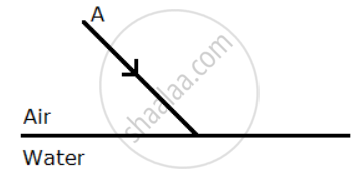
- Complete the diagram showing (i) the reflected ray B and (ii) the refracted ray C.
- How are the angles of incidence i and refraction r related?
Define the principal focus of a concave mirror.
What is atmospheric reflection? Explain with the help of a labelled diagram that the position of a star as seen by us is not its true position.
The phenomenon of change in the direction of light when it passes from one transparent medium to another is called ___________.
Identify the wrong figure from the following.
Right or wrong sentence.
The incident rays and refracted rays are on opposite sides of the column.
The speed of light varies in different media.
Write scientific reason.
The bottom of a pond appears raised.
State whether true or false. If false, correct the statement.
The angle of deviation depends on the refractive index of the glass.
The refractive index of four substances A, B, C, and D are 1.31, 1.43, 1.33, 2.4 respectively. The speed of light is maximum in
The refractive index of a transparent medium is always greater than ______.
Assertion and reasoning type
- Assertion: If the refractive index of the medium is high (denser medium) the velocity of the light in that medium will be small
- Reason: Refractive index of the medium is inversely proportional to the velocity of the light
If a beam of red light and a beam of violet light are incident at the same angle on the inclined surface of a prism from air medium and produce angles of refraction r and v respectively, which of the following is correct?
Noor, a young student, was trying to demonstrate some properties of light in her Science project work. She kept ‘X’ inside the box (as shown in the figure) and with the help of a laser pointer made light rays pass through the holes on one side of the box. She had a small butter-paper screen to see the spots of light being cast as they emerged.

Her friend noted the following observations from this demonstration:
- Glass is optically rarer than air.
- Air and glass allow light to pass through them with the same velocity.
- Air is optically rarer than glass.
- Speed of light through a denser medium is faster than that of a rarer medium.
- The ratio: sin of angle of incidence in the first medium to the ratio of sin of angle of refraction in the second medium, gives the refractive index of the second material with respect to the first one.
Which one of the combinations of the above statements given below is correct.
A pencil when dipped in water in a glass tumbler appears to be bent at the interface of air and water. Will the pencil appear to be bent to the same extent, if instead of water we use liquids like, kerosene or turpentine. Support your answer with reason.
Which surface will not reflect most of the light falling on them?
Light travels fastest in a vacuum. Why?
The ratio of the sine of the angle of incidence to the sine of ______ is constant.
Light is refracted or bent while going from one medium to another because of its ______ changes.
A star appears twinkling into the sky because of the reflection of light by the atmosphere.
A water tank appears shallower when it is viewed from the top due to refraction.
Twinkling of stars and Mirage are the two phenomena occurring due to refraction.
How do twinkling stars occur? (or) what is the cause of the twinkling of stars?
The change in the direction of the path of light when it passes from one transparent medium to another transparent medium is called:
When a light ray passes from a rarer medium to a denser medium, it bends:
When light travels from a denser medium to a rarer medium, its speed:
When a ray of light is incident along the normal on the surface separating two media:
According to the first law of refraction, the incident ray, the refracted ray, and the normal at the point of incidence:
According to the second law of refraction, for a given pair of media, the ratio of the sine of the angle of incidence to the sine of the angle of refraction:
