Advertisements
Advertisements
प्रश्न
Explain how the formation of a rainbow occurs.
Explain the phenomenon of rainbow formation in the sky. Draw the labelled ray diagram in support of your explanation.
Advertisements
उत्तर
- The beautiful phenomenon of the rainbow is a combination of different phenomena, such as dispersion, refraction, and reflection of light.
- The rainbow appears in the sky after a rain shower.
- The water droplets act as small prisms.
- When sunlight enters the water droplets present in the atmosphere, they refract and disperse the incident sunlight.
- Then they reflect it internally within the droplet and finally refract it again.
- As a collective effect of all these phenomena, the seven coloured rainbows are observed.

संबंधित प्रश्न
What is refraction of light?
Fill in the following blank with a suitable word:
When light is reflected, the angles of incidence and reflection are ............ .
A wall reflects light and a mirror also reflects light. What difference is three in the way they reflect light?
Which type of reflection of light leads to the formation of images?
What type of reflection of light takes place from a cinema screen?
A boy with a mouth 5 cm wide stands 2 m away from a plane mirror. Where is his image and how wide is the image of his mouth?
State and explain the laws of reflection of light at a plane surface (like a plane mirror), With the help of a labelled ray-diagram. Mark the angles of 'incidence' and 'reflection' clearly on the diagram. If the angle of reflection is 47.5°, what will be the angle of incidence?
Explain why, though both a plane mirror and a sheet of paper reflect light but we can see the image of our face in a plane mirror but not in a sheet of paper.
The image in a plane mirror is virtual and laterally inverted. What does this statement mean?
Write all the capital letters of the alphabet which look the same in a plane mirror.
An object is placed 20 cm in front of a plane mirror. The mirror is moved 2 cm towards the object. The distance between the positions of the positions of the original and final images seen in the mirror is ______.
A ray of light strikes a plane mirror PQ at an angle of incidence of 30°, is reflected from the plane mirror and then strikes a second plane mirror QR placed at right angles to the first mirror. The angle of reflection at the second mirror is ______.
A ray of light goes from water into air. Will it bend towards the normal or away from the normal?
State whether the following statement is true or false:
Refraction occurs because light slows down in denser materials.
A ray of light travelling in air is incident on a rectangular glass block and emerges out into the air from the opposite face. Draw a labelled ray diagram to show the completer path of this ray of light. Mark the two points where the refraction of light takes place. What can you say about the final direction of ray of light?
A coin in a glass tumbler appears to rise as the glass tumbler is slowly filled with water. Name the phenomenon responsible for this effect.
A ray of light passes from a medium X to another medium Y. No refraction of light occurs if the ray of light hits the boundary of medium Y at an angle of:
(a) 0°
(b) 45°
(c) 90°
(d) 120°
A vertical ray of light strikes the horizontal surface of some water:
- What is the angle of incidence?
- What is the angle of refraction?
A vertical ray of light strikes the horizontal surface of some water:
What is the angle of refraction?
A ray of light when passes from glass to air, bends towards the normal.
Light travels at a lower speed in water than in air.
Water is optically .......... than air.
A light ray suffers reflection and refraction at the boundary in passing from air to water. Draw a neat labelled ray diagram to show it.
The size of image of an object by a convex lens of focal length 20 cm is observed to be reduced to `1/3` rd of its size . Find the distance of the object from the optical centre of the lens .
Lights of different colours are used as signal for safety transport. From these, the wavelength of red light is _______ nm.
The speed of light varies in different media.
Write a scientific reason.
The coin disappears in a vessel as it is seen from a specific location. But as soon as the water is poured into the vessel to a certain level, the coin appears.
Why does a ray of light bend when it travels from one medium to another?
You are given water, mustard oil, glycerine and kerosene. In which of these media a ray of light incident obliquely at same angle would bend the most?
If a beam of red light and a beam of violet light are incident at the same angle on the inclined surface of a prism from air medium and produce angles of refraction r and v respectively, which of the following is correct?

The angle of incidence from air to glass at the point O on the hemispherical glass slab is.
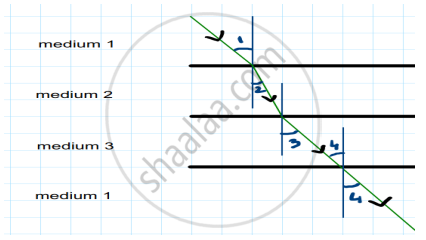
In the above diagram light is travelling through different media. It is noted by a scientist that ∠1= ∠3 = ∠4 but ∠2 < ∠1. Which of the following statement would be correct?
Why a pencil partly immersed in water appears to be bent at the water surface.
The bottom of swimming pool appears to be less deep than the actual one because of
In refraction of light through a glass slab, the directions of the incident ray and the refracted ray are ______.
A ray of light starting from diamond is incident on the interface separating diamond and water. Draw a labelled ray diagram to show. the refraction of light in this case.
The change in the direction of the path of light when it passes from one transparent medium to another transparent medium is called:
The part of light that enters into the other medium and travels in a straight path but in a direction different from its initial direction is called:
A normal is an imaginary line drawn ________ to the boundary at the point of incidence.
When light travels from a rarer medium to a denser medium, its speed:
According to the first law of refraction, the incident ray, the refracted ray, and the normal at the point of incidence:
The constant \[\frac{\sin i}{\sin r}\] for a given pair of media is called the:
Which of the following relations is called Snell's Law?
A medium with a higher refractive index is:
