Advertisements
Advertisements
प्रश्न
Light travels more quickly through water than through glass.
If a ray of light passes from glass into water, which way will it bend : towards the normal or away from the normal?
Advertisements
उत्तर
If a ray of light passes from glass to water, it will bend away from the normal because glass is a denser medium as compared to water.
संबंधित प्रश्न
Which property of light makes a pencil cast a shadow when it is held in front of a light source?
What are the important differences between looking at a photograph of your face and looking at yourself in a plane mirror?
The figure given alongside shows the image of a clock as seen in a plane mirror. The correct time is:

Name the phenomenon due to which a swimming pool appears less deep than it really is.
When a ray of light passes from air into glass, is the angle of refraction greater than or less than the angle of incidence?
Fill in the following blank with suitable word:
Light bends when is passes from water into air. We say that it is ............
What is meant by the ‘angle of incidence’ for a ray of light?
State two factors on which the lateral displacement of the emergent ray depends.
A light ray suffers reflection and refraction at the boundary in passing from air to water. Draw a neat labelled ray diagram to show it.
A real image is formed by the light rays after reflection or refraction when they:
- actually meet or intersect with each other.
- actually converge at a point.
- appear to meet when they are produced in the backward direction.
- appear to diverge from a point.
Which of the above statements are correct?
The laws of reflection hold true for ______.
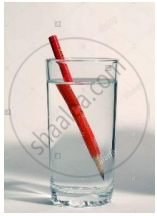
Due to _______ pencil looks bent in water, in the given experiment.
Lights of different colours are used as signal for safety transport. From these, the wavelength of red light is _______ nm.
What is refractive index?
Light travels fastest in a vacuum. Why?
The ratio of the sine of the angle of incidence to the sine of ______ is constant.
Why a pencil partly immersed in water appears to be bent at the water surface.
The change in the direction of the path of light when it passes from one transparent medium to another transparent medium is called:
When a ray of light is incident along the normal on the surface separating two media:
According to the first law of refraction, the incident ray, the refracted ray, and the normal at the point of incidence:
