Advertisements
Advertisements
प्रश्न
What are the important differences between looking at a photograph of your face and looking at yourself in a plane mirror?
Advertisements
उत्तर
| Photograph | Image in a Plane Mirror |
| A photograph is made when a real image is projected on a photographic film. | The image formed by a plane mirror is virtual and cannot be taken on a photograph. |
| The image is smaller in size compared to the actual object. | The image is the same size as the object. |
APPEARS IN
संबंधित प्रश्न
| Column I | Column II | Column III | |
| 1 | Dispersion | Long-sightedness | Twinkling of stars |
| 2 | Refraction | Splitting of white light into component colours | Convex lens |
| 3 | Hypermetropia | Change in the direction of the ray of light due to change in medium | Spectrum of seven colours |
Fill in the following blank with a suitable word:
When light is reflected, the angles of incidence and reflection are ............ .
Explain why, though both a plane mirror and a sheet of paper reflect light but we can see the image of our face in a plane mirror but not in a sheet of paper.
What is meant by ‘refraction of light’?
State two factors on which the lateral displacement of the emergent ray depends.
Explain with the help of a labelled ray diagram, why a pencil partly immersed in water appears to be bent at the water surface. State whether the bending of pencil will increase or decrease if water is replaced by another liquid which is optically more dense than water. Give reason for your answer.
A ray of light A incident from air suffers partial reflection and refraction at the boundary of water.
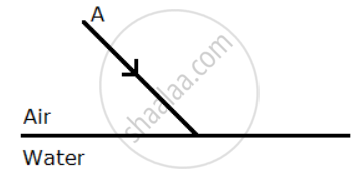
- Complete the diagram showing (i) the reflected ray B and (ii) the refracted ray C.
- How are the angles of incidence i and refraction r related?
The laws of reflection hold true for ______.
Identify the wrong figure from the following.
Observe the given figure and write appropriate phenomenon of light in the box.
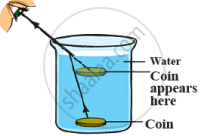
Why does a ray of light bend when it travels from one medium to another?

The angle of incidence from air to glass at the point O on the hemispherical glass slab is.
Which object use the reflection of light?
Which surface will not reflect most of the light falling on them?
Light travels fastest in a vacuum. Why?
The bending of light as it passes from one medium to another is called ______.
A water tank appears shallower when it is viewed from the top due to refraction.
How do twinkling stars occur? (or) what is the cause of the twinkling of stars?
A medium with a higher refractive index is:
