Advertisements
Advertisements
Question
What are the important differences between looking at a photograph of your face and looking at yourself in a plane mirror?
Advertisements
Solution
| Photograph | Image in a Plane Mirror |
| A photograph is made when a real image is projected on a photographic film. | The image formed by a plane mirror is virtual and cannot be taken on a photograph. |
| The image is smaller in size compared to the actual object. | The image is the same size as the object. |
APPEARS IN
RELATED QUESTIONS
Which type of reflection of light leads to the formation of images?
What is the difference between regular reflection of light and diffuse reflection of light?
What type of reflection of light takes place from a cinema screen?
The image of an object formed by a plane mirror is:
(a) virtual
(b) real
(c) diminished
(d) upside-down
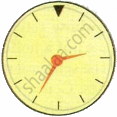
The figure given alongside shows the image of a clock as seen in a plane mirror. The correct time is:
A man stands 10 m in front of a large plane mirror. How far must the walk before he is 5 m away from his image?
A ray of light travelling in glass emerges into air. State whether it will bend towards the normal or away from the normal.
What is meant by ‘refraction of light’?
When a light ray passes from air into glass, what happens to its speed? Draw a diagram to show which way the ray of light bends.
- With the help of a diagram, show how when light falls obliquely on the side of a rectangular glass slab, the emergent ray is parallel to the incident ray.
- Show the lateral displacement of the ray on the diagram.
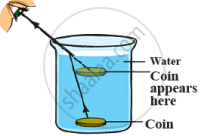
The depth of a pond when seen from above appears to be less.
What is the cause of refraction of light when it passes from one medium to another?
A small air bubble in a glass block when seen from above appears to be raised because of ______.
The size of image of an object by a convex lens of focal length 20 cm is observed to be reduced to `1/3` rd of its size . Find the distance of the object from the optical centre of the lens .
Identify the wrong figure from the following.
Write scientific reason.
A pencil appears to be broken near the surface of water.
Observe the given figure and write appropriate phenomenon of light in the box.
Mirage is an example of refraction and the total internal reflection of light.
Which of the following relations is called Snell's Law?
