Advertisements
Advertisements
प्रश्न
Explain with the help of a labelled ray diagram, why a pencil partly immersed in water appears to be bent at the water surface. State whether the bending of pencil will increase or decrease if water is replaced by another liquid which is optically more dense than water. Give reason for your answer.
Advertisements
उत्तर

In the above figure, the portion BO of the pencil AO is immersed in water and it appears to be bent at point B. The light ray OC coming from the lower end O of the pencil passes from water to air and gets refracted away from the normal in the direction CX. Another ray OD is refracted in the direction DY. These two refracted rays, CX and DY, meet at point I, when they are produced backwards. Point I is nearer to the water surface than point O. Therefore, a virtual image of end O of the pencil is formed as point I.
So, human eye at position E sees the end O at point I; i.e., pencil appears to be bent.
If water is replaced by another liquid, which is optically denser than water, the bending of pencil will increase because an optically denser medium causes more refraction or more bending of light rays.
APPEARS IN
संबंधित प्रश्न
Write the word AMBULANCE as it would appear when reflected in a plane mirror. Why is it sometimes written in this way (as its mirror image) on the front of an ambulance?
The boy walks towards the mirror at a speed of 1 m/s. At what speed does his image approach him?
As light rays pass from water into glass, are they refracted towards the normal or away from the normal?
Fill in the following blank with suitable word:
Light bends when is passes from water into air. We say that it is ............
A ray of light travelling in air is incident on a rectangular glass block and emerges out into the air from the opposite face. Draw a labelled ray diagram to show the completer path of this ray of light. Mark the two points where the refraction of light takes place. What can you say about the final direction of ray of light?
How does the light have to enter the glass:
for no refraction to happen?
Light travels at a lower speed in water than in air.
When a ray of light travels from air to glass, it bends .......... the normal.
List four characteristics of the image formed by a concave lens of focal length 20 cm when the object is placed at a distance of 40 cm from its optical centre.
Right or wrong sentence.
The incident rays and refracted rays are on opposite sides of the column.
Observe the given figure and name the following.
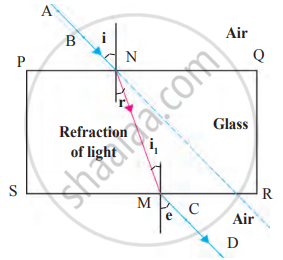
| Ray AB | |
| Ray NM | |
| Ray MD | |
| ∠ r |
Observe the given figure and write appropriate phenomenon of light in the box.
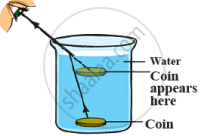
The refractive index of a transparent medium is always greater than ______.
Which surface will not reflect most of the light falling on them?
Mirage is an example of refraction and the total internal reflection of light.
Why a pencil partly immersed in water appears to be bent at the water surface.
When a ray of light travels normal to the given surface, then the angle of refraction is ______.
The ray that enters the second medium after crossing the boundary is called the:
When light passes from one transparent medium to another, its direction changes due to:
When light travels from a rarer medium to a denser medium, its speed:
