Advertisements
Advertisements
प्रश्न
How does the light have to enter the glass:
for no refraction to happen?
Advertisements
उत्तर
For no refraction, the light ray has to enter the glass perpendicularly.
APPEARS IN
संबंधित प्रश्न
Name the phenomenon responsible for the following effect:
When we sit in front of a plane mirror and write with our right hand, it appears in the mirror that we are writing with the left hand.
What are the important differences between looking at a photograph of your face and looking at yourself in a plane mirror?
What type of reflection of light takes place from a cinema screen?
A boy with a mouth 5 cm wide stands 2 m away from a plane mirror. Where is his image and how wide is the image of his mouth?
State the uses of plane mirrors.
Write all the capital letters of the alphabet which look the same in a plane mirror.
The image formed by a plane mirror is :
(a) virtual, behind the mirror and enlarged.
(b) virtual, behind the mirror and of the same size as the object.
(c) real, at the surface of the mirror and enlarged.
(d) real, behind the mirror and of the same size as the object.
A ray of light passes from air into a block of glass. Does it bend towards the normal or away from it?
Light travels more quickly through water than through glass.
If a ray of light passes from glass into water, which way will it bend : towards the normal or away from the normal?
The speed of light is more in glass than in water.
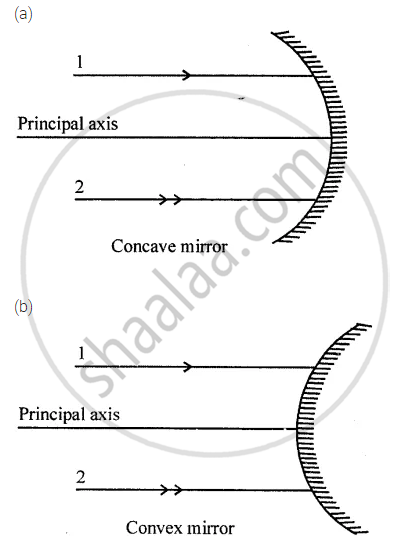
The diagram (figure) given below shows two parallel rays 1 and 2 incident on (a) a concave mirror, (b) a convex mirror. Draw the reflected rays and mark the focus by the symbol F.
A ray of light passes from medium 1 to medium 2. Which of the following quantities of the refracted ray will differ from that of the incident ray: Speed, intensity, frequency, wavelength?
Choose and write the correct option.
If we gradually increase the angle of incidence of a ray of light passing through prism then …..
Observe the given figure and name the following.
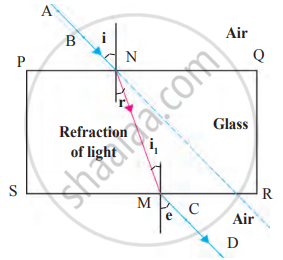
| Ray AB | |
| Ray NM | |
| Ray MD | |
| ∠ r |
The refractive index of a transparent medium is always greater than ______.
The deviation of light ray from its path when it travels from one transparent medium to another transparent medium is called ______.

The angle of incidence from air to glass at the point O on the hemispherical glass slab is.
The bending of light as it passes from one medium to another is called ______.
In refraction of light through a glass slab, the directions of the incident ray and the refracted ray are ______.
The ray that enters the second medium after crossing the boundary is called the:
