Advertisements
Advertisements
प्रश्न
How does the light have to enter the glass:
for no refraction to happen?
Advertisements
उत्तर
For no refraction, the light ray has to enter the glass perpendicularly.
APPEARS IN
संबंधित प्रश्न
What is refraction of light?
Name the phenomenon responsible for the following effect:
When we sit in front of a plane mirror and write with our right hand, it appears in the mirror that we are writing with the left hand.
A ray of light strikes a plane mirror such that its angle of incidence is 30°. What angle does the reflected ray make with the mirror surface?
Write the word AMBULANCE as it would appear when reflected in a plane mirror. Why is it sometimes written in this way (as its mirror image) on the front of an ambulance?
An extended object in the form of an arrow pointing upward has been placed in front of a plane mirror. Draw a labelled ray-diagram to show the formation of its image.
What is meant by 'reflection of light'?
A man sits in an optician's chair looking into plane mirror which is 2 m away from him and views the image of a chart which faces the mirror and is 50 cm behind his head. How far away from his eyes does the chart appear to be?
In which material do you think light rays travel faster-glass or air?
What is meant by ‘refraction of light’?
Draw suitable diagrams to illustrate how a beam of light incident parallel to the principal axis is reflected by:
(a) a concave mirror, and (b) a convex mirror
A small air bubble in a glass block when seen from above appears to be raised because of ______.
We can see the sun even when it is little below the horizon because of ______.
List four characteristics of the image formed by a concave lens of focal length 20 cm when the object is placed at a distance of 40 cm from its optical centre.
List in proper sequence the steps of the experiment for determining the approximate focal length of a given concave mirror by obtaining the image of a distant object.
Write scientific reason.
The sun appears on the western horizon for some time after sunset.
The refractive index of a transparent medium is always greater than ______.
The deviation of light ray from its path when it travels from one transparent medium to another transparent medium is called ______.
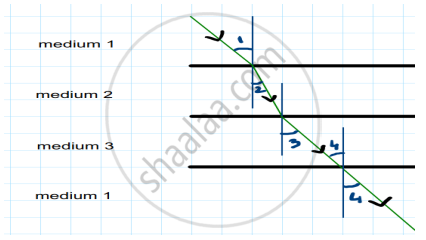
In the above diagram light is travelling through different media. It is noted by a scientist that ∠1= ∠3 = ∠4 but ∠2 < ∠1. Which of the following statement would be correct?
Under what circumstances there won’t be any refraction of light when it enters from one medium to another?
