Advertisements
Advertisements
Question
How does the light have to enter the glass:
for no refraction to happen?
Advertisements
Solution
For no refraction, the light ray has to enter the glass perpendicularly.
APPEARS IN
RELATED QUESTIONS
What is refraction of light?
A ray of light strikes a plane mirror such that its angle of incidence is 30°. What angle does the reflected ray make with the mirror surface?
A man stands 10 m in front of a large plane mirror. How far must the walk before he is 5 m away from his image?
If a ray of light goes form a denser medium to a rarer medium, will it bend towards the normal or away from the normal?
State two effects caused by the refraction of light.
Which phenomenon of light makes the water to appear shallower than it really is?
Light travels more quickly through water than through glass.
If a ray of light passes from glass into water, which way will it bend : towards the normal or away from the normal?
A coin in a glass tumbler appears to rise as the glass tumbler is slowly filled with water. Name the phenomenon responsible for this effect.
Light travelling from a denser medium to a rarer medium along a normal to the boundary:
(a) is refracted towards the normal
(b) is refracted away from the normal
(c) goes along the boundary
(d) is not refracted
Air is optically .......... than glass.
When a ray of light travels from water to air, it bends ............. the normal.
Draw suitable diagrams to illustrate how a beam of light incident parallel to the principal axis is reflected by:
(a) a concave mirror, and (b) a convex mirror
Observe the given figure and write appropriate phenomenon of light in the box.
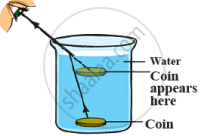
When light passes from one medium to another the ray gets bent. This property of light is called ______.
How does the light travel?
Light bends as it passes from one medium to another. What is this phenomenon called?
Why a pencil partly immersed in water appears to be bent at the water surface.
When light travels from a rarer medium to a denser medium, its speed:
A medium with a higher refractive index is:
