Advertisements
Online Mock Tests
Chapters
![Lakhmir Singh solutions for Physics Part 1 [English] Class 10 chapter 2 - Refraction of Light - Shaalaa.com](/images/physics-part-1-english-class-10_6:5e8f817651d047a288d517e10b532fb7.jpg "Lakhmir Singh solutions for Physics Part 1 [English] Class 10 chapter 2 - Refraction of Light")
Advertisements
Solutions for Chapter 2: Refraction of Light
Below listed, you can find solutions for Chapter 2 of CBSE, Karnataka Board Lakhmir Singh for Physics Part 1 [English] Class 10.
Lakhmir Singh solutions for Physics Part 1 [English] Class 10 2 Refraction of Light Exercise 1 [Pages 82 - 85]
Very Short Answer Type Questions
If a ray of light goes from a rarer medium to a denser medium, will it bend towards the normal or away from it?
If a ray of light goes form a denser medium to a rarer medium, will it bend towards the normal or away from the normal?
A beam of light travelling in a rectangular glass slab emerges into air. Draw a ray-diagram indicating the change in its path.
A beam of light travelling in air is incident of water. Draw a ray-diagram indicating the change in its path in water.
A ray of light travelling in water emerges into air. Draw a ray-diagram indicating the change in its path.
A ray of light travelling in air is incident on a parallel-sided glass slab (or rectangular glass slab). Draw a ray-diagram indicating the change in its path in glass.
A ray of light travelling in glass emerges into air. State whether it will bend towards the normal or away from the normal.
A ray of light travelling in air enters obliquely into water. Does the light ray bend towards the normal or away from the normal? Why?
A ray of light goes from water into air. Will it bend towards the normal or away from the normal?
State two effects caused by the refraction of light.
Name the phenomenon due to which a swimming pool appears less deep than it really is.
When a ray of light passes from air into glass, is the angle of refraction greater than or less than the angle of incidence?
A ray of light passes from air into a block of glass. Does it bend towards the normal or away from it?
As light rays pass from water into glass, are they refracted towards the normal or away from the normal?
In which material do you think light rays travel faster-glass or air?
Which phenomenon of light makes the water to appear shallower than it really is?
State whether the following statement is true or false:
Refraction occurs because light slows down in denser materials.
Why does a ray of light bend when it travels from one medium to another?
Fill in the following blank with suitable word:
Light travelling along a normal is ...............refracted.
Fill in the following blank with suitable word:
Light bends when is passes from water into air. We say that it is ............
Short Answer Type Questions
What is meant by ‘refraction of light’?
Draw a labelled ray diagram to show the refraction of light.
A ray of light travelling in air is incident on a rectangular glass block and emerges out into the air from the opposite face. Draw a labelled ray diagram to show the completer path of this ray of light. Mark the two points where the refraction of light takes place. What can you say about the final direction of ray of light?
Draw a labelled ray diagram to show how a ray of light is refracted when it passes:
from air into an optically denser medium.
Draw a labelled ray diagram to show how a ray of light is refracted when it passes:
from an optically denser medium into air.
The diagram given alongside shows a ray of light entering a rectangular block of glass.
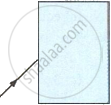
- Copy the diagram and draw the normal at the point of entry.
- Draw the approximate path of the ray of light through the glass block and out of the other side.
What is meant by the ‘angle of incidence’ for a ray of light?
What is meant by the ‘angle of refraction’ for a ray of light?
Draw a labelled ray diagram to show the angle of incidence and the angle of refraction for a refracted ray of light.
Light travels more quickly through water than through glass.
- Which is optically denser: water or glass?
- If a ray of light passes from glass into water, which way will it bend: towards the normal or away from the normal?
Draw a labelled ray diagram to show how a ray of light passes through a parallel-sided glass block if it hits the glass block at 90° (that is, perpendicular to the glass block).
Draw a labelled ray diagram to show how a ray of light passes through a parallel-sided glass block if it hits the glass block at an angle other than 90° (that is, obliquely to the glass block).
When a light ray passes from air into glass, what happens to its speed? Draw a diagram to show which way the ray of light bends.
Long Answer Type Questions
Explain why, a stick half immersed in water appears to be bent at the surface. Draw a labelled diagram to illustrate your answer.
A coin in a glass tumbler appears to rise as the glass tumbler is slowly filled with water. Name the phenomenon responsible for this effect.
With the help of a labelled diagram, explain why a tank full of water appears less deep than it actually is.
Name the phenomenon due to which a pencil partly immersed in water and held obliquely appears to be bent at the water surface.
- With the help of a diagram, show how when light falls obliquely on the side of a rectangular glass slab, the emergent ray is parallel to the incident ray.
- Show the lateral displacement of the ray on the diagram.
State two factors on which the lateral displacement of the emergent ray depends.
Explain with the help of a labelled ray diagram, why a pencil partly immersed in water appears to be bent at the water surface. State whether the bending of pencil will increase or decrease if water is replaced by another liquid which is optically more dense than water. Give reason for your answer.
Multiple Choice Questions (MCQS)
Light travelling from a denser medium to a rarer medium along a normal to the boundary:
(a) is refracted towards the normal
(b) is refracted away from the normal
(c) goes along the boundary
(d) is not refracted
A ray of light passes from glass into air. The angle of refraction will be:
(a) equal to the angle of incidence
(b) greater than the angle of incidence
(c) smaller than the angle of incidence
(d) 45°
A ray of light travelling in air goes into water. The angle of refraction will be:
(a) 90°
(b) smaller than the angle of incidence
(c) equal to the angle of incidence
(d) greater than the angle of incidence
The speed of light in air is:
(a) 3 × 108 cm/s
(b) 3 × 108 mm/s
(c) 3 × 10⁸ km/s
(d) 3 × 10⁸ m/s
When a ray of light travelling in glass enters into water obliquely ______.
it is refracted towards the normal
it is not refracted at all
it goes along the normal
it is refracted away from the normal
A ray of light travelling in water falls at right angles to the boundary of a parallel-sided glass block. The ray of light:
(a) is refracted towards the normal
(b) is refracted away from the normal
(c) does not get refracted
(d) is reflected along the same path
A ray of light passes from a medium X to another medium Y. No refraction of light occurs if the ray of light hits the boundary of medium Y at an angle of:
(a) 0°
(b) 45°
(c) 90°
(d) 120°
Which of the following diagrams shows the ray of light refracted correctly?


A vertical ray of light strikes the horizontal surface of some water:
- What is the angle of incidence?
- What is the angle of refraction?
How is the reflection of light ray from a plane mirror different from the refraction of light ray as it enters a block of glass?
How does the light have to enter the glass:
to produce a large amount of bending?
How does the light have to enter the glass:
for no refraction to happen?
How can you bend light away from the normal?
How must light travel out of a substance if it is not going to be refracted?
Draw and complete the following diagrams to show what happens to the beams of light as they enter the glass block and then leave it:
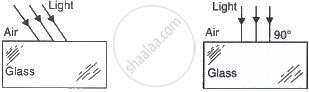
Why does a beam of light when it enters glass at an angle? Why does it not bend if it inters the glass at right angles?
Lakhmir Singh solutions for Physics Part 1 [English] Class 10 2 Refraction of Light Exercise 2 [Pages 91 - 94]
Very Short Answer Type Questions
What name is given to the ratio of sine of angle of incidence to the sine of angle of refraction?
Write the relation between the angle of incidence and the angle of refraction for a medium.
What is the unit of refractive index?
Which has higher refraction index : water of glass?
Refractive indices of carbon disulphide and ethyl alcohol are 1.63 and 1.36 respectively. Which is optically denser?
The refractive index of diamond is 2.42. What is the meaning of this statement in relation to the speed of light?
If the refractive index for light going from air to diamond be 2.42, what will be the refractive index from light going from diamond to air?
How is the refractive index of a material related to the speed of light in it?
Fill in the following blank with a suitable word:
When a ray of light goes from air into a clear material, you see the ray bend. How much the ray bends is determined by the ______ of the material.
Short Answer Type Questions
Give three examples of materials that refract light rays. What happens to the speed of light rays when they enter these materials?
Define Snell’s law of refraction.
A ray of light is incident on a glass slab at an angle of incidence of 60°. If the angle of refraction be 32.7°, calculate the refractive index of glass.
(Given: sin 60° = 0.866 and sin 32.7° = 0.540.)
The speed of light in vacuum and in two different glasses is given in the table below:
| Medium | Speed of light |
| Vacuum | 3.00 × 10⁸ m/s |
| Flint glass | 1.86 × 10⁸ m/s |
| Crown glass | 1.97 × 10⁸ m/s |
(a) Calculate the absolute refractive indexes of flint glass and crown glass.
(b) Calculate the relative refractive index for light going from crown glass to flint glass.
The speed of light in air is 3 × 10⁸ m/s. In medium X its speed is 2 × 10⁸ m/s and in medium Y the speed of light is 2.5 × 10⁸ m/s Calculate:
(a) air nx
(b) air nY
(c) x nY
What is the speed of light in a medium of refractive index `6/5` if its speed in air is 3,00,000 km/s?
What is the speed of light in a medium of refractive index `6/5` if its speed in air is 3,00,000 km/s?
The speed of light in water is 2.25 × 10⁸ m/s. If the speed of light in vacuum be 3 × 10⁸ m/s, calculate the refractive index of water.
Light enters from air into diamond which has a refractive index of 2.42. Calculate the speed of light in diamond. The speed of light in air is 3.0 × 10⁸ ms−1.
State and explain the laws of refraction of light with the help of a labelled diagram.
What is meant by the refractive index of a substance?
Light travels through air at 300 million ms−1. On entering water it slows down to 225 million ms−1. Calculate the refractive index of water.
Multiple Choice Questions (MCQs)
The refractive indices of four substance P, Q, R and S are 1.50, 1.36, 1.77 and 1.31 respectively. The speed of light is the maximum in the substance:
(a) P
(b) Q
(c) R
(d) S
The refractive indices of four materials A, B, C and D are 1.33, 1.43, 1.71 and 1.52 respectively. When the light rays pass from air into these materials, they refract the maximum in:
(a) material A
(b) material B
(c) material C
(d) material D
The refractive index of glass for light going from air to glass is `3/2`. The refractive index for light going 2 from glass to air will be ______.
`1/3`
`4/5`
`4/6`
`5/2`
The refractive indices of four media A, B, C and D are 1.44, 1.52, 1.65 and 1.36 respectively. When light travelling in air is incident in these media at equal angles, the angle of refraction will be the minimum ______.
in medium A
in medium B
in medium C
in medium D
The speed of light in substance X is 1.25 × 10⁸ m/s and that in air is 3 × 10⁸ m/s. The refractive index of this substance will be:
(a) 2.4
(b) 0.4
(c) 4.2
(d) 3.75
The refractive indexes of four substances P, Q, R and S are 1.77, 1.50, 2.42 and 1.31 respectively. When light travelling in air is incident on these substances at equal angles, the angle of refraction will be the maximum in:
(a) substance P
(b) substance Q
(c) substance R
(d) substance S
The refractive index of water is:
(a) 1.33
(b) 1.50
(c) 2.42
(d) 1.36
The refractive index of water with respect to air is `4/3`. The refractive index of air with respect to water will be:
(a) 1.75
(b) 0.50
(c) 0.75
(d) 0.25
Refractive indices of water, sulphuric acid, glass and carbon disulphide are 1.33, 1.43, 1.53 and 1.63 respectively. the light travels slowest in:
(a) sulphuric acid
(b) glass
(c) water
(d) carbon disulphide
The refractive index of glass with respect to air is `3/2` and the refractive index of water with respect to air is `4/3`. The refractive index of glass with respect to water will be:
(a) 1.525
(b) 1.225
(c) 1.425
(d) 1.125
Questions Based on High Order Thinking Skills (HOTS)/Case Based Questions
The following table gives the refractive indices of a few media:
| 1 | 2 | 3 | 4 | 5 | |
| Medium | Water | Crown glass | Rock salt | Ruby | Diamond |
| Refractive index | 1.33 | 1.52 | 1.54 | 1.71 | 2.42 |
Use this table to give an example of:
(i) a medium pair so that light speeds up when it goes from one of these medium to another.
(ii) a medium pair so that light slows down when it goes from one of these medium to another.
Refractive indices of four media A, B, C and D are given below:
| Medium | Refractive index |
| A | 1.33 |
| B | 1.44 |
| C | 1.52 |
| D | 1.65 |
In which of these four media is the speed of light (i) maximum, and (ii) minimum?
Lakhmir Singh solutions for Physics Part 1 [English] Class 10 2 Refraction of Light Exercise 3 [Pages 105 - 109]
Very Short Answer Type Questions
Name the lens which can concentrate sun's rays to a point and burn a hole in a piece of paper.
Give the usual name for the following:
A point inside a lens through which the light passes undeviated.
A 1 cm high object is placed at a distance of 2f from a convex lens. What is the height of the image formed?
If the image formed by a convex lens is of the same size as that of the object, what is the position of the image with respect to the lens?
If an object is placed at the focus of a convex lens, where is the image formed?
Where should an object be placed in order to use a convex lens as a magnifying glass?
Where should an object be placed in front of a convex lens so as to obtain its virtual, erect and magnified image?
Where should an object be placed in front of a convex lens so as to obtain its real, inverted and magnified image?
For what position of an object a real, diminished image is formed by a convex lens?
If an object is at a considerable distance (or infinity) in front of a convex lens, where is the image formed?
Draw the given diagram in your answer book and complete it for the path of a ray of light after passing through the lens.
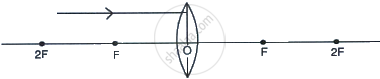
What type of lens would you use as a magnifying glass? How close must the object be to the lens?
Name two factors on which the focal length of a lens depends.
State any two uses of convex lenses.
Fill in the following blank with suitable word:
Parallel rays of light are refracted by a convex lens to a point called the ______.
Fill in the following blank with suitable word:
The image in a convex lens depends upon the distance of the ........... from the lens.
Short Answer Type Questions
What is a lens?
Distinguish between a convex lens and concave lens. Which of the two is a converging lens : convex lens of concave lens?
Explain with the help of a diagram, why the convex lens is also called a converging lens.
Define the principal axis of a convex lens.
Define the principal focus of a convex lens.
Define the focal length of a convex lens.
Explain with the help of a diagram, why the concave lens is also called a diverging lens.
Define the principal focus of a concave lens.
Draw a ray diagram to show the formation of a real magnified image by a convex lens. (In your sketch the position of object and image with respect to the principal focus of lens should be shown clearly).
Describe with the help of a ray-diagram, the formation of image of a finite object placed in front of convex lens between f and 2f. Give two characteristics of the image so formed.
Describe with the help of a ray diagram the nature, size and position of the image formed when an object is placed in front of a convex lens between focus and optical centre. State three characteristics of the image formed.
An object is placed at a distance equal to 2f in front of a convex lens. Draw a labelled ray diagram to show the formation of image. State two characteristics of the image formed.
Describe with the help of a ray-diagram, the size, nature and position of the image formed by a convex lens when an object is placed beyond 2f in front of the lens.
Describe with the help of a ray diagram the nature, size and position of the image formed when an object is placed at infinity (considerable distance) in front of a convex lens. State three characteristics of the image so formed.
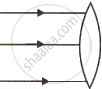
What type of lens is shown in the diagram on the right? What will happen to the parallel rays of light? Show by completing the ray diagram.
You eye contains a convex lens. Why is it unwise to look at the sun?
Where must the object be placed for the image formed by a converging lens to be:
real, inverted and smaller than the object?
Where must the object be placed for the image formed by a converging lens to be:
real, inverted and same size as the object?
Where must the object be placed for the image formed by a converging lens to be:
real, inverted and larger than the object?
Where must the object be placed for the image formed by a converging lens to be:
virtual, upright and larger than the object?
Draw a diagram to show how a converging lens held close to the eye acts as a magnifying glass. Why is it usual to choose a lens of short focal length for this purpose rather than one of long focal length?
How could you find the focal length of a convex lens rapidly but approximately?
Long Answer Type Questions
With the help of a labelled diagram explain how a convex lens converges a beam of parallel light rays. Mark the principal axis, optical centre, principal focus and focal length of the convex lens on the diagram.
State whether the convex lens has a real focus or a virtual focus.
List some things that convex lens and concave mirror have in common.
With the help of a labelled diagram, explain how a concave lens diverges a beam of parallel light rays. Mark the principal axis, optical centre, principal focus and focal length of the concave lens on the diagram.
State whether concave lens has a real focus or a virtual focus.
List some things that concave lens and concave mirror have in common.
Draw ray diagrams to represent the nature, position and relative size of the image formed by a convex lens for the object placed:
- at 2F1,
- between F₁ and the optical centre O of the lens.
Which of the above two cases shows the use of a convex lens as a magnifying glass? Give reasons for your choice.
An object is placed well outside the principal focus of a convex lens. Draw a ray diagram to show how the image is formed, and say whether the image is real or virtual.
What is the effect on the size and position of the image of moving the object (i) towards the lens and (ii) away from the lens?
Explain what is meant by a virtual, magnified image.
Draw a ray diagram to show the formation of a virtual magnified image of an object by a convex lens. In your diagram, the position of the object and image with respect to the principal focus should be shown clearly.
Three convex lenses are available having focal lengths of 4 cm, 40 cm and 4 m respectively. Which one would you choose as a magnifying glass and why?
Explain why a real image can be projected on a screen but a virtual image cannot.
Draw a ray diagram to show the formation of a real diminished image of an object by a convex lens. In your diagram, the position of object and image with respect to the principal focus should be shown clearly.
Name one simple optical instrument in which the above arrangement of convex lens is used.
Multiple Choice Questions (MCQs)
A convex lens has a focal length of 10 cm. At which of the following positions should an object be placed so that this convex lens may act as a magnifying glass?
15 cm
7 cm
20 cm
25 cm
Which one of the following materials cannot be used to make a lens?
Water
Glass
Plastic
Clay
A small bulb is placed at the focal point of a converging lens. When the bulb is switched on, the lens produces ______.
a convergent beam of light
a divergent beam of light
a parallel beam of light
a patch of coloured light
An illuminated object is placed at a distance of 20 cm from a converging lens of focal length 15 cm. The image obtained on the screen is:
(a) upright and magnified
(b) inverted and magnified
(c) inverted and diminished
(d) upright and diminished
An object is placed f and 2f of a convex lens. Which of the following statements correctly describes its image?
(a) real, larger than the object
(b) erect, smaller than the object
(c) inverted, same size as object
(d) virtual, larger than the object
Which of the following can make a parallel beam of light when light from a bulb falls on it?
concave mirror as well as concave lens
convex mirror as well as convex lens
concave mirror as well as convex lens
convex mirror as well as concave lens
In order to obtain a real image twice the size of the object with a convex lens of focal length 15 cm, the object distance should be:
(a) more than 5 cm but less than 10 cm
(b) more than 10 cm but less than 15 cm
(c) more than 15 cm but less than 30 cm
(d) more than 30 cm but less than 60 cm
A converging lens is used to produce an image of an object on a screen,object on a screen. What change is needed for the image to be formed nearer to the lens?
(a) increase the focal length of the lens
(b) insert a diverging lens between the lens and the screen
(c) increase the distance of the object from the lens
(d) move the object closer to the lens
A convex lens of focal length 8 cm forms a real image of the same size as the object. The distance between object and its image will be:
8 cm
16 cm
24 cm
32 cm
A virtual, erect and magnified image of an object is to be obtained with a convex lens. For this purpose,the object should be placed:
(a) between 2F and infinity
(b) between F and optical centre
(c) between F and 2F
(d) at F
A burning candle whose flame is 1.5 cm tall is placed at a certain distance in front of a convex lens. An image of candle flame is received on a white screen kept behind the lens. The image of flame also measures 1.5 cm. If f is the focal length of convex lens, the candle is placed:
(a) at f
(b) between f and 2f
(c) at 2f
(d) beyond 2f
Questions Based on High Order Thinking Skills (HOTS)/Case Based Questions
A lens of focal length 12 cm forms an erect image three times the size of the object. The distance between the object and image is ______.
8 cm
16 cm
24 cm
36 cm
If an object is placed 21 cm from a converging lens, the image formed is slightly smaller than the object. If the object is placed 19 cm from the lens, the image formed is slightly larger than object. The approximate focal length of the lens is ______.
20 cm
18 cm
10 cm
5 cm
An object is placed at the following distance from a convex lens of focal length 15 cm:
(a) 35 cm
(b) 30 cm
(c) 20 cm
(d) 10 cm
Which position of the object will produce:
(i) a magnified real image?
(ii) a magnified virtual image?
(iii) a diminished real image?
(iv) an image of same size as the object?
When an object is placed at a distance of 36 cm from a convex lens, an image of the same size as the object is formed. What will be the nature of image formed when the object is placed at a distance of:
- 10 cm from the lens?
- 20 cm from the lens?
- Draw a diagram to show how a converging lens focusses parallel rays of light.
- How would you alter the above diagram to show how a converging lens can produce a beam of parallel rays of light.
Lakhmir Singh solutions for Physics Part 1 [English] Class 10 2 Refraction of Light Exercise 4 [Pages 113 - 116]
Very Short Answer Type Questions
Write the formula for a lens connecting image distance (v), object distance (u) and the focal length (f). How does the lens formula differ from the mirror formula?
Write down the magnification formula for a lens in terms of object distance and image distance. How does this magnification formula for a lens differ from the corresponding formula for a mirror?
What is the nature of the image formed by a convex lens if the magnification produced by the lens is +3?
What is the nature of the image formed by a convex lens if the magnification produced by the lens is, – 0.5?
What is the position of image when an object is placed at a distance of 10 cm from a convex lens of focal length 10 cm?
Describe the nature of image formed when an object is placed at a distance of 30 cm from a convex lens of focal length 15 cm.
At what distance from a converging lens of focal length 12 cm must an object be placed in order that an image of magnification 1 will be produced?
Short Answer Type Questions
Write the new Cartesian sign convention for spherical lenses.
An object 4 cm high is placed at a distance of 10 cm from a convex lens of focal length 20 cm. Find the position, nature and size of the image.
A small object is so placed in front of a convex lens of 5 cm focal length that a virtual image is formed at a distance of 25 cm. Find the magnification.
Find the position and nature of the image of an object 5 cm high and 10 cm in front of a convex lens of focal length 6 cm.
Calculate the focal length of a convex lens which produces a virtual image at a distance of 50 cm of an object placed 20 cm in front of it.
An object is placed at a distance of 100 cm from a converging lens of focal length 40 cm.
(i) What is the nature of image?
(ii) What is the position of image?
A convex lens produces an inverted image magnified three times of an object placed at a distance of 15 cm from it. Calculate the focal length of the lens.
A converging lens of focal length 5 cm is placed at a distance of 20 cm from a screen. How far from the lens should an object be placed so as to form its real image on the screen?
An object 5 cm in length is held 25 cm away from a converging lens of focal length 10 cm. Draw the ray diagram and find the position, size and the nature of the image formed.
At what distance should an object be placed from a convex lens of focal length 18 cm to obtain an image at 24 cm from it on the other side? What will be the magnification produced in this case?
An object 2 cm tall is placed on the axis of a convex lens of focal length 5 cm at a distance of 10 m from the optical centre of the lens. Find the nature, position and size of the image formed. Which case of image formation by convex lenses is illustrated by this example?
The filament of a lamp is 80 cm from a screen and a converging lens forms an image of it on a screen, magnified three times. Find the distance of the lens from the filament and the focal length of the lens.
An erect image 2.0 cm high is formed 12 cm from a lens, the object being 0.5 cm high. Find the focal length of the lens.
A convex lens of focal length 0.10 m is used to form a magnified image of an object of height 5 mm placed at a distance of 0.08 m from the lens. Calculate the position, nature and size of the image.
A convex lens of focal length 6 cm is held 4 cm from a newspaper which has print 0.5 cm high. By calculation, determine the size and nature of the image produced.
Determine how far an object must be placed in front of a converging lens of focal length 10 cm in order to produce an erect (upright) image of linear magnification 4.
A lens of focal length 20 cm is used to produce a ten times magnified image of a film slide on a screen. How far must the slide be placed from the lens?
An object placed 4 cm in front of a converging lens produces a real image 12 cm from the lens.
(a) What is the magnification of the image?
(b) What is the focal length of the lens?
(c) Draw a ray diagram to show the formation of image. Mark clearly F and 2F in the diagram.
Long Answer Type Questions
An object 2 cm tall stands on the principal axis of a converging lens of focal length 8 cm. Find the position, nature and size of the image formed if the object is:
(i) 12 cm from the lens
(ii) 6 cm from the lens
State one practical application each of the use of such a lens with the object in position (i) and (ii).
- An object 3 cm high is placed 24 cm away from a convex lens of focal length 8 cm. Find by calculations, the position, height and nature of the image.
- If the object is moved to a point only 3 cm away from the lens, what is the new position, height and nature of the image?
- Which of the above two cases illustrates the working of a magnifying glass?
Find the nature, position and magnification of the images formed by a convex lens of focal length 0.20 m if the object is placed at a distance of:
0.50 m
Find the nature, position and magnification of the images formed by a convex lens of focal length 0.20 m if the object is placed at a distance of:
0.25 m
Find the nature, position and magnification of the images formed by a convex lens of focal length 0.20 m if the object is placed at a distance of:
0.15 m
Multiple Choice Questions (MCQS)
A spherical mirror and a thin spherical lens have each a focal length of -15 cm. The mirror and the lens are likely to be ______.
both concave
both convex
the mirror is concave and the lens is convex
the mirror is convex, but the lens is concave
Linear magnification produced by a convex lens can be ______.
less than 1 or more than 1
less than 1 or equal to 1
more than 1 or equal to 1
less than 1, equal to 1 or more than 1
Magnification produced by a concave lens is always:
(a) more than 1
(b) equal to 1
(c) less than 1
(d) more than 1 or less than 1
In order to obtain a magnification of, –3 (minus 3) with a convex lens, the object should be placed:
(a) between optical centre and F
(b) between F and 2F
(c) at 2F
(d) beyond 2F
A convex lens produces a magnification of + 5. The object is placed:
(a) at focus
(b) between f and 2f
(c) at less than f
(d) beyond 2f
If a magnification of, –1 (minus 1) is obtained by using a converging lens, then the object has to be placed:
(a) within f
(b) at 2f
(c) beyond 2f
(d) at infinity
To obtain a magnification of, –0.5 with a convex lens, the object should be placed:
(a) at F
(b) between optical centre and F
(c) between F and 2F
(d) beyond 2F
An object is 0.09 m from a magnifying lens and the image is formed 36 cm from the lens. The magnification produced is:
(a) 0.4
(b) 1.4
(c) 4.0
(d) 4.5
To obtain a magnification of, –2 with a convex lens of focal length 10 cm, the object should be placed:
(a) between 5 cm and 10 cm
(b) between 10 cm and 20 cm
(c) at 20 cm
(d) beyond 20 cm
A convex lens of focal length 15 cm produces a magnification of +4. The object is placed:
(a) at a distance of 15 cm
(b) between 15 cm and 30 cm
(c) at less than 15 cm
(d) beyond 30 cm
If a magnification of, –1 is to be obtained by using a converging lens of focal length 12 cm, then the object must be placed:
(a) within 12 cm
(b) at 24 cm
(c) at 6 cm
(d) beyond 24 cm
In order to obtain a magnification of, –0.75 with a convex lens of focal length 8 cm, the object should be placed:
(a) at less than 8 cm
(b) between 8 cm and 16 cm
(c) beyond 16 cm
(d) at 16 cma
Questions Based on High Order Thinking Skills (HOTS)/Case Based Questions
A student did an experiment with a convex lens. He put an object at different distances 25 cm, 30 cm, 40 cm, 60 cm and 120 cm from the lens. In each case he measured the distance of the image from the lens. His results were 100 cm, 24 cm, 60 cm, 30 cm and 40 cm, respectively. Unfortunately his results are written in wrong order.
- Rewrite the image distances in the correct order.
- What would be the image distance if the object distance was 90 cm?
- Which of the object distances gives the biggest image?
- What is the focal length of this lens?
A magnifying lens has a focal length of 100 mm. An object whose size is 16 mm is placed at some distance from the lens so that an image is formed at a distance of 25 cm in front of the lens.
- What is the distance between the object and the lens?
- Where should the object be placed if the image is to form at infinity?
A lens forms a real image 3 cm high of an object 1 cm high. If the separation of object and image is 15 cm, find the focal length of the lens.
An object 50 cm tall is placed on the principal axis of a convex lens. Its 20 cm tall image is formed on the screen placed at a distance of 10 cm from the lens. Calculate the focal length of the lens.
Lakhmir Singh solutions for Physics Part 1 [English] Class 10 2 Refraction of Light Exercise 5 [Pages 119 - 122]
Very Short Answer Type Questions
If the image formed by a lens is always diminished and erect, what is the nature of the lens?
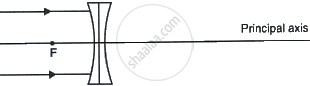
Copy and complete the diagram below to show what happens to the rays of light when they pass through the concave lens:
Which type of lenses are:
thinner in the middle than at the edges?
Which type of lenses are:
thicker in the middle than at the edges?
A ray of light is going towards the focus of a concave lens. draw a ray diagram to show the path of this ray of light after refraction through the lens.
What type of images can a convex lens make?
What type of image is always made by a concave lens?
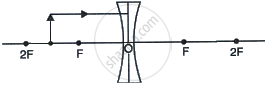
Take down this figure into your answer book and complete the path of the ray.
Fill in the following blank with suitable word:
A convex lens .................. rays of light, whereas a concave lens .................. rays of light.
Fill in the following blank with suitable word:
Lenses refract light to form images: a..................... lens can form both real and virtual images, but a diverging lens forms only ...................... images.
Things always look small on viewing through a lens. What is the nature of the lens?
Short Answer Type Questions
An object lies at a distance of 2f from a concave lens of focal length f. Draw a ray-diagram to illustrate the image formation.
Show by drawing a ray-diagram that the image of an object formed by a concave lens is virtual, erect and diminished.
Give the position, size and nature of image of formed by a concave lens when the object is placed anywhere between optical centre and infinity.
Give the position, size and nature of image of formed by a concave lens when the object is placed at infinity.
Which type of lens is a converging lens? Explain your answer with diagrams.
Which type of lens is a diverging lens? Explain your answer with diagrams.
With the help of a diagram, explain why the image of an object viewed through a concave lens appears smaller and closer than the object.
How would a pencil look like if you saw it through a concave lens? (Assume the pencil is close to the lens). Is the image real or virtual?
How would a pencil look like if you saw it through a convex lens? (Assume the pencil is close to the lens). Is the image real or virtual?
Long Answer Type Questions
An object is placed 10 cm from a lens of focal length 5 cm. Draw the ray diagrams to show the formation of image if the lens is converging,
An object is placed 10 cm from a lens of focal length 5 cm. Draw the ray diagrams to show the formation of image if the lens is diverging.
State one practical use of a convex mirror.
State any two uses of convex lenses.
State two applications of a concave lens.
- Construct ray diagrams to illustrate the formation of a virtual image using
- a converging lens, and
- a diverging lens.
- What is the difference between the two images formed above?
Multiple Choice Questions (MCQs)
A diverging lens is used in ______.
a magnifying glass
a car to see objects on rear side
spectacles for the correction of short sight
a simple camera
When an object is kept at any distance in front of a concave lens, the image formed is always ______.
virtual, erect and magnified
virtual, inverted and diminished
virtual, erect and diminished
virtual, erect and same size as object
When sunlight is concentrated on a piece of paper by a spherical mirror or lens, then a hole can be burnt in it. For doing this, the paper must be placed at he focus of:
(a) either a convex mirror or convex lens
(b) either a concave mirror or concave lens
(c) either a concave mirror or convex lens
(d) either a convex mirror or concave lens
A beam of parallel light rays is incident through the holes on one side of a box and emerges out through the holes on its opposite side as shown in the diagram below:
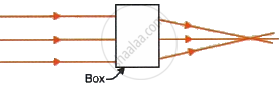
Which of the following could be inside the box?
a rectangular glass block
a concave lens
a convex lens
a glass prism
A beam of light is incident through the holes on one side of a box and emerges out through the holes on its opposite side as shown in the following figure:
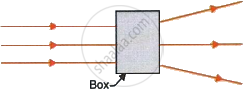
The box contains:
a glass prism
a concave lens
a convex lens
a parallel-sided glass slab
Which of the following can form a virtual image which is always smaller than the object?
a plane mirror
a convex lens
a concave lens
a concave mirror
Which of the following can form a virtual image which is always smaller than the object?
a plane mirror
a convex lens
a concave lens
a concave mirror
Questions Based on High Order Thinking Skills (HOTS)/Case Based Questions
When an object is placed 10 cm in front of lens A, the image is real, inverted, magnified and formed at a great distance. When the same object is placed 10 cm in front of lens B, the image formed is real, inverted and same size as the object.
- What is the focal length of lens A?
- What is the focal length of lens B?
- What is the nature of lens A?
- What is the nature of lens B?
When a fork is seen through lenses A and B one by one, it appears as shown in the diagrams. What is the nature of
- lens A, and
- lens B?
Give reason for your answer.
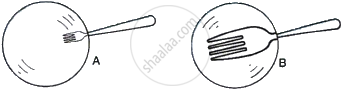
What kind of lens can form:
an inverted magnified image?
What kind of lens can form:
an erect magnified image?
What kind of lens can form:
an inverted diminished image?
What kind of lens can form:
am erect diminished image?
Lakhmir Singh solutions for Physics Part 1 [English] Class 10 2 Refraction of Light Exercise 6 [Pages 124 - 126]
Very Short Answer Type Questions
The lens A produces a magnification of, −0.6 whereas lens B produces a magnification of + 0.6.
- What is the nature of lens A?
- What is the nature of lens B?
A 50 cm tall object is at a very large distance from a diverging lens. A virtual, erect and diminished image of the object is formed at a distance of 20 cm in front of the lens. How much is the focal length of the lens?
Short Answer Type Questions
An object is placed at a distance of 4 cm from a concave lens of focal length 12 cm. Find the position and nature of the image.
A concave lens of focal length 15 cm forms an image 10 cm from the lens. How far is the object placed from the lens? Draw the ray diagram.
An object 60 cm from a lens gives a virtual image at a distance of 20 cm in front of the lens. What is the focal length of the lens? Is the lens converging or diverging? Give reasons for your answer.
A concave lens of 20 cm focal length forms an image 15 cm from the lens. Compute the object distance.
A concave lens has focal length 15 cm. At what distance should the object from the lens be placed so that it forms an image at 10 cm from the lens? Also find the magnification produced by the lens.
Calculate the image distance for an object of height 12 mm at a distance of 0.20 m from a concave lens of focal length 0.30 m, and state the nature and size of the image.
The focal length of a concave lens is 20 cm. At what distance from the lens should a 5 cm tall object be placed so that its image is formed at a distance of 15 cm from the lens? Also calculate the size of the image formed.
An object is placed 20 cm from (a) a converging lens, and (b) a diverging lens, of focal length 15 cm. Calculate the image position and magnification in each case.
A 2.0 cm tall object is placed 40 cm from a diverging lens of focal length 15 cm. Find the position and size of the image.
Long Answer Type Questions
(a) Find the position and size of the virtual image formed when an object 2 cm tall is placed 20 cm from:
(i) a diverging lens of focal length 40 cm.
(ii) a converging lens of focal length 40 cm.
(b) Draw labelled ray diagrams to show the formation of images in case (i) and (ii) above (The diagrams may not be according to scale).
- A small object is placed 150 mm away from a diverging lens of focal length 100 mm.
- Copy the figure below and draw rays to show how an image is formed by the lens.
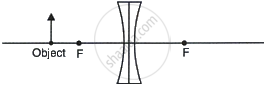
- Calculate the distance of the image from the lens by using the lens formula.
- Copy the figure below and draw rays to show how an image is formed by the lens.
- The diverging lens in part (a) is replaced by a converging lens also of focal length 100 mm. The object remains in the same position and an image is formed by the converging lens. Compare two properties of this image with those of the image formed by the diverging lens in part (a).
Multiple Choice Questions (MCQs)
A concave lens produces an image 20 cm from the lens of an object placed 30 cm from the lens. The focal length of the lens is:
(a) 50 cm
(b) 40 cm
(c) 60 cm
(d) 30 cm
Only one of the following applies to a concave lens. This is:
(a) focal length is positive
(b) image distance can be positive or negative
(c) height of image can be positive or negative
(d) image distance is always negative
The magnification produced by a spherical mirror and a spherical lens is + 0.8.
(a) The mirror and lens are both convex
(b) The mirror and lens are both concave
(c) The mirror is concave but the lens is convex
(d) The mirror is convex but the lens is concave
The magnification produced by a spherical lens and a spherical mirror is + 2.0.
(a) The lens and mirror are both concave
(b) The lens and mirror are both convex
(c) The lens is convex but the mirror is concave
(d) The lens is concave but the mirror is convex
Questions Based on High Order Thinking Skills (HOTS)/Case Based Questions
A camera fitted with a lens of focal length 50 mm is being used to photograph a flower that is 5 cm in diameter. The flower is placed 20 cm in front of the camera lens.
- At what distance from the film should the lens be adjusted to obtain a sharp image of the flower?
- What would be the diameter of the image of the flower on the film?
- What is the nature of camera lens?
An object is 2 m from a lens which forms an erect image one-fourth (exactly) the size of the object. Determine the focal length of the lens. What type of lens is this?
An image formed on a screen is three times the size of the object. The object and screen are 80 cm apart when the image is sharply focussed.
- State which type of lens is used.
- Calculate focal length of the lens.
Lakhmir Singh solutions for Physics Part 1 [English] Class 10 2 Refraction of Light Exercise 7 [Pages 131 - 133]
Very Short Answer Type Questions
The lens A has a focal length of 25 cm whereas another lens B has a focal length of 60 cm. Giving reason state, which lens has more power: A or B.
Which causes more bending (or more refraction) of light rays passing through it : a convex lens of long focal length or a convex lens of short focal length?
Name the physical quantity whose unit is dioptre.
Define 1 dioptre of power of a lens.
Which type of lens has a positive power?
Which type of lens has a negative power?
Which of the two has a greater power: a lens of short focal length or a lens of large focal length?
How is the power of a lens related to its focal length?
Which has more power : a thick convex lens or a thin convex lens, made of the same glass? Give reason for your choice.
The focal length of a convex lens is 25 cm. What is its power?
What is the power of a convex lens of focal length 0.5 m?
A converging lens has focal length of 50 mm. What is the power of the lens?
What is the power of a convex lens lens whose focal length is 80 cm?
A diverging lens has focal length of 3 cm. Calculate the power.
The power of a lens is + 0.2 D. Calculate its focal length.
The power of a lens is, −2 D. What is its focal length?
What is the nature of a lens having a power of + 0.5 D?
What is the nature of a lens whose power is, −4 D?
The optician's prescription for a spectacle lens is marked +0.5 D. What is the:
(a) nature of spectacle lens?
(b) focal length of spectacle lens?
A doctor has prescribed a corrective lens of power, −1.5 D. Find the focal length of the lens. Is the prescribed lens diverging or converging?
A lens has a focal length of, −10 cm. What is the power of the lens and what is its nature?
The focal length of a lens is +150 mm. What kind of lens is it and what is its power?
Fill in the following blank with suitable words :
The reciprocal of the focal length in metres gives you the _________ of the lens, which is measured in ___________.
Fill in the following blank with suitable word:
For converging lenses, the power is __________ while for diverging lenses, the power is ___________.
Short Answer Type Questions
An object of height 4 cm is placed at a distance of 15 cm in front of a concave lens of power, −10 dioptres. Find the size of the image.
An object of height 4.25 mm is placed at a distance of 10 cm from a convex lens of power +5D. Find (i) the focal length of the lens, and (ii) the size of the image.
A convex lens of power 5 D and a concave lens of power 7.5 D are placed in contact with each other. What is the :
(a) power of this combination of lenses?
(b) focal length of this combination of lenses?
A convex lens of focal length 25 cm and a concave lens of focal length 10 cm are placed in close contact with one another.
(a) What is the power of this combination?
(b) What is the focal length of this combination?
(c) Is this combination converging or diverging?
The power of a combination of two lenses X and Y is 5 D. If the focal length of lens X be 15 cm :
(a) calculate the focal length of lens Y.
(b) state the nature of lens Y.
Two lenses A and B have focal lengths of +20 cm and, −10 cm, respectively.
(a) What is the nature of lens A and lens B?
(b) What is the power of lens A and lens B?
(c) What is the power of combination if lenses A and B are held close together?
Long Answer Type Questions
What do you understand by the power of a lens?
Name one factor on which the power of a lens depends.
What is the unit of power of a lens? Define the unit of power of a lens.
A combination of lenses for a camera contains two converging lenses of focal lengths 20 cm and 40 cm and a diverging lens of focal length 50 cm. Find the power and focal length of the combination.
Two lenses A and B have power of (i) +2D and (ii) −4D respectively. What is the nature and focal length of each lens?
An object is placed at a distance of 100 cm from each of the above lenses A and B. Calculate
- image distance, and
- magnification, in each of the two cases.
Multiple Choice Questions (MCQs)
The focal lengths of four convex lenses P, Q, R and S are 20 cm, 15 cm, 5 cm and 10 cm, respectively. The lens having the greatest power is:
P
Q
R
S
A converging lens has a focal length of 50 cm. The power of this lens is:
+0.2D
−2.0D
+2.0D
−0.2D
A diverging lens has a focal length of 0.10 m. The power of this lens will be:
+10.0D
+1.0D
−1.0D
−10.0D
The power of a lens is +2.0D. Its focal length should be :
100 cm
50 cm
25 cm
40 cm
If a spherical lens has a power of, −0.25 D, the focal length of this lens will be :
(a) −4 cm
(b) −400 mm
(c) −4 m
(d) −40 cm
The power of a concave lens is 10 D and that of a convex lens is 6 D. When these two lenses are placed in contact with each other, the power of their combination will be :
(a) +16 D
(b) +4 D
(c) −16 D
(d) −4 D
The power of a converging lens is 4.5 D and that of a diverging lens is 3 D. The power of this combination of lenses placed close together is :
(a) +1.5D
(b) +7.5D
(c) −7.5D
(d) −1.5D
A convex lens of focal length 10 cm is placed in contact with a concave lens of focal length 20 cm. The focal length of this combination of lenses will be:
(a) +10 cm
(b) +20 cm
(c) −10 cm
(d) −20 cm
Questions Based on High Order Thinking Skills (HOTS)/Case Based Questions
The optical prescription for a pair of spectacles is:
Right eye: −3.50 D
Left eye: −4.00 D
- Are these lenses thinner at the middle or at the edges?
- Which lens has a greater focal length?
- Which is the weaker eye?
A person got his eyes tested by an optician. The prescription for the spectacle lenses to be made reads:
Left eye: + 2.50 D
Right eye: +2.00 D
- State whether these lenses are thicker in the middle or at the edges.
- Which lens bends the light rays more strongly?
- State whether these spectacle lenses will converge light rays or diverge light rays.
Lakhmir Singh solutions for Physics Part 1 [English] Class 10 2 Refraction of Light Exercise 8 [Page 134]
Questions Based on Assertion-Reason
In the following questions, two statements are given-one labelled Assertion (A) and the other labelled Reason (R): Select the correct answer to these questions from the options given below:
Assertion (A): Air is an optically rarer medium whereas glass is an optically denser medium. When a ray of light goes from air into a rectangular glass slab perpendicularly, it bends towards the normal (at the point of incidence).
Reason (R): A stick held obliquely and partly immersed in water appears to be bent at the water surface due to the phenomenon of refraction of light.
Both A and R are true and R is correct explanation of the assertion.
Both A and R are true but R is not the correct explanation of the assertion.
A is true but R is false.
A is false but R is true.
Assertion (A): A piece of paper is placed on the ground in bright sunshine and a converging lens is held at some distance above the piece of paper in such a way that a sharp image of the sun is formed on the piece of paper. After a few minutes, the paper burns at the point of image and a hole is formed in it.
Reason (R): The converging lens concentrates a lot of sun’s rays to a small point on paper (called focus). The heat energy of these concentrated sun rays burns the paper to form a hole in it.
Both A and R are true and R is correct explanation of the assertion.
Both A and R are true but R is not the correct explanation of the assertion.
A is true but R is false.
A is false but R is true.
Assertion (A): A ray of light travelling in air enters obliquely into a parallel-sided glass slab. The angle of refraction will not be equal to the angle of incidence.
Reason (R): A ray of light travelling in air enters perpendicularly into a parallel-sided glass slab. The angle of refraction will be equal to the angle of incidencе.
Both A and R are true and R is correct explanation of the assertion.
Both A and R are true but R is not the correct explanation of the assertion.
A is true but R is false.
A is false but R is true.
Assertion (A): In order to read small letters found in a dictionary conveniently, we should use a diverging lens of short focal length.
Reason (R): A converging lens has a focal length of 0.5x. In order to obtain an image which is real, inverted and same size as the object, the object should be placed at a distance x in front of it.
Both A and R are true and R is correct explanation of the assertion.
Both A and R are true but R is not the correct explanation of the assertion.
A is true but R is false.
A is false but R is true.
Assertion (A): No matter where the object is placed in front of a diverging lens, the diverging lens always forms a virtual, erect and diminished image of the object.
Reason (R): A diverging lens is used as a magnifying glass (or magnifying lens) by watch-makers, palmists, etc.
Both A and R are true and R is correct explanation of the assertion.
Both A and R are true but R is not the correct explanation of the assertion.
A is true but R is false.
A is false but R is true.
Solutions for 2: Refraction of Light
Lakhmir Singh solutions for Physics Part 1 [English] Class 10 chapter 2 - Refraction of Light
Shaalaa.com has the CBSE, Karnataka Board Mathematics Physics Part 1 [English] Class 10 CBSE, Karnataka Board solutions in a manner that help students grasp basic concepts better and faster. The detailed, step-by-step solutions will help you understand the concepts better and clarify any confusion. Lakhmir Singh solutions for Mathematics Physics Part 1 [English] Class 10 CBSE, Karnataka Board 2 (Refraction of Light) include all questions with answers and detailed explanations. This will clear students' doubts about questions and improve their application skills while preparing for board exams.
Further, we at Shaalaa.com provide such solutions so students can prepare for written exams. Lakhmir Singh textbook solutions can be a core help for self-study and provide excellent self-help guidance for students.
Concepts covered in Physics Part 1 [English] Class 10 chapter 2 Refraction of Light are .
Using Lakhmir Singh Physics Part 1 [English] Class 10 solutions Refraction of Light exercise by students is an easy way to prepare for the exams, as they involve solutions arranged chapter-wise and also page-wise. The questions involved in Lakhmir Singh Solutions are essential questions that can be asked in the final exam. Maximum CBSE, Karnataka Board Physics Part 1 [English] Class 10 students prefer Lakhmir Singh Textbook Solutions to score more in exams.
Get the free view of Chapter 2, Refraction of Light Physics Part 1 [English] Class 10 additional questions for Mathematics Physics Part 1 [English] Class 10 CBSE, Karnataka Board, and you can use Shaalaa.com to keep it handy for your exam preparation.
