Advertisements
Advertisements
Question
A converging lens has focal length of 50 mm. What is the power of the lens?
Advertisements
Solution
Power of a lens is given by:
Power (P) `=1/f`
∴`p=1/(50xx10^-3)=1000/50=20.D`
RELATED QUESTIONS
Calculate the focal length of a corrective lens having power +2D.
What is meant by a power of a lens? Define its SI unit.
State the power of a lens S.I. unit.
What is the focal length of a convex lens of focal length 30 cm in contact with a concave lens of focal length 20 cm? Is the system a converging or a diverging lens? Ignore thickness of the lenses.
A student uses a lens of focal length 40 cm and another of –20 cm. Write the nature and power of each lens
Give the usual name for the following:
A point inside a lens through which the light passes undeviated.
Name the physical quantity whose unit is dioptre.
The focal length of a convex lens is 25 cm. What is its power?
A diverging lens has focal length of 3 cm. Calculate the power.
The focal length of a lens is +150 mm. What kind of lens is it and what is its power?
Fill in the following blank with suitable word:
For converging lenses, the power is __________ while for diverging lenses, the power is ___________.
Define power of a lens. Write its units. Deduce the relation `1/f =1/f_1 +1/f_2`for two thin lenses kept in contact coaxially.
Find the radius of curvature of the convex surface of a plano-convex lens, whose focal length is 0.3 m and the refractive index of the material of the lens is 1.5.
A diverging lens of focal length 20 cm and a converging lens of focal length 30 cm are placed 15 cm apart with their principal axes coinciding. Where should an object be placed on the principal axis so that its image is formed at infinity?
Surabhi from std. X uses spectacle. The power of the lenses in her spectacle is 0.5 D.
Answer the following questions from the given information:
- Identify the type of lenses used in her spectacle.
- Identify the defect of vision Surabhi is suffering from.
- Find the focal length of the lenses used in her spectacle.
A stick partly immersed in water appears to be bent. Draw a ray diagram to show the bending of the stick when placed in water and viewed obliquely from above.
Find the power of a convex lens of focal length of + 25 cm.
Increase in the converging power of eye lens cause ‘hypermetropia'
Assertion and reasoning type
- Assertion: Myopia is due to the increase in the converging power of eye lens.
- Reason: Myopia can be corrected with the help of concave lens.
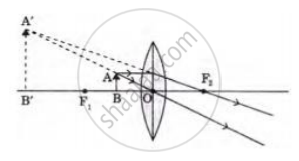
The above lens has a focal length of 10 cm. The object of height 2 mm is placed at a distance of 5 cm from the pole. Find the height of the image.
The focal length of a concave lens is 20 cm. The focal length of a convex lens is 25 cm. These two are placed in contact with each other. What is the power of the combination? Is it diverging, converging or undeviating in nature?
A point object is placed at O in front of a glass sphere as shown in figure.

Show the formation of the image by the sphere.
The power of convex lens of focal length 20 cm is ______.
The power of a lens placed in a medium is given by:
A positive power of a lens indicates a:
When a lens is placed in a liquid, light refracts at:
For a lens immersed in a medium of refractive index \[n_1\], the power is related to the focal length by:
If the refractive index of the lens material is less than that of the surrounding liquid (\[n_2 < n_1\]), then:
