Advertisements
Online Mock Tests
Chapters
2: Work, Power and Energy
3: Machines
4: Refraction of Light at Plane Surfaces
▶ 5: Refraction of Light through Lenses
6: Spectrum
7: Sound
8: Current Electricity
9: Household Circuits
10: Electromagnetism
11: Heat
12: Modern Physics
![Lakhmir Singh solutions for Physics [English] Class 10 ICSE chapter 5 - Refraction of Light through Lenses - Shaalaa.com](/images/physics-english-class-10-icse_6:bfbcc704031b4fd398b72f80ee978e3f.jpg "Lakhmir Singh solutions for Physics [English] Class 10 ICSE chapter 5 - Refraction of Light through Lenses")
Advertisements
Solutions for Chapter 5: Refraction of Light through Lenses
Below listed, you can find solutions for Chapter 5 of CISCE Lakhmir Singh for Physics [English] Class 10 ICSE.
Lakhmir Singh solutions for Physics [English] Class 10 ICSE 5 Refraction of Light through Lenses Intex Question [Pages 112 - 129]
TEST YOUR UNDERSTANDING - 1
What is lens?
Distinguish between a convex lens and concave lens. Which of the two is a converging lens : convex lens of concave lens?
Name two factors on which the focal length of a lens depends.
State whether the convex lens has a real focus or a virtual focus.
Define the following term in reference to a lens with a proper diagram:
Principal axis
Define the optical centre of a lens.
Define the following term in reference to a lens with a proper diagram:
Radius of curvature
Define the following term in reference to a lens with a proper diagram:
Centre of curvature
Choose the correct option for each of the following questions.
Which one of the following materials cannot be used to make a lens?
Water
Glass
Plastic
Clay
Which of the following is used to correct short-sightedness?
Convex lens
Concave lens
Convex mirror
Concave mirror
A light ray passing through the ______ of the lens will not undergo any deviation.
focus
centre of curvature
optical centre
principal axis
Explain the lens action assuming it as a combination of frustum of prisms.
THINK AND ANSWER
If we are are given two convex lenses of focal lengths 5 cm and 50 cm, respectively. Which lens should we prefer as a magnifying glass?
THINK AND ANSWER
Can we obtain an image twice the size of the object using a concave lens?
TEST YOUR UNDERSTANDING - 2
What are the three convenient light rays used to obtain the image of any object placed in front of a lens? Explain your answer with a proper diagram.
Does a convex lens form a virtual image of an object? Support your answer with the help of a neat ray diagram.
A lens forms an erect, magnified, and virtual image of an object.
- Name the type of lens.
- Draw a ray diagram to show the formation of the image.
- Where is the object placed in relation to the lens?
- Name the device which uses this principle.
We can burn a piece of paper by focussing the sun rays by using a particular type of lens. Name the type of lens used for the above purpose. Draw a ray diagram to support your answer.
Distinguish between:
Concave lens and Convex lens
Distinguish between a concave lens and a convex lens by looking at the image through them.
THINK AND ANSWER
Does a thick convex lens or a thin convex lens (made of the same glass) has more power?
TEST YOUR UNDERSTANDING - 3
Write the new Cartesian sign convention for spherical lenses.
Write the formula for a lens connecting image distance (v), object distance (u) and the focal length (f). How does the lens formula differ from the mirror formula?
Explain the term magnification.
Write down the magnification formula for a lens in terms of object distance and image distance.
Name one factor on which the power of a lens depends.
Define 1 dioptre of power of a lens.
What is the nature of a lens having a power of + 0.5 D?
The power of a lens is, −2 D. What is its focal length?
The lens A produces a magnification of, −0.6 whereas lens B produces a magnification of + 0.6.
- What is the nature of lens A?
- What is the nature of lens B?
How does the power of a lens change when its focal length is increased?
Fill in the following blanks with suitable words.
Fill in the following blank with suitable word:
For converging lenses, the power is __________ while for diverging lenses, the power is ___________.
Fill in the following blank with suitable words :
The reciprocal of the focal length in metres gives you the _________ of the lens, which is measured in ___________.
Magnification produced by a ______ lens is always less than 1.
THINK AND ANSWER
Is it possible to use a concave lens as a magnifying glass?
THINK AND ANSWER
Can you find the focal length of a concave lens using the distant object method?
TEST YOUR UNDERSTANDING - 4
What is a magnifying glass?
Explain the working of a magnifying glass with a ray diagram.
What is meant by the magnifying power of a simple microscope?
Draw a ray diagram to illustrate the determination of the focal length of a convex lens using an auxiliary plane mirror.
Explain an experimental method to determine the focal length of a convex lens by obtaining the image of a distant object. Why this method cannot be used to determine the focal length of a concave lens?
State any five applications of lenses.
What is meant by least distance of distinct vision? Mention its value.
Why does a magnifying glass of short focal length preferred?
State whether the following statement is true or false.
A convex lens is used as a magnifying glass.
State whether the following statement is true or false.
A magnifying glass forms a real and magnified image.
State whether the following statement is true or false.
A magnifying glass should be held far away from the eye to view the magnified object.
State whether the following statement is true or false.
A simple microscope is also known as a magnifying glass.
Lakhmir Singh solutions for Physics [English] Class 10 ICSE 5 Refraction of Light through Lenses EXERCISE [Pages 132 - 136]
Objective Questions
True or False:
A concave lens can produce a real and inverted image of an object.
True or False:
An object placed in front of a converging lens on the principal axis at a distance of twice the focal length of the lens produces a real image of the same size as that of the object.
True or False:
A light ray falling on a lens passes undeviated through the focus of the lens.
True or False:
An object placed between the first focus and the optical centre of a convex lens produces an enlarged virtual image.
True or False:
The lens formula is `1/v - 1/u = 1/f`.
Fill in the Blanks
A ______ lens forms an upright and diminished image of an object placed at the focal point of the lens.
Parallel rays of light are refracted by a convex lens to a point called the ______.
The distance between the focus and the optical centre of the lens is called the ______ of the lens.
A ______ lens forms an erect, magnified and virtual image of an object placed between the principal focus and the optical centre of the lens.
When the focal length of a lens increases, the power of the lens ______.
Multiple Choice Questions
The unit of power of lens is ______.
Centimetre
Dioptre
Watt
Metre
Which of the following can form a virtual image which is always smaller than the object?
a plane mirror
a convex lens
a concave lens
a concave mirror
Linear magnification produced by a convex lens can be ______.
less than 1 or more than 1
less than 1 or equal to 1
more than 1 or equal to 1
less than 1, equal to 1 or more than 1
A convex lens has a focal length of 10 cm. At which of the following positions should an object be placed so that this convex lens may act as a magnifying glass?
15 cm
7 cm
20 cm
25 cm
A diverging lens has a focal length of 0.10 m. The power of this lens will be:
+10.0D
+1.0D
−1.0D
−10.0D
A diverging lens is used in ______.
a magnifying glass
a car to see objects on rear side
spectacles for the correction of short sight
a simple camera
A small bulb is placed at the focal point of a converging lens. When the bulb is switched on, the lens produces ______.
a convergent beam of light
a divergent beam of light
a parallel beam of light
a patch of coloured light
When an object is kept at any distance in front of a concave lens, the image formed is always ______.
virtual, erect and magnified
virtual, inverted and diminished
virtual, erect and diminished
virtual, erect and same size as object
The focal lengths of four convex lenses P, Q, R and S are 20 cm, 15 cm, 5 cm and 10 cm, respectively. The lens having the greatest power is:
P
Q
R
S
A convex lens of focal length 8 cm forms a real image of the same size as the object. The distance between object and its image will be:
8 cm
16 cm
24 cm
32 cm
Match the items of Column I with that of Column II and choose the correct codes.
| Column I | Column II |
| A. Virtual image | (i) Diverges the incident light ray |
| B. Real image | (ii) Can be obtained on a screen |
| C. Concave lens | (iii) Converges the incident light ray |
| D. Convex lens | (iv) Cannot be obtained on a screen |
A - (iii), B - (iv), C - (i), D - (ii)
A - (i), B - (ii), C - (iii), D - (iv)
A - (iv), B - (iii), C - (ii), D - (i)
A - (iv), B - (ii), C - (i), D - (iii)
In a dark room, only by touching the lens, how will you distinguish between a convex and a concave lens?
What happens if the lower half of a convex lens is painted dark?
The upper half of a convex lens is made of one transparent medium while the lower half is made of another medium. Will this affect the focal length of the lens? Explain.
You are provided with a printed piece of paper. Using this paper how will you differentiate between a convex lens and a concave lens?
State three characteristics of the image of an extended source, formed by a concave lens.
What should be the position of the object on the principal axis so that a real and inverted image of the same size as the object is obtained using a convex lens? Draw a ray diagram to show the formation of the image.
A lens produces a virtual image between the object and the lens.
- Name the lens.
- Draw a ray diagram to show the formation of this image.
Complete the following ray diagram and locate the image position.
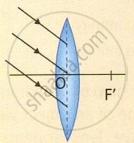
Complete the following ray diagram and locate the image position.
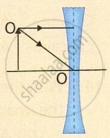
A convex lens of focal length 15 cm is placed on a horizontal plane mirror. A pin is placed above the lens such that no parallax is obtained between the pin and its image. Calculate the height of the pin from the lens. Explain with a neat ray diagram.
Describe with the help of a ray diagram the nature, size and position of the image formed when an object is placed at infinity (considerable distance) in front of a convex lens. State three characteristics of the image so formed.
Define the power of a lens.
State the power of a lens S.I. unit.
State whether the power of a converging lens is positive or negative.
The given ray diagram illustrates the experimental set up for the determination of the focal length of a converging lens using a plane mirror.
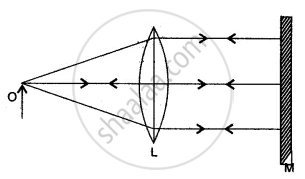
- State the magnification of the image formed.
- Write two characteristics of the image formed.
- What is the name given to the distance between the object and optical centre of the lens in the above diagram?
Copy and complete the following table:
| Types of Lenses | Position of Object | Nature of Image | Size of Image |
| Convex | At F | ||
| Convex | At infinity | ||
| Concave | At infinity |
With the help of a diagram, explain why the image of an object viewed through a concave lens appears smaller and closer than the object.
Describe with the help of a ray diagram the nature, size and position of the image formed when an object is placed in front of a convex lens between focus and optical centre. State three characteristics of the image formed.
Draw a neat ray diagram to show the image formation from a convex lens when parallel light rays from a distant object fall on it at some angle to the principal axis.
Describe with the help of a ray-diagram, the size, nature and position of the image formed by a convex lens when an object is placed beyond 2f in front of the lens.
How could you find the focal length of a convex lens rapidly but approximately?
Give the position, size and nature of image of formed by a concave lens when the object is placed anywhere between optical centre and infinity.
Give the position, size and nature of image of formed by a concave lens when the object is placed at infinity.
A ray of light passing through the optical centre of the lens does not deviate from its path after refraction. Explain.
Long Answer Questions
An object is placed in front of a lens between its optical centre and the focus and forms a virtual, diminished and upright image.
- Name the type of lens.
- Draw a ray diagram to show the formation of the image.
An object AB is placed between 2F1 and F1 on the principal axis of a convex lens as shown in the diagram. Copy the diagram and using three rays starting from point A, obtain the image of the object formed by the lens.
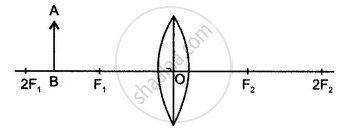
An object is placed well outside the principal focus of a convex lens. Draw a ray diagram to show how the image is formed, and say whether the image is real or virtual.
What is the effect on the size and position of the image of moving the object (i) towards the lens and (ii) away from the lens?
Explain why a real image can be projected on a screen but a virtual image cannot.
Draw a ray diagram to show the formation of a real diminished image of an object by a convex lens. In your diagram, the position of object and image with respect to the principal focus should be shown clearly.
Name one simple optical instrument in which the above arrangement of convex lens is used.
- An object 3 cm high is placed 24 cm away from a convex lens of focal length 8 cm. Find by calculations, the position, height and nature of the image.
- If the object is moved to a point only 3 cm away from the lens, what is the new position, height and nature of the image?
- Which of the above two cases illustrates the working of a magnifying glass?
Explain what is meant by a virtual, magnified image.
Draw a ray diagram to show the formation of a virtual magnified image of an object by a convex lens. In your diagram, the position of the object and image with respect to the principal focus should be shown clearly.
Three convex lenses are available having focal lengths of 4 cm, 40 cm and 4 m respectively. Which one would you choose as a magnifying glass and why?
Numerical Problems
An object is placed at a distance 24 cm in front of a convex lens of focal length 8 cm.
(i) What is the nature of the image so formed?
(ii) Calculate the distance of the image from the lens.
(iii) Calculate the magnification of the image.
A lens of focal length 20 cm forms an inverted image at a distance 60 cm from the lens.
- Identify the lens.
- How far is the lens present in front of the object?
- Calculate the magnification of the image.
An object of height 4 cm is placed at a distance of 15 cm in front of a concave lens of power, −10 dioptres. Find the size of the image.
A converging lens has focal length of 50 mm. What is the power of the lens?
A concave lens of 20 cm focal length forms an image 15 cm from the lens. Compute the object distance.
The focal length of a concave lens is 20 cm. At what distance from the lens should a 5 cm tall object be placed so that its image is formed at a distance of 15 cm from the lens? Also calculate the size of the image formed.
A concave lens of focal length 15 cm forms an image 10 cm from the lens. How far is the object placed from the lens? Draw the ray diagram.
Determine how far an object must be placed in front of a converging lens of focal length 10 cm in order to produce an erect (upright) image of linear magnification 4.
An erect image 2.0 cm high is formed 12 cm from a lens, the object being 0.5 cm high. Find the focal length of the lens.
At what distance should an object be placed from a convex lens of focal length 18 cm to obtain an image at 24 cm from it on the other side? What will be the magnification produced in this case?
A combination of lenses for a camera contains two converging lenses of focal lengths 20 cm and 40 cm and a diverging lens of focal length 50 cm. Find the power and focal length of the combination.
A convex lens produces an inverted image magnified three times of an object placed at a distance of 15 cm from it. Calculate the focal length of the lens.
DO IT RIGHT
| Manoj is a 12-year-old boy. He obtained a lens from one of his friends. Manoj held the lens towards the Sun and started looking at the Sun through it. On seeing this, Manoj’s elder brother ran towards him and snatched away the lens from him. The brother firmly told Manoj not to do it again. |
- What could be the nature of the lens?
- Why did the brother snatch the lens from Manoj?
- What could have happened to Manoj if his brother had not snatched away the lens from him? Explain.
- What values are shown by Manoj’s brother?
Research about the different types of lenses and their interesting applications. Record your answers. Then, discuss the answers with your friends and teacher.
Solutions for 5: Refraction of Light through Lenses
Lakhmir Singh solutions for Physics [English] Class 10 ICSE chapter 5 - Refraction of Light through Lenses
Shaalaa.com has the CISCE Mathematics Physics [English] Class 10 ICSE CISCE solutions in a manner that help students grasp basic concepts better and faster. The detailed, step-by-step solutions will help you understand the concepts better and clarify any confusion. Lakhmir Singh solutions for Mathematics Physics [English] Class 10 ICSE CISCE 5 (Refraction of Light through Lenses) include all questions with answers and detailed explanations. This will clear students' doubts about questions and improve their application skills while preparing for board exams.
Further, we at Shaalaa.com provide such solutions so students can prepare for written exams. Lakhmir Singh textbook solutions can be a core help for self-study and provide excellent self-help guidance for students.
Concepts covered in Physics [English] Class 10 ICSE chapter 5 Refraction of Light through Lenses are .
Using Lakhmir Singh Physics [English] Class 10 ICSE solutions Refraction of Light through Lenses exercise by students is an easy way to prepare for the exams, as they involve solutions arranged chapter-wise and also page-wise. The questions involved in Lakhmir Singh Solutions are essential questions that can be asked in the final exam. Maximum CISCE Physics [English] Class 10 ICSE students prefer Lakhmir Singh Textbook Solutions to score more in exams.
Get the free view of Chapter 5, Refraction of Light through Lenses Physics [English] Class 10 ICSE additional questions for Mathematics Physics [English] Class 10 ICSE CISCE, and you can use Shaalaa.com to keep it handy for your exam preparation.
