Advertisements
Online Mock Tests
Chapters
![Lakhmir Singh solutions for Physics [English] Class 10 ICSE chapter 7 - Sound - Shaalaa.com](/images/physics-english-class-10-icse_6:bfbcc704031b4fd398b72f80ee978e3f.jpg "Lakhmir Singh solutions for Physics [English] Class 10 ICSE chapter 7 - Sound")
Advertisements
Solutions for Chapter 7: Sound
Below listed, you can find solutions for Chapter 7 of CISCE Lakhmir Singh for Physics [English] Class 10 ICSE.
Lakhmir Singh solutions for Physics [English] Class 10 ICSE 7 Sound Intex Question [Pages 159 - 170]
THINK AND ANSWER
Humans cannot hear ultrasonic sounds. Can animals hear ultrasonic sounds? Name the animals that can hear these sounds. Do certain animals communicate using ultrasonic sounds?
THINK AND ANSWER
How do we hear different sounds?
How does the sound from different musical instruments reach our ears?
TEST YOUR UNDERSTANDING - 1
What do you mean by reflection of sound ?
State the laws of reflection of sound.
Name any two objects which are good reflectors of sound.
What is an echo ? How is echo formed ?
On which day, a hot day or a cold day, an echo is heard sooner ? Give reason for your answer.
Why do we hear more clearly in a room with curtains than in a room without curtains ?
Explain three uses of echo.
Explain how, bats use ultrasound to catch the prey.
Which property of sound leads of the formation of echoes ?
Choose the correct option for each of the following questions.
The ultrasound waves can penetrate into matter to a large extent because they have :
very high speed
very high frequency
very high wavelength
very high amplitude
What type of waves are generated by SONAR device fixed to a fishing ship ?
water waves
radio waves
sound waves
infrared waves
Fill in the following blanks with suitable words.
Fill in the blank with suitable word :
Echoes are caused by the ...................... of sound.
The persistence of sound in a big hall or auditorium is known as ______.
TEST YOUR UNDERSTANDING - 2
What do you understand by free (or natural) vibrations?
Define damped vibrations.
Give one example of damped vibrations
Distinguish between natural and damped vibrations.
What are forced vibrations?
Draw a sketch showing the displacement of a body executing damped vibrations against time.
What is meant by resonance?
Explain resonance using n and f as different frequencies of vibrations.
Which phenomenon is a special case of forced vibrations? Give an example.
State the condition for the occurrence of resonance.
When a body is made to vibrate by applying an external periodic force, such vibrations are known as ______ vibrations.
The amplitude of forced vibrations of a body depends on the ______ of the external force applied on the body.
TEST YOUR UNDERSTANDING - 3
What is meant by the 'loudness' of sound ? On what factor does the loudness of a sound depend ?
Explain the term 'pitch' of a sound. On what factor does the 'pitch' of a sound depend ?
What is meant by the quality (or timbre) of sound ? On what factor does the quality (or timbre) of a sound depend ?
Draw labelled diagrams to represent sound of (a) low pitch, and (b) high pitch, of the same loudness.
Write the answer in your own words.
What is meant by noise pollution?
What is the unit of intensity of sound?
How is the loudness of sound related to the intensity of the wave producing it?
Define one decibel.
Fill in the following blanks with suitable words.
If the amplitude of sound increases, the loudness of sound ______.
Fill in the blank with suitable word :
Quality of sound depends on ........................
Lakhmir Singh solutions for Physics [English] Class 10 ICSE 7 Sound EXERCISE [Pages 172 - 177]
Objective Questions
True or False.
The amplitude of forced vibrations of a body changes with time.
True or False.
The loudness of sound depends on the amplitude of vibration.
True or False.
Natural vibrations are produced in a body when it vibrates under an external periodic force.
True or False.
A faint sound is heard during resonance.
True or False.
The pitch of a sound wave decreases with increase in its frequency.
Fill in the Blanks
Shrillness of a sound is determined by the ______ of vibration.
The sound having a frequency above 20000 Hz is ______ sound.
Resonance is produced in a body when its ______ is equal to the frequency of external force applied on the body.
The sound level is measured in ______.
The quality of a note depends on its ______.
Multiple Choice Questions
In SONAR we use:
ultrasonic waves
infrasonic waves
radio waves
audible sound waves
Note is a sound
of a mixture of several frequencies
of a mixture of two frequencies only
of a single frequency
always unpleasant to listen
The bouncing back of a sound wave on hitting a hard surface is known as ______.
reverberation
resonance
echo sounding
reflection
A key of mechanical piano is first struck gently and then struck again but much harder this time. In the second case :
sound will be louder but pitch will not be different
sound will be louder and the pitch will also be higher
sound will be louder but pitch will be lower
both loudness and pitch will remain unaffected
At 20°C, the minimum distance of a person from a sound reflecting surface to hear an echo is :
12.2 m
17.2 m
15.2 m
34.4 m
We can distinguish between the musical sounds produced by different singers on the basis of the characteristic of sound called :
frequency
timbre
pitch
loudness
The frequencies of four sound waves are given below. Which of these sound waves can be used to measure the depth of sea by the echo method ?
15,000 Hz
10 kHz
50 kHz
10,000 Hz
We can recognise a person by hearing his voice even if we cannot see him. This happens because of the ______.
pitch of his voice
quality of his voice
loudness of his voice
none of the above
The product of frequency and wavelength of a sound is known as ______.
speed
resonance
time period
loudness
The unit of intensity of sound is ______.
W
`V/s`
`W/m^2`
`m/s`
Match the items of Column I with that of Column II and choose the appropriate code.
| Column I | Column II |
| A. Reverberation | (i) Special type of forced vibration |
| B. Resonance | (ii) Frequency of vibration |
| C. Timbre | (iii) Persistence of sound |
| D. Pitch | (iv) Waveform |
A - (iii), B - (ii), C - (i), D - (iv)
A - (iii), B - (i), C - (iv), D - (ii)
A - (iv), B - (i), C - (ii), D - (iii)
A - (iii), B - (i), C - (ii), D - (iv)
Descriptive Questions Short Answer Questions
State the use of echo in medical science/field.
Explain echo sounding.
State the safe limit of sound level in terms of decibel for human hearing.
Name the characteristic of sound in relation to its waveform.
Draw labelled diagrams to represent (a) soft sound, and (b) loud sound, of the same frequency.
What is an echo ? How is echo formed ?
What is the minimum distance in air required from a sound reflecting surface to hear an echo (at 20°C) ?
What is sonar ? Explain its use.
Guess which sound has a higher pitch: guitar or car horn?
Draw a graph between displacement from mean position and time for a body executing free vibrations in vacuum.
Explain a tuning fork (vibrating) is held close to ear. One hears a faint sound. The same vibrating tuning fork is placed on table, such that its handle is in contact with table, one hears a loud sound.
A man playing a flute is able to produce notes of different frequencies. If he closes the holes near his mouth, will the pitch of the note produced, increase or decrease? Give a reason.
Two waves of the same pitch have amplitudes in the ratio 1 : 3. What will be the ratio of their :
(i) intensities and
(ii) frequencies
Define resonant vibrations.
Which characteristic of sound makes it possible to recognize a person by his voice without seeing him?
It is observed that during march-past we hear a base drum distinctly from a distance compared to the side drums.
(i) Name the characteristics of sound associated with the above obervation.
(ii) Give a reason for the above observation.
The displacement distance graph of two sound waves A and B, travelling in a medium, are as shown in the diagram below.
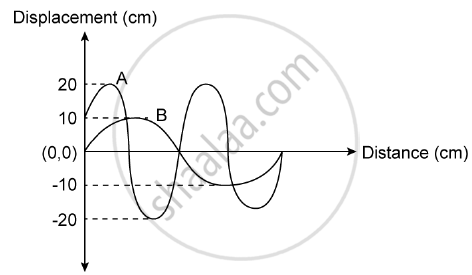
Study the two sound waves and compare their:
- Amplitudes
- Wavelengths
What do you understand by free vibrations of a body?
Why does the amplitude of a vibrating body continuously decrease during damped vibrations?
Name the phenomenon that causes a loud sound when the stem of a vibrating tuning fork is kept pressed on the surface of a table.
The ratio of the amplitudes of two waves is 3 : 4. What is the ratio of their loudness?
The ratio of the amplitude of two waves is 3 : 4. What is the ratio of their Frequencies?
Draw a graph between displacement and the time for a body executing free/natural vibrations.
Where can a body execute free vibrations?
Which characteristics of sound will change if there is a change in its amplitude and its waveform.
State two differences between light and sound waves.
Explain the requirement of sound box in musical instruments.
Long Answer Questions
Two pendulums C and D are suspended from a wire as shown in the figure give below. Pendulum C is made to oscullate by displaying it from its mean position. It is seen that D also starts oscillating.
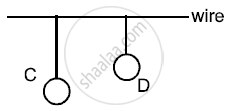
(i) Name the type of oscillation, C will execute.
(ii) Name the type of oscillation, D will execute.
(iii) If the length of D is made equal to C then what difference will you notice in the oscillations of D ?
(iv) What is the name of the phenomenon when the length of D is made equal to C ?
Name the phenomenon involved in tunning a radio set to a particular station.
Define the resonance phenomenon.
What do you understand by the loudness of sound?
In which units is the loudness of sound measured?
The adjacent diagram shows three different modes of vibrations P, Q and R of the same string.
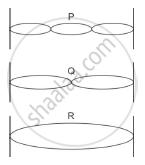
(i) Which vibration will produce a louder sound and why?
(ii) The sound of which string will have maximum shrillness?
(iii) State the ratio of wavelengths of P and R.
In the diagram below, A, B, C, D are four pendulums suspended from the same elastic string PQ. The lengths of A and C are equal to each other, while the length of pendulum B is smaller than that of D. Pendulum A is set into a mode of vibrations.
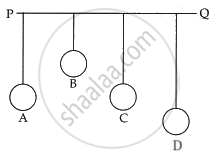
- Name the type of vibrations taking place in pendulums B and D.
- What is the state of pendulum C?
- State the reason for the type of vibrations in pendulums B and C.
Numerical Problems
A man standing 825 metres away from a cliff (steep rock) fires a gun. After how long will he hear its echo ? Speed of sound in air is 330 m/s.
A sonar station picks up a return signal after 3 seconds. How far away is the object ? (Speed of sound in water = 1440 m/s).
A sound wave travelling in water has wavelength 0.4 m. Is this wave audible in air? (The speed of sound in water = 1400 m s−1)
The human ear can detect continuous sounds in the frequency range from 20 Hz to 20,000 Hz. Assuming that the speed of sound in air is 330 m s−1 for all frequencies, calculate the wavelengths corresponding to the given extreme frequencies of the audible range.
A sound made on the surface of a lake takes 3 s to reach a boatman. How much time will it take to reach a diver inside the water at the same depth?
Velocity of sound in air = 330 ms−1
Velocity of sound in water = 1450 ms−1
A radar sends a signal to an aeroplane at a distance of 45 km away with a speed of 3 × 10⁸ m s−1. After how long is the signal received back from the aeroplane?
A pendulum has a frequency of 4 vibrations per second. An oberver starts the pendulum and fires a gun simultaneously. He hears the echo from the cliff after 6 vibrations of the pendulum, if the velocity of sound in air is 340 m/s, find the distance betwen the cliff and the obsever.
A man standing in front of a vertical cliff fires a gun. He hears the echo after 3.5 s. On moving closer to the cliff by 84 m, he hears the echo after 3 s. Calculate the distance of the cliff from the initial position of the man.
DO IT RIGHT
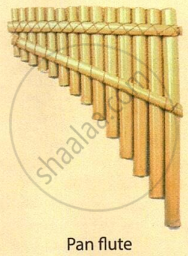
Make a pan flute using straws to understand the difference in pitch of sound waves due to differences in length. For this activity, acquire 9 to 10 straws. Place them on a table side by side. Then, tape them together and cut the straws at an angle from the top to form the pan flute. The straws should be cut such that it looks similar to the wooden pan flute shown in the figure. Now, blow through every straw and observe the difference in pitch.
Solutions for 7: Sound
Lakhmir Singh solutions for Physics [English] Class 10 ICSE chapter 7 - Sound
Shaalaa.com has the CISCE Mathematics Physics [English] Class 10 ICSE CISCE solutions in a manner that help students grasp basic concepts better and faster. The detailed, step-by-step solutions will help you understand the concepts better and clarify any confusion. Lakhmir Singh solutions for Mathematics Physics [English] Class 10 ICSE CISCE 7 (Sound) include all questions with answers and detailed explanations. This will clear students' doubts about questions and improve their application skills while preparing for board exams.
Further, we at Shaalaa.com provide such solutions so students can prepare for written exams. Lakhmir Singh textbook solutions can be a core help for self-study and provide excellent self-help guidance for students.
Concepts covered in Physics [English] Class 10 ICSE chapter 7 Sound are .
Using Lakhmir Singh Physics [English] Class 10 ICSE solutions Sound exercise by students is an easy way to prepare for the exams, as they involve solutions arranged chapter-wise and also page-wise. The questions involved in Lakhmir Singh Solutions are essential questions that can be asked in the final exam. Maximum CISCE Physics [English] Class 10 ICSE students prefer Lakhmir Singh Textbook Solutions to score more in exams.
Get the free view of Chapter 7, Sound Physics [English] Class 10 ICSE additional questions for Mathematics Physics [English] Class 10 ICSE CISCE, and you can use Shaalaa.com to keep it handy for your exam preparation.
