Advertisements
Advertisements
Question
Two pendulums C and D are suspended from a wire as shown in the figure give below. Pendulum C is made to oscullate by displaying it from its mean position. It is seen that D also starts oscillating.
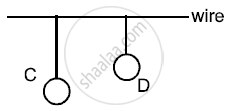
(i) Name the type of oscillation, C will execute.
(ii) Name the type of oscillation, D will execute.
(iii) If the length of D is made equal to C then what difference will you notice in the oscillations of D ?
(iv) What is the name of the phenomenon when the length of D is made equal to C ?
Advertisements
Solution
(i) C will execute damped oscillation.
(ii) D will execute forced oscillation.
(iii) D will start executing with very large amplitude.
(iv) Resonance
RELATED QUESTIONS
In the diagram below, A, B, C, D are four pendulums suspended from the same elastic string PQ. The lengths of A and C are equal to each other, while the length of pendulum B is smaller than that of D. Pendulum A is set into a mode of vibrations.
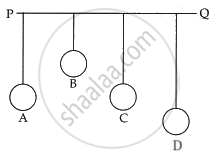
- Name the type of vibrations taking place in pendulums B and D.
- What is the state of pendulum C?
- State the reason for the type of vibrations in pendulums B and C.
Describe a simple experiment to illustrate the phenomenon of resonance and explain it.
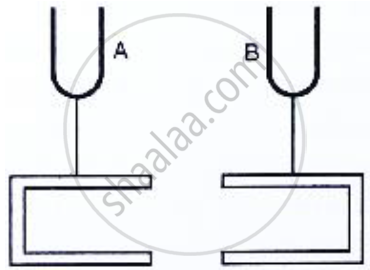
In following figure shows two tuning forks A and B of the same frequency mounted on two separate sound boxes with their open ends facing each other. The fork A is set into vibration.
- Describe your observation.
- State the principle illustrated by this experiment.
Name the phenomenon involved in tuning your radio set to a particular station and define it.
Give two examples of forced vibrations.
What do you mean by resonance? When does resonance occur?
Explain why stringed musical instruments, like the guitar, are provided with a hollow box.
Explain Why are stringed musical instruments provided with large sound boxes?
When the stem of vibrating tuning fork is pressed on a table, the tabletop starts vibrating. These vibrations are definitely an example of ______.
