Advertisements
Advertisements
Question
Describe a simple experiment to illustrate the phenomenon of resonance and explain it.
Advertisements
Solution
Mount two identical tuning forks A and B of same frequency upon two separate sound boxes such that their open ends face each other as shown.

If the prong A is struck on a rubber pad, it starts vibrating. On putting A on its sound box, tuning
fork B also starts vibrating and a loud sound is heard. The vibrations produced in B are due to
resonance.
RELATED QUESTIONS
Define the Resonance phenomenon?
How does the medium affect the amplitude of free/natural vibrations of a body?
Why are the stringed instruments like guitar provided with a hollow sound box?
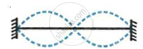
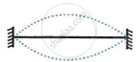
The diagram below shows three different modes of vibration P, Q and R of the same string of a given length.
 |
 |
 |
| P | Q | R |
- Which vibration will produce a louder sound and why?
- Which vibration will produce sound of maximum shrillness (or pitch) and why?
- What is the ratio of wavelength of vibrations P and R?
Explain why stringed musical instruments, like the guitar, are provided with a hollow box.
State two ways in which resonance differs from forced vibrations.
The rearview mirror of a motorbike starts vibrating violently at some particular speed of the motorbike. What is the name of the phenomenon taking place? Why does the happen?
Explain why does the rear mirror of a motorbike start Vibrating Violently, at some particular speed of motorbike?
