Advertisements
Advertisements
Question
Resonance is a special case of ______ vibrations, when frequency of the driving force is ______ natural frequency of the body.
Advertisements
Solution
Resonance is a special case of forced vibrations, when frequency of the driving force is equal to the natural frequency of the body.
APPEARS IN
RELATED QUESTIONS
The adjacent diagram shows three different modes of vibrations P, Q and R of the same string.
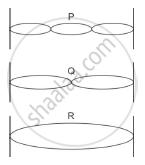
(i) Which vibration will produce a louder sound and why?
(ii) The sound of which string will have maximum shrillness?
(iii) State the ratio of wavelengths of P and R.
Distinguish between the free (or natural) and forced vibrations.
Why is a loud sound heard at resonance?
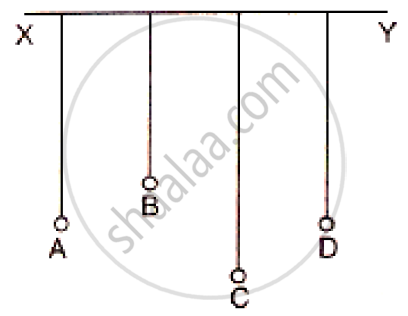
In following figure shows A, B, C and D are four pendulums suspended from the same elastic string XY. Lengths of pendulum A and D are equal, while the length of pendulum B is smaller and the pendulum C is longer. The pendulum A is set into vibration.
(a) what is your observation? (b) Give reason for your observation.
When a troop crosses a suspension bridge, the soldiers are asked to break steps. Explain the reason.
Differentiate between the following:
Free and forced vibrations.
The rearview mirror of a motorbike starts vibrating violently at some particular speed of the motorbike, what could be done to stop the violent vibrations.
Explain why are soldiers asked to walk out of step while crossing bridges?
A string stretched between its ends is made to vibrate by placing the stem of a vibrating tuning fork at its one end. State three ways how you will increase the frequency of note produced by the string.
