Advertisements
Advertisements
Questions
Differentiate between the forced and resonant vibrations.
State two differences between forced and resonant vibrations.
Advertisements
Solution
| Forced Vibrations | Resonant vibrations |
| These are vibrations of a body under an external periodic force of frequency different than the body's natural frequency. | These are vibrations of a body under an external periodic force of frequency exactly equal to the natural frequency of the body. |
| The amplitude of the vibration is usually small. | The amplitude of vibration is very large. |
| The body's vibrations are not in phase with the external periodic force. | The vibrations of the body are in phase with the external periodic force. |
| These vibrations last very short after the periodic force has ceased to act. | These vibrations last long after the periodic force has ceased to act. |
Notes
Students should refer to the answer according to their questions.
APPEARS IN
RELATED QUESTIONS
What are mechanical waves?
The adjacent diagram shows three different modes of vibrations P, Q and R of the same string.
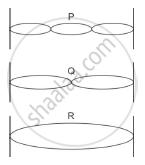
(i) Which vibration will produce a louder sound and why?
(ii) The sound of which string will have maximum shrillness?
(iii) State the ratio of wavelengths of P and R.
Resonance is a special case of ______ vibrations, when frequency of the driving force is ______ natural frequency of the body.
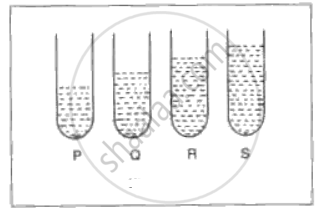
In fig. , P, Q, R and S represent test tubes each of height 20 cm which are filled with water upto heights of 10 cm, 14 cm, 16 cm and 18 cm respectively. If a vibrating tuning fork is placed over the mouth of test tube Q, a loud sound is heard.
(i) Describe the observations with the tubes P, R and S.
(ii) Give the reason for your observation in each case.
(iii) State the principle illustrated by the above experiment.
In Fig. A, B, C and D are four pendulums suspended from the same elastic string XY. The lengths of pendulum A and D are equal, while the length of pendulum B is shorter and of the pendulum C is longer. Pendulum A is set into vibrations.

- What is your observation about the vibrations of pendulum D?
- Give reason for your observation in part (a).
- What type of vibrations take place in pendulums Band C?
- Give reason for the answer in part (c).
Give two examples of forced vibrations.
State two ways in which resonance differs from forced vibrations.
Explain why are soldiers asked to walk out of step while crossing bridges?
Explain a person walking past a railway line, in the middle of night hears a ringing sound along with the sound of his footsteps.
What do you understand by forced vibrations?
