Advertisements
Advertisements
प्रश्न
Differentiate between the forced and resonant vibrations.
State two differences between forced and resonant vibrations.
Advertisements
उत्तर
| Forced Vibrations | Resonant vibrations |
| These are vibrations of a body under an external periodic force of frequency different than the body's natural frequency. | These are vibrations of a body under an external periodic force of frequency exactly equal to the natural frequency of the body. |
| The amplitude of the vibration is usually small. | The amplitude of vibration is very large. |
| The body's vibrations are not in phase with the external periodic force. | The vibrations of the body are in phase with the external periodic force. |
| These vibrations last very short after the periodic force has ceased to act. | These vibrations last long after the periodic force has ceased to act. |
Notes
Students should refer to the answer according to their questions.
APPEARS IN
संबंधित प्रश्न
Define the resonance phenomenon.
Describe a simple experiment to illustrate the phenomenon of resonance and explain it.
When a troop crosses a suspension bridge, the soldiers are asked to break steps. Explain the reason.
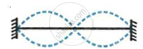
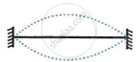
The diagram below shows three different modes of vibration P, Q and R of the same string of a given length.
 |
 |
 |
| P | Q | R |
- Which vibration will produce a louder sound and why?
- Which vibration will produce sound of maximum shrillness (or pitch) and why?
- What is the ratio of wavelength of vibrations P and R?
Explain why stringed musical instruments, like the guitar, are provided with a hollow box.
State two ways in which resonance differs from forced vibrations.
The rearview mirror of a motorbike starts vibrating violently at some particular speed of the motorbike, what could be done to stop the violent vibrations.
Explain a tuning fork (vibrating) is held close to ear. One hears a faint sound. The same vibrating tuning fork is placed on table, such that its handle is in contact with table, one hears a loud sound.
What are the factors that affect the frequency of a vibrating string and how do they affect the frequency?
