Advertisements
Advertisements
प्रश्न
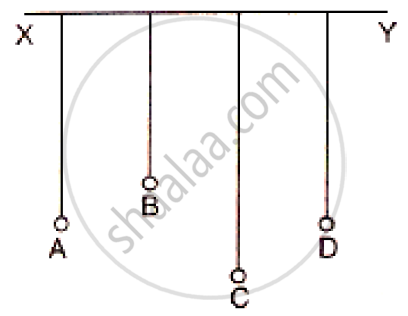
In Fig. A, B, C and D are four pendulums suspended from the same elastic string XY. The lengths of pendulum A and D are equal, while the length of pendulum B is shorter and of the pendulum C is longer. Pendulum A is set into vibrations.

- What is your observation about the vibrations of pendulum D?
- Give reason for your observation in part (a).
- What type of vibrations take place in pendulums Band C?
- Give reason for the answer in part (c).
Advertisements
उत्तर
-
The lengths of A and D are equal. When A and D's inherent frequencies are equivalent, D enters a resonance condition. In perfect phase with pendulum A, pendulum D swings at a rate of A.
- This is because the lengths of A and D are equal.
- Forced vibrations have taken hold of B and C.
-
Since the elastic string XY transfers the vibrations from pendulum A to pendulums B and C, the amplitude of their vibrations is similarly tiny.
APPEARS IN
संबंधित प्रश्न
Define the resonance phenomenon.
The adjacent diagram shows three different modes of vibrations P, Q and R of the same string.
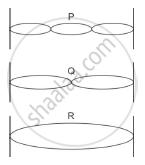
(i) Which vibration will produce a louder sound and why?
(ii) The sound of which string will have maximum shrillness?
(iii) State the ratio of wavelengths of P and R.
Differentiate between the forced and resonant vibrations.
Why is a loud sound heard at resonance?
In following figure shows A, B, C and D are four pendulums suspended from the same elastic string XY. Lengths of pendulum A and D are equal, while the length of pendulum B is smaller and the pendulum C is longer. The pendulum A is set into vibration.
(a) what is your observation? (b) Give reason for your observation.
Name the phenomenon involved in tuning your radio set to a particular station and define it.
When a body vibrates under a periodic force, the vibrations of the body are ______.
A string stretched between its ends is made to vibrate by placing the stem of a vibrating tuning fork at its one end. State three ways how you will increase the frequency of note produced by the string.
When the stem of vibrating tuning fork is pressed on a table, the tabletop starts vibrating. These vibrations are definitely an example of ______.
