Advertisements
Advertisements
प्रश्न
Differentiate between the following:
Light and sound waves.
Advertisements
उत्तर
| Light waves | Sound waves |
| 1. These are electromagnetic waves. | 1. These are mechanical waves. |
| 2. They can travel in vacuum. | 2. They re qui re a materia I medium for propagation. |
| 3. The speed of light waves is very high ( = 3 x 10⁸ m/s in air). | 3. The speed of sound waves is low ( =3 30 m/s in air). |
| 4. The wavelength of the light waves (visible) is very small, of the order of 10-6 m. | 4. The wavelength of sound waves is in the range of 10-2 m to lOm. |
| 5. These waves are transverse. | 5. These waves are lonaitud ina I waves. |
APPEARS IN
संबंधित प्रश्न
Define the resonance phenomenon.
Differentiate between the forced and resonant vibrations.
Why is a loud sound heard at resonance?
Name the phenomenon involved in tuning your radio set to a particular station and define it.
Differentiate between the following:
Radio waves and light waves.
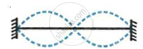
The diagram below shows three different modes of vibration P, Q and R of the same string of a given length.
 |
 |
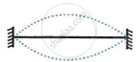 |
| P | Q | R |
- Which vibration will produce a louder sound and why?
- Which vibration will produce sound of maximum shrillness (or pitch) and why?
- What is the ratio of wavelength of vibrations P and R?
Explain why does the rear mirror of a motorbike start Vibrating Violently, at some particular speed of motorbike?
When a tuning fork, struck by a rubber pad, is held over a length of the air column in a tube, it produces a loud sound for a fixed length of the air column. Name the above phenomenon. How does the frequency of the loud sound compare with that of the tuning fork? State the unit for measuring loudness.
