Advertisements
Advertisements
प्रश्न
Differentiate between the following:
Light and sound waves.
Advertisements
उत्तर
| Light waves | Sound waves |
| 1. These are electromagnetic waves. | 1. These are mechanical waves. |
| 2. They can travel in vacuum. | 2. They re qui re a materia I medium for propagation. |
| 3. The speed of light waves is very high ( = 3 x 10⁸ m/s in air). | 3. The speed of sound waves is low ( =3 30 m/s in air). |
| 4. The wavelength of the light waves (visible) is very small, of the order of 10-6 m. | 4. The wavelength of sound waves is in the range of 10-2 m to lOm. |
| 5. These waves are transverse. | 5. These waves are lonaitud ina I waves. |
APPEARS IN
संबंधित प्रश्न
The adjacent diagram shows three different modes of vibrations P, Q and R of the same string.
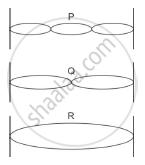
(i) Which vibration will produce a louder sound and why?
(ii) The sound of which string will have maximum shrillness?
(iii) State the ratio of wavelengths of P and R.
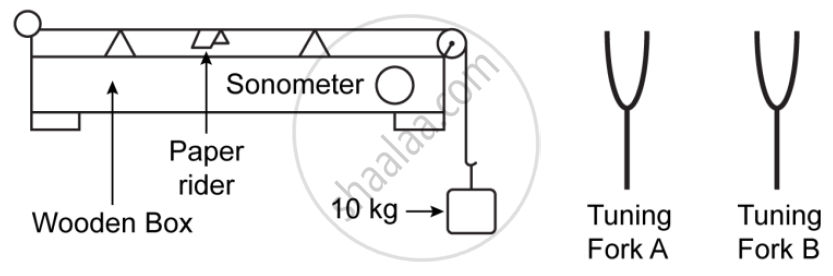
The diagram above shows a wire stretched over a sonometer. Stems of two vibrating tuning forks A and Bare touched to the wooden box of the sonometer. It is observed that the paper rider (a small piece of paper folded at the centre) present on the wire flies off when the stem of vibrating tuning fork B is touched to the wooden box but the paper just vibrates when the stem of vibrating tuning fork A is touched to the wooden box.
1) Name the phenomenon when the paper rider just vibrates.
2) Name the phenomenon when the paper rider flies off.
3) Why does the paper rider fly off when the stem of tuning fork B is touched to the box?
Give one example to illustrate forced vibrations.
Why is a loud sound heard at resonance?
Why are the stringed instruments like guitar provided with a hollow sound box?
Explain why are soldiers asked to walk out of step while crossing bridges?
Describe a simple experiment to illustrate the phenomenon of resonance and explain it.
