Advertisements
Advertisements
प्रश्न
A vibrating tuning fork is placed over the mouth of a burette filled with water. The tap is opened and the water level gradually falls. It is observed that the sound becomes the loudest for a particular length of the air column. What is the name of the phenomenon taking place when this happens? Why does the sound become the loudest?
Advertisements
उत्तर
Resonance in the air column. The frequency of vibrating tuning fork becomes equal to the frequency of vibrating air column. As a result, the amplitude of the sound produced increases. Since loudness is proportional to the square of the amplitude, so the sound is loudest.
संबंधित प्रश्न
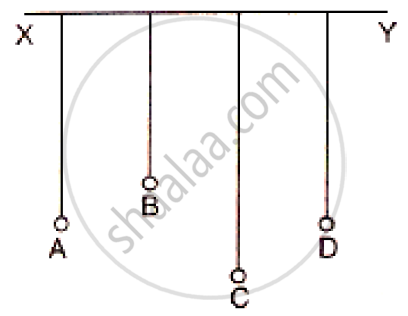
In following figure shows A, B, C and D are four pendulums suspended from the same elastic string XY. Lengths of pendulum A and D are equal, while the length of pendulum B is smaller and the pendulum C is longer. The pendulum A is set into vibration.
(a) what is your observation? (b) Give reason for your observation.
A vibrating tuning fork, held over an air column of a given length with its one end closed, produces a loud audible sound. Name the phenomenon responsible for it and explain the observation.
Name the phenomenon involved in tuning your radio set to a particular station and define it.
A tuning fork of frequency 256 Hz will resonate with another tuning fork of frequency:
Two pendulums C and D are suspended from a wire as shown in the figure give below. Pendulum C is made to oscullate by displaying it from its mean position. It is seen that D also starts oscillating.
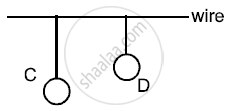
(i) Name the type of oscillation, C will execute.
(ii) Name the type of oscillation, D will execute.
(iii) If the length of D is made equal to C then what difference will you notice in the oscillations of D ?
(iv) What is the name of the phenomenon when the length of D is made equal to C ?
Differentiate between the following:
Light and sound waves.
Differentiate between the following:
Radio waves and light waves.
On keeping the stem of a vibrating tuning fork on the surface of a table, a loud sound is heard. Give reason.
When acoustic resonance takes place, a loud sound is heard. Why does this happen? Explain.
Explain why are soldiers asked to walk out of step while crossing bridges?
