Advertisements
Advertisements
प्रश्न
Advertisements
उत्तर
When the frequency of the forced vibration is equal to the natural frequency of a body nearby or an integer multiple of it then the body vibrates with a large amplitude. This phenomenon is called resonance.
E.g.1 all stringed instruments are provided with sound box (or sound chamber). This box is so constructed that the column of of air inside it, has a natural frequency which is the same as that of the strings stretched on it, so that when the strings are made to vibrate, the air column inside the box is set to forced vibrations. Since the sound box has a large area, it sets a large volume of air into vibration of the same frequency as that of the string. So, due to resonance, a loud sound is produced.
E.g.2 Radio and TV receivers have electronic circuits which produce electrical vibrations, the frequency of which can be changed by changing the values of the electrical components of that circuit. When we want to tune a radio or TV receiver, we merely adjust the values of the electronic components to produce vibrations of frequency equal to that of the incoming radio waves which we want to receive. When the two frequencies match, due to resonance, the energy or signal of that particular frequency is received from the incoming waves. The signal is then amplified in the receiver set.
APPEARS IN
संबंधित प्रश्न
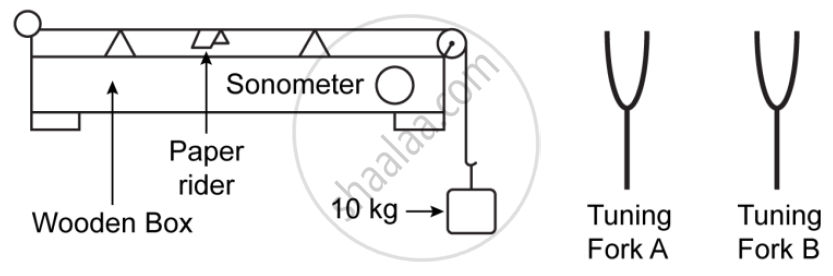
The diagram above shows a wire stretched over a sonometer. Stems of two vibrating tuning forks A and Bare touched to the wooden box of the sonometer. It is observed that the paper rider (a small piece of paper folded at the centre) present on the wire flies off when the stem of vibrating tuning fork B is touched to the wooden box but the paper just vibrates when the stem of vibrating tuning fork A is touched to the wooden box.
1) Name the phenomenon when the paper rider just vibrates.
2) Name the phenomenon when the paper rider flies off.
3) Why does the paper rider fly off when the stem of tuning fork B is touched to the box?
Resonance is a special case of ______ vibrations, when frequency of the driving force is ______ natural frequency of the body.
Differentiate between the forced and resonant vibrations.
When a body vibrates under a periodic force, the vibrations of the body are ______.
A tuning fork of frequency 256 Hz will resonate with another tuning fork of frequency:
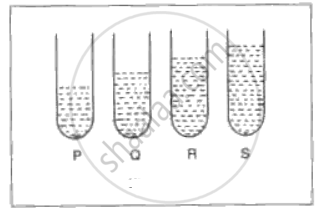
In fig. , P, Q, R and S represent test tubes each of height 20 cm which are filled with water upto heights of 10 cm, 14 cm, 16 cm and 18 cm respectively. If a vibrating tuning fork is placed over the mouth of test tube Q, a loud sound is heard.
(i) Describe the observations with the tubes P, R and S.
(ii) Give the reason for your observation in each case.
(iii) State the principle illustrated by the above experiment.
State two ways in which resonance differs from forced vibrations.
Explain a tuning fork (vibrating) is held close to ear. One hears a faint sound. The same vibrating tuning fork is placed on table, such that its handle is in contact with table, one hears a loud sound.
What do you understand by free vibrations of a body? Draw a displacement-time graph to represent them. Given one example.
