Advertisements
Advertisements
प्रश्न
Differentiate between the forced and resonant vibrations.
State two differences between forced and resonant vibrations.
Advertisements
उत्तर
| Forced Vibrations | Resonant vibrations |
| These are vibrations of a body under an external periodic force of frequency different than the body's natural frequency. | These are vibrations of a body under an external periodic force of frequency exactly equal to the natural frequency of the body. |
| The amplitude of the vibration is usually small. | The amplitude of vibration is very large. |
| The body's vibrations are not in phase with the external periodic force. | The vibrations of the body are in phase with the external periodic force. |
| These vibrations last very short after the periodic force has ceased to act. | These vibrations last long after the periodic force has ceased to act. |
Notes
Students should refer to the answer according to their questions.
APPEARS IN
संबंधित प्रश्न
When a body vibrates under a periodic force, the vibrations of the body are ______.
In Fig. A, B, C and D are four pendulums suspended from the same elastic string XY. The lengths of pendulum A and D are equal, while the length of pendulum B is shorter and of the pendulum C is longer. Pendulum A is set into vibrations.

- What is your observation about the vibrations of pendulum D?
- Give reason for your observation in part (a).
- What type of vibrations take place in pendulums Band C?
- Give reason for the answer in part (c).
On keeping the stem of a vibrating tuning fork on the surface of a table, a loud sound is heard. Give reason.
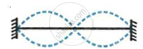
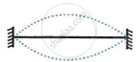
The diagram below shows three different modes of vibration P, Q and R of the same string of a given length.
 |
 |
 |
| P | Q | R |
- Which vibration will produce a louder sound and why?
- Which vibration will produce sound of maximum shrillness (or pitch) and why?
- What is the ratio of wavelength of vibrations P and R?
The rearview mirror of a motorbike starts vibrating violently at some particular speed of the motorbike. What is the name of the phenomenon taking place? Why does the happen?
When a tuning fork, struck by a rubber pad, is held over a length of the air column in a tube, it produces a loud sound for a fixed length of the air column. Name the above phenomenon. How does the frequency of the loud sound compare with that of the tuning fork? State the unit for measuring loudness.
Explain Why are stringed musical instruments provided with large sound boxes?
What do you understand by free vibrations of a body? Draw a displacement-time graph to represent them. Given one example.
