Advertisements
Advertisements
प्रश्न
Advertisements
उत्तर
When an oscillatory system is made to oscillate under the action of an externally applied periodic force, it is said to execute forced vibrations. In this case the external frequency may or may not be equal to the natural frequency of the body.
In case of resonance, the externally applied periodic force has the same frequency as the natural frequency of oscillation of the given oscillatory system.
APPEARS IN
संबंधित प्रश्न
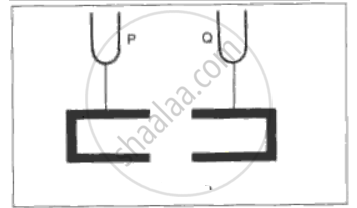
In following figure shows two tuning forks A and B of the same frequency mounted on two separate sound boxes with their open ends facing each other. The fork A is set into vibration.
- Describe your observation.
- State the principle illustrated by this experiment.

In fig. shows two tuning forks P and Q of the same frequency mounted on separate sound boxes with their open ends facing each other. The fork A is set into vibration. (i) Describe your observation. (ii) State the principle illustrated by this experiment.
Differentiate between the following:
Free and forced vibrations.
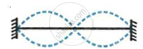
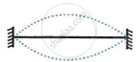
The diagram below shows three different modes of vibration P, Q and R of the same string of a given length.
 |
 |
 |
| P | Q | R |
- Which vibration will produce a louder sound and why?
- Which vibration will produce sound of maximum shrillness (or pitch) and why?
- What is the ratio of wavelength of vibrations P and R?
Explain a person walking past a railway line, in the middle of night hears a ringing sound along with the sound of his footsteps.
What do you understand by forced vibrations?
What do you understand by free vibrations of a body? Draw a displacement-time graph to represent them. Given one example.
