Advertisements
Advertisements
प्रश्न
In the diagram below, A, B, C, D are four pendulums suspended from the same elastic string PQ. The lengths of A and C are equal to each other, while the length of pendulum B is smaller than that of D. Pendulum A is set into a mode of vibrations.
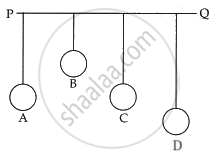
- Name the type of vibrations taking place in pendulums B and D.
- What is the state of pendulum C?
- State the reason for the type of vibrations in pendulums B and C.
Advertisements
उत्तर
1) The vibrations which occur in pendulums B and D are called forced vibrations.
2) Pendulum C is in the state of resonance with pendulum A as it is of the same length.
3) The pendulums vibrate because the forced vibration from A is transferred due to string PQ.
Pendulum B is of a different length as compared to pendulum A. Hence, it will continuously vibrate with a frequency which is different from that of pendulum A. Its amplitude will also be very small.
Pendulum C is of the same length as compared to pendulum A. Hence, it will vibrate in phase with pendulum A. Its amplitude will be equal to that of pendulum A, as it will attain resonance.
संबंधित प्रश्न
The adjacent diagram shows three different modes of vibrations P, Q and R of the same string.
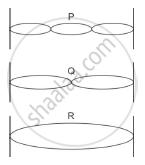
(i) Which vibration will produce a louder sound and why?
(ii) The sound of which string will have maximum shrillness?
(iii) State the ratio of wavelengths of P and R.
In following figure shows two tuning forks A and B of the same frequency mounted on two separate sound boxes with their open ends facing each other. The fork A is set into vibration.
- Describe your observation.
- State the principle illustrated by this experiment.

In following figure shows A, B , C and D represent test tube each of height 20 cm which are filled with water up to heights of 12 cm, 14 cm, 16cm and 18cm respectively. If a vibrating tuning fork is placed over the mouth if test tube D, a loud sound is heard.

- Describe the observations with the tubes A, B and C when the vibrating tuning fork is placed over the mouth of these tubes.
- Give the reason for your observation in each case.
- State the principle illustrated by the above experiment.
In fig. shows two tuning forks P and Q of the same frequency mounted on separate sound boxes with their open ends facing each other. The fork A is set into vibration. (i) Describe your observation. (ii) State the principle illustrated by this experiment.

In Fig. A, B, C and D are four pendulums suspended from the same elastic string XY. The lengths of pendulum A and D are equal, while the length of pendulum B is shorter and of the pendulum C is longer. Pendulum A is set into vibrations.

- What is your observation about the vibrations of pendulum D?
- Give reason for your observation in part (a).
- What type of vibrations take place in pendulums Band C?
- Give reason for the answer in part (c).
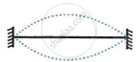
The diagram below shows three different modes of vibration P, Q and R of the same string of a given length.
 |
 |
 |
| P | Q | R |
- Which vibration will produce a louder sound and why?
- Which vibration will produce sound of maximum shrillness (or pitch) and why?
- What is the ratio of wavelength of vibrations P and R?
Explain a tuning fork (vibrating) is held close to ear. One hears a faint sound. The same vibrating tuning fork is placed on table, such that its handle is in contact with table, one hears a loud sound.
Describe a simple experiment to illustrate the phenomenon of resonance and explain it.
