Advertisements
Advertisements
प्रश्न
The adjacent diagram shows three different modes of vibrations P, Q and R of the same string.
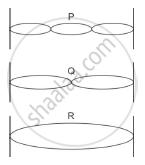
(i) Which vibration will produce a louder sound and why?
(ii) The sound of which string will have maximum shrillness?
(iii) State the ratio of wavelengths of P and R.
Advertisements
उत्तर १
(i) The loudness or softness of a sound is determined by the amplitude (or intensity) of the wave. In this case the amplitude of R is greater than the amplitude of other vibration modes. Hence, the vibration R will produce more sound than the other two. Louder sound corresponds to the wave of larger amplitude.
(ii) Shrillness or Pitch of a note depends on the wavelength or frequency of wave and here the vibration P has m ore frequency than others. If f is the principle frequency, then
Frequency (P) = 3 f
Frequency (Q) = 2 f
Frequency (R) = f
Hence P has more shrillness than others.
(iii) If the frequency of vibration of R = f, frequency of vibration of Q = 2f, and that of P =3 f.
`Ratio f_P/f_R=3/1`
`f_P:f_R=3:1`
As `fprop1/lambda` hence `lambda_P/lambda_R=1:3`
OR (Another method)
From figure we can say that 3 vibration of P corresponds to 1 vibration of R
i.e `3lambda_P=1lambdaR`
`thereforelambda_P/lambda_R=1/3=1:3`
Therefore, ratio of wavelength of P and R is 1:3.
उत्तर २
(i) Vibration R as its amplitude is high as loudness ∝ A2
(ii) Sound of string ‘P’ will have maximum shrillness as its frequency is maximum.
Pitch ∝ frequency.
(iii) λP : λR = 3 : 1
APPEARS IN
संबंधित प्रश्न
Distinguish between the free (or natural) and forced vibrations.
How do you tune your radio set to a particular station ? Name the phenomenon involved in doing so and define it.
In Fig. A, B, C and D are four pendulums suspended from the same elastic string XY. The lengths of pendulum A and D are equal, while the length of pendulum B is shorter and of the pendulum C is longer. Pendulum A is set into vibrations.

- What is your observation about the vibrations of pendulum D?
- Give reason for your observation in part (a).
- What type of vibrations take place in pendulums Band C?
- Give reason for the answer in part (c).
A bucket kept under a running tap is getting filled with water. A person sitting at a distance is able to get an idea when the bucket is about to be filled.
(i) What change takes place in the sound to give this idea?
(ii) What causes the change in the sound?
What do you mean by resonance? When does resonance occur?
State two ways in which resonance differs from forced vibrations.
Explain why are soldiers asked to walk out of step while crossing bridges?
Explain Why are stringed musical instruments provided with large sound boxes?
