Advertisements
Online Mock Tests
Chapters
1: Forces: Turning Forces and Uniform Circular Motion
2: Work, Power and Energy
3: Machines
(B) Light
4: Refraction of Light
5: Electromagnetic Waves and Spectrum
(C) Sound
▶ 6: Sound
(D) Electricity and Magnetism
Chapter 7: Electric Circuits, Resistance and Ohm's Law
Chapter 8: Electric Energy, Power and Household Circuits
Chapter 9: 1. Electromagnetism 2. Magnetic Effects of Electric Current 3. Electromagnetic Induction
(E) Heat
Chapter 10: Calorimetry
(F) Modern Physics
Chapter 11: Radioactivity

Advertisements
Solutions for Chapter 6: Sound
Below listed, you can find solutions for Chapter 6 of CISCE Goyal Brothers Prakashan for अ न्यू अप्रोच टू आईसीएसई [अंग्रेजी] कक्षा १०.
Goyal Brothers Prakashan solutions for अ न्यू अप्रोच टू आईसीएसई [अंग्रेजी] कक्षा १० 6 Sound EXERCISE-1 [Pages 122 - 124]
What is an echo?
State two practical uses of the phenomenon of echo.
How do bats avoid obstacles in their way, when in flight?
Speed of sound in air is 330 ms−1. A man standing at a distance of 165 m from a high wall, claps his hands.
- Will the man hear a distinct echo?
- Give a reason for your answer in (i).
A man standing between two cliffs fires a gun and hears an echo after every one second. The distance of the man from the nearest cliff is 170 m, calculate:
- velocity of sound,
- distance between two cliffs.
Explain, why an under water explosion recorded by sonar is about 4.5 times faster than heard through air.
A boy sets up a simple pendulum which makes four oscillations per second. The boy then stands in front of a high wall and blows a whistle. He hears an echo, after 6 oscillations of the pendulum. If the speed of sound in air is 330 ms−1, what is the distance between the boy and the wall?
What is 'SONAR'?
State the principle on which SONAR is based.
An instrument is able to detect the reflected waves from an enemy aeroplane, after a time interval of 0.02 milliseconds. If the velocity of the waves is 3 × 10⁸ ms−1, calculate the distance of the plane from the radar.
- Name the wave used for echo depth sounding.
- Give one reason why the waves mentioned in (a) is used for the above purpose.
A man standing 25 m away from a wall produces a sound and receives a reflected sound. It the speed of sound is 350 ms−1, after what time he hears sound?
MULTIPLE CHOICE QUESTIONS Choose the most appropriate option.
The practical application based on the reflection of sound is:
megaphone
sounding board
sonometer
both megaphone and sounding board
Which is not the condition for the formation of echoes?
Minimum distance between the source of sound and reflecting body should be 17 m.
The temperature of air should be above 20°C.
The wavelength of sound should be less than the height of the reflecting body.
The intensity of sound should be sufficient so that it could be heard after reflection.
For hearing an echo, the minimum distance between the source of sound and reflecting body should be:
12 m
24 m
17 m
51 m
To locate its prey in the darkness the owl or the bat emits:
infrasonic waves
ultrasonic waves
sonic waves
infrared waves
AB is a sound wave striking a high wall at an angle of 20°.
The angle between the incident ray and the reflected ray is :
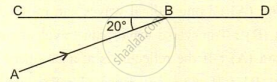
70°
90°
120°
140°
The persistance of audibility for a normal human ear is:
0.01 s
0.1 s
0.12 s
0.15 s
The repetition of sound after reflection from a distant object, after original sound from a given source dies, is called ______.
reflection of sound
resonance of sound
echo
reverberations
After the thunder of a cloud, hearing of series of echoes from different reflectors is called:
resonance
reverberations
serial echoes
none of these
Sonar uses ultrasonic vibrations because, ultrasonic vibrations ______.
carry more energy
travel with a greater speed
do not get scattered in water
all of these
If the speed of ultrasound in water is 1600 ms−1 and an impulse sent by the sonar is received by the observer in 3.6 s, then the depth of sea is:
2880 m
2860 m
2840 m
2820 m
The echoes are used in:
Sonar
Radar
Army for gun raising
all of these
Echoes are not used by:
Geologists
Ultrasonography
Radars
Homogenising milk
A person fires a gun in front of high-rise building 167 m away. If the velocity of sound is 339 ms−1, the time for hearing echo, after the firing of gun is:
1.00 s
1.05 s
0.95 s
1.10 s
A person fires a gun in front of hillock situated at a distance of S from the person and hears the echo after 1.5 s. If the speed of sound is 310 ms−1, the value of S is:
233.5 m
231.5 m
230.5 m
232.5 m
A boy explodes a cracker in front of a high-rise building 132.8 m away and hears an echo after 0.8 s. The speed of sound in air is:
336 ms−1
332 ms−1
331 ms−1
330 ms−1
An echo is heard by a radar in 0.08 s. If the velocity of radio waves is 3 × 10⁸ ms−1, the enemy plane is at a distance of:
120 km
120000 km
12000 km
1200 km
A man stands in between two high-rise buildings and explodes a cracker. He hears two successive echoes after 0.8 s and 1.6 s. The distance between two high-rise buildings is:
398.4 m
396.4 m
392.4 m
388.4 m
Direction for Q. Numbers 18 to 20: The questions given below are Assertion (A) and Reason (R) type questions. Choose the correct answer from options given below:
Assertion (A): Sound waves necessarily require a medium for their propagation.
Reason (R): The transfer of energy by the waves is through the vibrations of the medium particles about their mean positions.
Both Assertion (A) and Reason (R) are true and Reason (R) is the correct explanation of Assertion.
Both Assertion (A) and Reason (R) are true but Reason (R) is not the correct explanation of Assertion.
Assertion (A) is false, but Reason (R) is true.
Assertion (A) is true, but Reason (R) is false.
Assertion (A): Longitudinal waves can travel only in solids and on the surface of liquids.
Reason (R): Transverse waves can travel in solid, liquid as well as in gas.
Both Assertion (A) and Reason (R) are true and Reason (R) is the correct explanation of Assertion.
Both Assertion (A) and Reason (R) are true but Reason (R) is not the correct explanation of Assertion.
Assertion (A) is false, but Reason (R) is true.
Assertion (A) is true, but Reason (R) is false.
Both Assertion and Reason are false.
Assertion (A): If the reflector is at a distance less than 17 m, the reflected sound gets as an echo.
Reason (R): If there are repeated reflections at the reflected surface, the sound gets prolonged. This effect is known as reverberation.
Both Assertion (A) and Reason (R) are true and Reason (R) is the correct explanation of Assertion.
Both Assertion (A) and Reason (R) are true but Reason (R) is not the correct explanation of Assertion.
Assertion (A) is false, but Reason (R) is true.
Assertion (A) is true, but Reason (R) is false.
Complete the following by choosing correct answers from brackets.
The phenomenon of echo is based on the ______ of sound.
refraction
reflection
Radar is based on the reflection of ______ waves.
sound
electromagnetic
______ waves are used in sonar because they do not get scattered easily.
Infrasonic
Ultrasonic
Sound travels about ______ time faster in water than in air.
4.5
5.6
8.0
In ultrasonography the mechanical waves employed are ______.
infrasonic
sonic
ultrasonic
Match the statements in Column A with those in Column B.
| Column A | Column B |
|---|---|
| (a) Echo | (i) Mechanical waves which do not get scattered in water easily. |
| (b) Sonar | (ii) A branch of medical science which uses ultrasonic waves to find any damage in internal organs. |
| (c) Radar | (iii) A device based on echoes and used for finding depth of sea or lakes. |
| (d) Ultrasonic waves | (iv) A phenomenon based on the reflection of sound. |
| (e) Ultrasonography | (v) A device based on reflection of sound and used for locating enemy aircraft. |
Goyal Brothers Prakashan solutions for अ न्यू अप्रोच टू आईसीएसई [अंग्रेजी] कक्षा १० 6 Sound NUMERICAL PROBLEMS ON ECHOES [Pages 125 - 127]
A boy stands 83 m in front of a high wall and then blows a whistle. Calculate the time interval when hears an echo. Speed of sound is 332 ms−1.
Practice Problems 1:
A person fires a gun in front of a building 167 m away. If the speed of sound is 334 ms−1, calculate the time in which he hears an echo.
An echo is heard after 0.8 s, when a person fires a cracker, 132.8 m from a high building. Calculate the speed of sound.
The speed of sound is 310 ms−1. A person fires a gun. An echo is heard after 1.5 s. Calculate the distance of the person from the cliff from which the echo is heard.
The radiowaves travel at a speed of 3 × 10⁸ ms−1. If a radar can hear an echo from an enemy plane in 0.015 milliseconds, how far is the enemy plane from the radar?
An echo is heard by a radar in 0.08 s. If velocity of radio waves is 3 × 10⁸ ms−1, how far is the enemy plane?
An enemy plane is at a distance of 300 km from a radar. In how much time the radar will be able to detect the plane? Take velocity of radio waves as 3 × 10⁸ ms−1.
A man stands in between two parallel cliffs and fires a gun. He hears two successive echoes after 2 seconds and 4.5 seconds. What is the distance between the two cliffs? [Speed of sound = 332 ms−1]
Practice Problems 3:
A man stands in between two high rise buildings and blows a whistle. He hears two successive echoes after 0.4 s and 1.6 s. Calculate the distance between the buildings. [Speed of sound = 332 ms−1]
A man stands in between two parallel cliffs and explodes a cracker. He hears the first echo after 0.6 s and the second echo after 2.4 s. Calculate the distance between the cliffs. [Speed of sound is 336 ms−1]
A man stands in between two cliffs X and Y, such that he is at a distance of 66 m from X. When he blows a whistle he hears the first echo after 0.4 s and the second echo after 1.2 s. Calculate : (a) speed of sound (b) distance of cliff Y from the man.
Practice Problems 4 :
A man stands in between two cliffs, such that he is at a distance of 133.6 m from the nearer cliff. He fires a gun and hears the first echo after 0.8 s and the second echo after 1.8 s. Calculate : (a) speed of sound (b) distance between the two cliffs.
A person stands in between two parallel cliffs which are 99 m apart. He fires a gun and hears two successive echoes after 0.2 s and 0.4 s. Calculate : (a) the distance of the person from the nearer cliff (b) speed of sound.
A man stands in front of a cliff and fires a gun. He hears an echo after 4 seconds. On moving closer to the cliff by 41.25 m and again firing a gun, he hears an echo after 3.75 s. Calculate : (a) speed of sound and (b) distance of the man from the cliff to his initial position.
Practice Problems 5 :
A person standing in front of a cliff fires a gun and hears its echo after 3 s. If the speed of sound in air is 336 ms−1.
- Calculate the distance of the person from the cliff.
- After moving a certain distance from the cliff, he fires the gun again, and this time the echo is heard 1.5 s later than the first. Calculate the distance that the person moved.
A boy stands in from of a cliff on the other side of a river. He fires a gun and hears an echo after 6 seconds. The boy then moves backward by 170 m and again fires the gun. He hears an echo after 7 seconds. Calculate
(i) width of river,
(ii) speed of sound.
Goyal Brothers Prakashan solutions for अ न्यू अप्रोच टू आईसीएसई [अंग्रेजी] कक्षा १० 6 Sound EXERCISE-2 [Pages 131 - 133]
Define: Natural vibrations and support your answer by two examples.
Define: Forced vibrations and support your answer by two examples.
What is meant by resonance?
State two conditions under which resonance takes place.
Explain why does a wine glass starts rattling, when a note of some particular frequency is struck by a piano?
When a tuning fork (vibrating) is held close to ear, one hears a faint hum. The same [vibrating tuning fork] is held such that its stem is in contact with the table surface, then one hears a loud sound. Explain.
Explain Why are stringed musical instruments provided with large sound boxes?
Sometimes when a vehicle is driven at a particular speed, a rattling sound is heard. Explain briefly, why this happens and give the name of the phenomenon taking place.
Suggest one way by which the rattling sound can be stopped.
- A person is tuning radio-set to a particular station. What the person is trying to do during tuning?
- Name the phenomenon involved in tuning radio set.
- Define the phenomenon named by you in (b).
State two ways in which resonance differs from forced vibrations.
Distinguish between the free (or natural) and forced vibrations.
Distinguish between natural and damped vibrations.
The following diagram shows the displacement – time graph of the vibrating body.
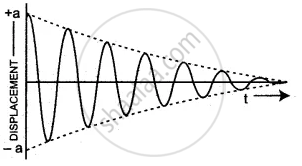
- Name the kind of vibrations
- Give one example of such vibrations.
- Why is the amplitude of vibrations gradually decreasing?
- What happens to the vibrations of the body after some time?
A bucket kept under a running tap is getting filled with water. A person sitting at a distance is able to get an idea when the bucket is about to be filled.
(i) What change takes place in the sound to give this idea?
(ii) What causes the change in the sound?
A vibrating tuning fork is placed over the mouth of a burette filled with water. The tap of the burette is opened and the water level gradually starts falling. It is found that the sound from the tuning fork becomes very loud for a particular length of the water column.
- Name the phenomenon taking place when this happens.
- Why does the sound become very loud for this length of the water column?
In the diagram below, A, B, C, D are four pendulums suspended from the same elastic string PQ. The lengths of A and C are equal to each other, while the length of pendulum B is smaller than that of D. Pendulum A is set into a mode of vibrations.
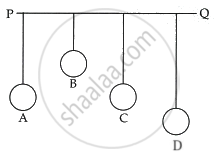
- Name the type of vibrations taking place in pendulums B and D.
- What is the state of pendulum C?
- State the reason for the type of vibrations in pendulums B and C.
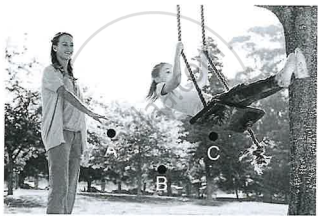
The above picture shows a mother pushing her daughter sitting on a swing. The swing is going through the positions A, B, C where A and C are extreme positions and B is the mean position.
- Which is the right position i.e. at A, B or C, for the mother to give a constant periodic push to the swing every time in the forward direction to increase the amplitude of the swing? (1)
- Name the phenomenon involved in this. (1)
- Explain with this example how this phenomenon helps to increase the amplitude of the swing. (2)
MULTIPLE CHOICE QUESTIONS Choose the most appropriate option.
A string is stretched between two nails fixed in the opposite walls and plucked from middle. The vibrations produced by the string are:
forced vibrations
free vibrations
damped vibrations
resonant vibrations
Water from a tap is allowed to fall in a vessel with a thin neck. The pitch of sound produced by falling water ______ with the volume of water in the vessel.
decreases
increases
remains same
none of these
The amplitude of forced vibrations is generally ______ than the amplitude of applied external force.
more
less
equal to
none of these
A tuning fork has a frequency of 212 Hz. It will produce resonance in a wooden board of frequency:
106 Hz
318 Hz
212 Hz
548 Hz
Which is not true for free vibrations?
The amplitude of such vibrations is a constant quantity theoretically.
There is no loss of energy theoretically.
They are produced under the action of restoring force and hence no external force is required.
There frequencies changes with respect to time.
Which are the characteristics of damped vibrations?
There amplitude gradually decreases with time.
There is a progressive loss of energy with each vibration.
The frictional forces act on them in the direction opposite to the motion of vibrations.
All of these
The vibrations which take place under the influence of an external force are called:
damped vibrations
forced vibrations
resonant vibrations
both forced and resonant vibrations
Which are characteristics of forced vibrations?
These vibrations are produced by a body in the presence of external periodic force.
There frequency is equal to the frequency of applied external force.
There amplitude is very small, if the frequency of applied force differs widely from the natural frequency of body.
All of these
The phenomenon which takes place when the natural frequency of a given body is equal to the natural frequency of a vibrating body is called:
reverberations
echo
resonance
forced vibrations
A burette is filled with water upto its neck and clamped vertically in an iron stand. The water is allowed to trickle drop by drop in a beaker and a vibrating tuning fork is held above the neck of the burette. It is observed that at some particular depth the loudness of sound of the tuning fork rises. The phenomenon which takes place is:
Forced vibrations
Free vibrations
Resonance
Reverberations
If the wavelength of a note increases, its:
loudness increases
frequency decreases
the pitch becomes less
- frequency decreases and the pitch becomes less
The loudness of a note decreases if:
its distance from observer increases
the amplitude of vibrating body decreases
the amplitude of vibrating body increases
- its distance from observer increases and the amplitude of vibrating body decreases
A wire of length 80 cm has a frequency of 256 Hz. If another wire of same material and same diameter has frequency of 1024 Hz, the length of wire is:
20 cm
24 cm
26 cm
16 cm
Direction for Q. Numbers 14 to 17: The questions given below are Assertion (A) and Reason (R) type questions. Choose the correct answer from options given below:
Assertion (A): All bodies on being disturbed start vibrating with a definite frequency, thereby producing vibrations.
Reason (R): The vibrations produced by a disturbance are called free vibrations.
Both Assertion (A) and Reason (R) are true and Reason (R) is the correct explanation of Assertion.
Both Assertion (A) and Reason (R) are true but Reason (R) is not the correction explanation of Assertion.
Assertion (A) is false, but Reason (R) is true.
Assertion (A) is true, but Reason (R) is false.
Assertion (A): The free vibrations are simple harmonic vibrations under a restoring force in which amplitude and frequency are constant.
Reason (R): The vibrations of constant amplitude and frequency can occur only in vacuum.
Both Assertion (A) and Reason (R) are true and Reason (R) is the correct explanation of Assertion.
Both Assertion (A) and Reason (R) are true but Reason (R) is not the correction explanation of Assertion.
Assertion (A) is false, but Reason (R) is true.
Assertion (A) is true, but Reason (R) is false.
Assertion (A): The amplitude of damped vibrations generally decreases with time and at the end vibration stops.
Reason (R): In each vibrations there is a progressive loss of energy.
Both Assertion (A) and Reason (R) are true and Reason (R) is the correct explanation of Assertion.
Both Assertion (A) and Reason (R) are true but Reason (R) is not the correction explanation of Assertion.
Assertion (A) is false, but Reason (R) is true.
Assertion (A) is true, but Reason (R) is false.
Assertion (A): The frequency of free vibrations depends on the shape and size of object.
Reason (R): The frequency of free vibrations is a variable quantity.
Both Assertion (A) and Reason (R) are true and Reason (R) is the correct explanation of Assertion.
Both Assertion (A) and Reason (R) are true but Reason (R) is not the correction explanation of Assertion.
Assertion (A) is false, but Reason (R) is true.
Assertion (A) is true, but Reason (R) is false.
Complete the following by choosing correct answer from brackets.
The periodic vibrations of continuously decreasing ______ in the presence of resistive force are called damped vibrations.
wavelength
frequency
amplitude
The periodic vibrations of a body of constant amplitude in the absence of any ______ force are called free vibrations.
internal
external
The vibrations which take place under the influence of an external periodic force are called ______ vibrations.
free
forced
When the needle of a gramophone player moves in the grooves of a record, it produces ______ vibrations.
free
forced
In case ______ vibrations, the amplitude of vibration is very large, compared to the amplitude of vibrations of external force.
forced
resonant
Match the statements in Column A with those in Column B.
| Column A | Column B |
|---|---|
| (a) Resonance | (i) The vibrations which take place under the influence of external force. |
| (b) Damped vibrations | (ii) Periodic vibrations of a body of constant amplitude in the absence of external force. |
| (c) Forced vibration | (iii) Number of vibrations executed per second by a vibrating body. |
| (d) Natural frequency | (iv) The phenomenon, which takes place when natural frequency of a given body is equal to frequency of vibrating body. |
| (e) Free vibrations | (v) Periodic vibrations of continuously decreasing amplitude in the presence of resistive force. |
Goyal Brothers Prakashan solutions for अ न्यू अप्रोच टू आईसीएसई [अंग्रेजी] कक्षा १० 6 Sound EXERCISE-3 [Pages 136 - 138]
Define:
Musical Sound
Define the following term:
Noise
State three characteristics of noise.
Define the term "Pitch of musical sound".
How does the pitch of a musical note depend upon frequency?
How does the pitch of a musical note depend upon wavelength?
Are ‘pitch’ and ‘frequency’ of a musical note same? If not explain.
Which of the two ‘pitch’ or frequency of a musical note is subjective and why? Explain with an example.
Define the term “Loudness of musical sound or intensity of musical sound”.
Are “loudness of sound” and intensity of sound same? If not explain.
How does intensity of musical sound depend upon amplitude of sound wave?
How does intensity of musical sound depend upon distance of observer from the source of sound?
How does intensity of musical sound depend upon density of a medium in which sound travels?
Name two factors on which loudness of sound depends.
Name the unit in which loudness of sound is measured.
Define one decibel.
What is the normal range of loudness for humans?
What do you understand by the term quality of musical sound?
Is the quality of musical sound a subjective or objective characteristic of a musical note? Explain.
Why do the different musical instruments producing note of same frequency, same amplitude have different quality?
What adjustments will you make for tuning a stringed instrument, such as violin for it to emit a desired pitch?
In what respect does the wave pattern of a noise and a music differ? Draw diagram to explain your answer.
Why are wires of different thickness and different lengths provided on the same musical instrument?
Why can a person easily recognise the horn of his own car, no matter most of the cars use the factory made horn of same quality?
List two sources of noise in on roads.
List two sources of noise in homes.
List sources of noise pollution in your surroundings.
List two sources of noise in factories.
What is meant by noise pollution?
State any two harmful effects of noise pollution on human health.
State any four measures to control noise pollution.
Two waves of the same pitch have their amplitudes in the ratio 2 : 3.
(i) What will be the ratio of their loudness?
(ii) What will be the ratio of their frequencies?
Name the subjective property of sound related to its frequency.
Name the subjective property of light related to its wavelength.
Which characteristics of sound will change if there is a change in its amplitude.
Which characteristics of sound will change if there is a change in its waveform.
Name one factor which affects the frequency of sound emitted due to vibrations in an air column.
The adjacent diagram shows three different modes of vibrations P, Q and R of the same string.
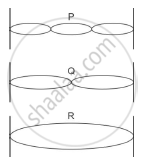
(i) Which vibration will produce a louder sound and why?
(ii) The sound of which string will have maximum shrillness?
(iii) State the ratio of wavelengths of P and R.
MULTIPLE CHOICE QUESTIONS Choose the most appropriate option.
The amplitude of a sound wave is increased from 1 mm to 2 mm. The loudness of the sound will:
increase two times
increase four times
same
decrease
By decreasing the amplitude of a pure note its:
speed decreases
wavelength decreases
quality changes
loudness decreases
Two notes are produced from a flute and piano, such that they have same loudness and same pitch. The notes so produced differ in their:
waveform
wavelength
frequency
speed
The voice of women is shrill as compared to men because of the difference in their:
speed
loudness
frequency
all of these
Two sound waves X and Y have the same amplitude and the same wave pattern but their frequencies are 60 Hz and 120 Hz respectively, then ______.
X will be shriller and Y will be grave
X will be grave and Y will be shriller
X will differ in quality than Y
X is louder than Y
Direction for Q. Numbers 6 and 7 : The questions given below are Assertion (A) and Reason (R) type questions. Choose the correct answer from options given below:
Assertion (A): Strings of different thicknesses are provided on a stringed instrument.
Reason (R): Notes of different frequencies can be obtained by producing vibrations in different strings having different thicknesses.
Both Assertion (A) and Reason (R) are true and Reason (R) is the correct explanation of Assertion.
Both Assertion (A) and Reason (R) are true but Reason (R) is not the correction explanation of Assertion.
Assertion (A) is false, but Reason (R) is true.
Assertion (A) is true, but Reason (R) is false.
Assertion (A): Frequency is a measurable quantity. It depends on the source producing the sound.
Reason (R): Pitch depends on the sensation as perceived by a listener.
Both Assertion (A) and Reason (R) are true and Reason (R) is the correct explanation of Assertion.
Both Assertion (A) and Reason (R) are true but Reason (R) is not the correction explanation of Assertion.
Assertion (A) is false, but Reason (R) is true.
Assertion (A) is true, but Reason (R) is false.
Goyal Brothers Prakashan solutions for अ न्यू अप्रोच टू आईसीएसई [अंग्रेजी] कक्षा १० 6 Sound COMPETENCY-FOCUSED PRACTICE QUESTIONS RELEASED BY CISCE [Pages 138 - 140]
Sumit, a teenager, enjoys playing his music loudly. However, his grandmother consistently lowers the volume of the music player. Analyse the wave to identify which characteristic of the wave has been altered when the grandmother reduces the volume.
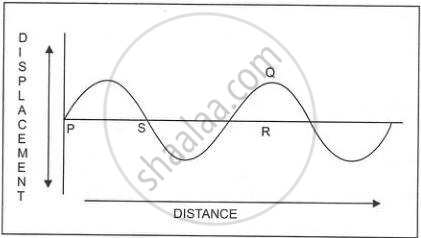
The length PS becomes more.
The length SR becomes less.
The length QR becomes less.
The length PR becomes less.
The picture shows three cylinders filled with water to a different extent. The tuning forks L, M and N in vibration produce louder sound when held above the mouth of the cylinders. Which combination is correct for hearing a louder sound of the tuning fork?
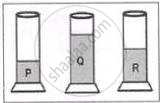
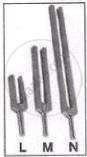
L - R, M - Q, N - P
L - P, M - Q, N - R
L - R, M - P, N - Q
L - Q, M - R, N - P
The diagram shows the magnificent dome at Gol Ghumbaz at Bijapur. A boy standing at A whispers, and it is clearly heard at B across the huge dome. [Speed of sound is 330 ms−1]
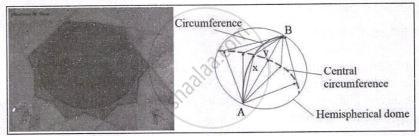
Assertion (A): The distance travelled by sound waves (x + y) should be < 33 m.
Reason (R): Sound reflected within 0.1 s is not heard by humans.
A and R are true, and R is the reason for A.
A and R are true, and R is not the reason for A.
A is true, but R is false.
A is false, but R is true.
Which of the following statement is CORRECT?
The frequency of a stretched string is:
directly proportional to its length but inversely proportional to the tension of the wire.
inversely proportional to its length but directly proportional to the tension of the wire.
directly proportional to the square root of its length but inversely proportional to the tension of the wire.
inversely proportional to its length but directly proportional to the square root of the tension of the wire.
What is the ratio of wavelengths between P, Q and R?
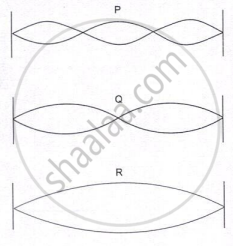
3 : 2 : 1
1 : 2 : 3
6 : 3 : 2
2 : 3 : 6
John is trying to create musical notes using water-filled bottles, as shown in the picture. Which of the bottles is likely to produce a musical note with the highest pitch? Give reasons.

When Shyam, the band leader, struck both the bass drum and the kettle drum with equal force, the bass drum emitted a sound measuring 120 dB, whereas the kettle drum produced a sound of 90 dB. Explain this discrepancy in the loudness.
Seismic waves have different frequencies. During earthquakes, why are short-length buildings more prone to damage caused by high-frequency seismic waves?
Ashish, Sameer, Aditya and Mohit were sitting on the terrace of Ashish's house listening to the songs playing on Aditya's mobile phone. Mohit, sitting in one corner, a little distance away from the others, requests to increase the volume of the songs. But Aditya says the volume is full. Sameer, being a smart guy, gets up, goes into the kitchen, brings an empty steel glass, places the mobile phone inside it and solves the problem. What is the reason for Sameer to keep the mobile phone in the glass?
Study the diagram and answer the following:
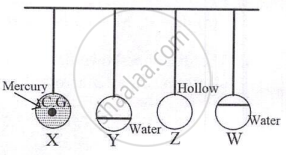
- Arrange the following pendulums according to their natural frequencies (use < > =).
- If Pendulum Z is initiated into oscillation, which pendulum among the others will exhibit the highest amplitude of vibration?
- Give reasons for your answer.
Solutions for 6: Sound
Goyal Brothers Prakashan solutions for अ न्यू अप्रोच टू आईसीएसई [अंग्रेजी] कक्षा १० chapter 6 - Sound
Shaalaa.com has the CISCE Mathematics अ न्यू अप्रोच टू आईसीएसई [अंग्रेजी] कक्षा १० CISCE solutions in a manner that help students grasp basic concepts better and faster. The detailed, step-by-step solutions will help you understand the concepts better and clarify any confusion. Goyal Brothers Prakashan solutions for Mathematics अ न्यू अप्रोच टू आईसीएसई [अंग्रेजी] कक्षा १० CISCE 6 (Sound) include all questions with answers and detailed explanations. This will clear students' doubts about questions and improve their application skills while preparing for board exams.
Further, we at Shaalaa.com provide such solutions so students can prepare for written exams. Goyal Brothers Prakashan textbook solutions can be a core help for self-study and provide excellent self-help guidance for students.
Concepts covered in अ न्यू अप्रोच टू आईसीएसई [अंग्रेजी] कक्षा १० chapter 6 Sound are Sound Waves, Forced Vibrations, Resonance (a special case of forced vibrations), Demonstration of Resonance, Examples of Resonance, Characteristics of Sound, Reflection of Sound Waves, Echo, Determination of Speed of Sound by the Method of Echo, Use of Echoes, Natural Vibrations, Damped Vibrations, Loudness and Intensity, Pitch and frequency, Quality and Wave Form, Music and Noise, Light Waves vs Sound Waves, Natural Vibrations vs Damped Vibrations, Natural Vibrations vs Forced Vibrations, Forced Vibrations vs Resonant Vibrations.
Using Goyal Brothers Prakashan अ न्यू अप्रोच टू आईसीएसई [अंग्रेजी] कक्षा १० solutions Sound exercise by students is an easy way to prepare for the exams, as they involve solutions arranged chapter-wise and also page-wise. The questions involved in Goyal Brothers Prakashan Solutions are essential questions that can be asked in the final exam. Maximum CISCE अ न्यू अप्रोच टू आईसीएसई [अंग्रेजी] कक्षा १० students prefer Goyal Brothers Prakashan Textbook Solutions to score more in exams.
Get the free view of Chapter 6, Sound अ न्यू अप्रोच टू आईसीएसई [अंग्रेजी] कक्षा १० additional questions for Mathematics अ न्यू अप्रोच टू आईसीएसई [अंग्रेजी] कक्षा १० CISCE, and you can use Shaalaa.com to keep it handy for your exam preparation.
