Advertisements
Online Mock Tests
Chapters
1: Forces: Turning Forces and Uniform Circular Motion
2: Work, Power and Energy
3: Machines
(B) Light
4: Refraction of Light
5: Electromagnetic Waves and Spectrum
(C) Sound
6: Sound
(D) Electricity and Magnetism
7: Electric Circuits, Resistance and Ohm's Law
▶ 8: Electric Energy, Power and Household Circuits
Chapter 9: 1. Electromagnetism 2. Magnetic Effects of Electric Current 3. Electromagnetic Induction
(E) Heat
Chapter 10: Calorimetry
(F) Modern Physics
Chapter 11: Radioactivity
Advertisements
Solutions for Chapter 8: Electric Energy, Power and Household Circuits
Below listed, you can find solutions for Chapter 8 of CISCE Goyal Brothers Prakashan for अ न्यू अप्रोच टू आईसीएसई [अंग्रेजी] कक्षा १०.
Goyal Brothers Prakashan solutions for अ न्यू अप्रोच टू आईसीएसई [अंग्रेजी] कक्षा १० 8 Electric Energy, Power and Household Circuits EXERCISE-1 [Pages 177 - 179]
Define the term electric work.
State and define the SI unit of electric work.
Name three bigger units of electric work and state their magnitude.
- State two practical units of electric energy.
- Define each unit mentioned in (i).
500,000 J of energy is consumed in 500 s. What is the power consumed?
Express 20 Wh of energy in S.I. units.
Express kilowatt-hour in joules.
A current of 0.5 A flows through the filament of a bulb with a resistance of 500 Ω for 100 s.
- What is the power of bulb?
- What is magnitude of energy consumed by bulb in watt hours?
400,000 joules of energy is consumed by an electric heater in 400 s.
- What is power of heater?
- If the above energy is supplied at 200 V, what is the magnitude of current flowing through heater?
- What is the resistance of the element of the heater?
Express watt-hour in joules.
Express kilowatt-hour in joules.
Which of the two units (watt-hour or kilowatt-hour) is used for selling electrical energy to domestic consumers?
Calculate the current flowing through an electric bulb, which consumes 2 kWh of electric energy in 5 hours, such that the resistance of the bulb is 400 Ω.
How do kilowatt and kilowatt-hour differ?
A power house generates 200 MW of power. If the generating e.m.f. 40,000 V, what is the magnitude of current produced?
A nichrome wire X with length (l) and cross-sectional area (A) is connected to a 10 V source and another nichrome wire Y with length (2l) and cross-sectional area `(A/2)`, is connected to a 20 V source.
(a) Compare the resistances of wires X and Y. [Given that the resistivity of nichrome is (ρ).]
(b) Compare the electrical power consumed by each wire.
(c) Compare the masses of these wires. (Given that the density of nichrome is d.)
(d) State true or false:
Wire X and wire Y both show the same rise in temperature in the same time.
A electrical appliance is rated 2000 W − 200 V. This appliance is connected to 200 V mains. Calculate:
- Current drawn by the appliance.
- Resistance offered by the appliance.
- Electric energy consumed by the appliance in 10 hours.
- Cost of the electric energy consumed at ₹ 7.50 per kWh.
MULTIPLE CHOICE QUESTIONS Choose the most appropriate option.
A bulb has a resistance of 20 Ω and the p.d. across its terminals is V. If the bulb is used for t seconds, then the energy consumed by the bulb is:
$$\frac{V}{20} \times t$$
$$\frac{V^2}{20} \times t$$
$$V \times t \times 20$$
$$\frac{V \times t^2}{20}$$
A current I flows through a resistance R for the time 't', the electric energy consumed by the resistance is:
$$\mathrm{I} \times \mathrm{R} \times t$$
$$\mathrm{I} \times \mathrm{R}^{2} \times t$$
$$\mathrm{I}^{2} \times \mathrm{R} \times t$$
$$\frac{I^2 \times R}{t}$$
The unit for electric work in SI system is:
joule
watt
watt second
watt hour
An electric appliance has a rating of 1000 W–200 V. The resistance of the element of the electric appliance is:
200 Ω
400 Ω
40 Ω
4000 Ω
Kilowatt hour is commercial unit of ______.
power
electric energy
heat energy
mechanical energy
Kilowatt hour and kilowatt are ______.
SI units of power and electric energy
commercial units of power and electric energy
SI units of electric energy and power
commercial units of electric energy and power
Which is not the commercial unit of power, based on the decimal system?
kilowatt
mega-watt
giga-watt
horse power
One mega watt is equal to ______.
10,000 Js−1
100,000 Js−1
1000,000 Js−1
100,000,000 Js−1
If P is the power of an electric circuit such that R is its resistance, I is the current flowing through it and V is potential difference at the ends of electric circuit then:
P = I × V
P = I2R
$$P = \frac{V^2}{R}$$
all of these
One kilowatt hour is equal to ______.
1000 J
10,000 J
3.6 × 10³ J
3.6 × 10⁶ J
Electric energy in kilowatt-hours (kWh) is equal to:
$$\frac{\text{Power (in W)} \times 1000}{\text{time (in h)}}$$
$$\frac{\text{Power (in W)} \times \text{time (in h)}}{100}$$
$$\frac{\text{Power (in W)} \times \text{time (in h)}}{1000}$$
$$\frac{\text{Power (in W)} \times \text{time (in h)}}{1000,000}$$
A heater draws a current of 5A at 220 V for 2 minutes. The energy released by heater in kilojoules is:
132 kJ
66 kJ
99 kJ
33 kJ
An electric bulb consumes 8640 J of energy while operating at 24 V for 30 min. The current drawn by the bulb is:
0.4 A
0.3 A
0.2 A
0.5 A
An electric kettle draws a current of 4 A for 5 min. If the resistance of its element is 100 Ω, the energy drawn by kettle in kilo joules is:
240 kJ
360 kJ
720 kJ
480 kJ
A soldering rod draws an energy of 86400 J in 8 min when the current flowing through its element is 6 A. The resistance of the heating element of the soldering rod is:
5 Ω
5.5 Ω
4.5 Ω
6 Ω
An electric bulb whose filament is of resistance 4 Ω operates at 12 V for 20 s. The energy released by the bulb is:
700 J
720 J
680 J
740 J
An electric device consumes 5760 J of energy in 1.0 minute when the p.d. at its ends is 24 V. The electrical resistance of the device is:
4.5 Ω
5 Ω
6 Ω
5.5 Ω
An electric heater draws a current of 5 A when the supply voltage is 200 V. The power of 5 such heaters will be:
5000 W
4500 W
4000 W
none of these
An electric bulb is rated 500 W-250 V. The magnitude of the current of such a bulb is:
2.2 A
2 A
2.4 A
none of these
An electric geyser is rated 2000 W – 200 V and operates 2.0 hours daily. If the energy cost ₹ 7.50 per kWh, the weekly bill of the geyser is:
₹ 210.00
₹ 200.50
₹ 198.50
₹ 220.00
Direction for Q. Numbers 21 to 25: The questions given below are Assertion (A) and Reason (R) type questions. Choose the correct answer from options given below:
Assertion (A): An electric bulb is rated as 100 W–220 V.
Reason (R): If the bulb is lighted on a 220 V supply, the electric power consumed by it is 100 W (100 J/s).
Both Assertion (A) and Reason (R) are true and Reason (R) is the correct explanation of Assertion (A).
Both Assertion (A) and Reason (R) are true but Reason (R) is not the correct explanation of Assertion (A).
Assertion (A) is false, but Reason (R) is true.
Assertion (A) is true, but Reason (R) is false.
Assertion (A): One watt is the electric power consumed when a current of 1A flows through a circuit having potential difference of 1 V.
Reason (R): One watt-hour (Wh) is the electrical energy consumed by an electrical appliance of power 1 W used for 1 h.
Both Assertion (A) and Reason (R) are true and Reason (R) is the correct explanation of Assertion (A).
Both Assertion (A) and Reason (R) are true but Reason (R) is not the correct explanation of Assertion (A).
Assertion (A) is false, but Reason (R) is true.
Assertion (A) is true, but Reason (R) is false.
Assertion (A): The power generated at the generating station is directly transmitted to the consumers at 11 kV.
Reason (R): Before transmission of power from the generating station, its voltage is raised to reduce the loss of energy in the form of heat in the transmission line wires.
Both Assertion (A) and Reason (R) are true and Reason (R) is the correct explanation of Assertion (A).
Both Assertion (A) and Reason (R) are true but Reason (R) is not the correct explanation of Assertion (A).
Assertion (A) is false, but Reason (R) is true.
Assertion (A) is true, but Reason (R) is false.
Assertion (A): Kilowatt hour is the commercial unit of electric energy.
Reason (R): When 1000 W of power is used it is called one kilowatt.
Both Assertion (A) and Reason (R) are true and Reason (R) is the correct explanation of Assertion (A).
Both Assertion (A) and Reason (R) are true but Reason (R) is not the correct explanation of Assertion (A).
Assertion (A) is false, but Reason (R) is true.
Assertion (A) is true, but Reason (R) is false.
Assertion (A): Higher the resistance of a filament lamp, less is the energy consumed by it.
Reason (R): Higher resistance of filament reduces the magnitude of current in an electric circuit.
Both Assertion (A) and Reason (R) are true and Reason (R) is the correct explanation of Assertion (A).
Both Assertion (A) and Reason (R) are true but Reason (R) is not the correct explanation of Assertion (A).
Assertion (A) is false, but Reason (R) is true.
Assertion (A) is true, but Reason (R) is false.
The amount of electric energy, which flows through a conductor in one ______ at a power of one watt is called one watt hour.
second
hour
One kilowatt hour is equal to ______.
3.6 kJ
3.6 MJ
The electric energy is sold for domestic purposes in ______.
kWh
MWh
At fixed potential difference the electric energy flowing in a conductor is directly proportional to square of ______.
resistance of conductor
current flowing in conductor
The product of electric charge flowing through a conductor and the potential differences at the ends of the conductor gives the magnitude of ______ flowing through conductor.
electric power
electric energy
Match the statements in Column A with those in Column B.
| Column A | Column B |
|---|---|
| (a) One watt | (i) The amount of electric work done when a charge of one coulomb flows through conductor at a p.d. of 1 volt. |
| (b) Kilowatt | (ii) Commercial unit at which electric energy is sold. |
| (c) Electrical power | (iii) When one joule of electric work is done in one second. |
| (d) 1 joule | (iv) Product of square of current and resistance of an electric circuit. |
| (e) Kilowatt hour | (v) A bigger unit of electric power. |
Goyal Brothers Prakashan solutions for अ न्यू अप्रोच टू आईसीएसई [अंग्रेजी] कक्षा १० 8 Electric Energy, Power and Household Circuits NUMERICAL PROBLEMS ON ELECTRIC ENERGY [Pages 179 - 186]
A torch bulb of 4.5 V, draws a current of 0.3 A. If the bulb is switched on for 10 minutes, calculate the energy released by the bulb.
Practice Problems 1:
Calculate the energy released by a heater, which draws a current of 5 A at 220 V for 1 min.
An electric device consumes 8640 J of energy in 30 min, while operating at 24 V. Calculate the current drawn by the device.
An electric heater draws a current of 4 A and its element has a resistance of 40 Ω. If the heater is switched on for 8 minutes, calculate the energy released in kilojoules.
Practice Problems 2:
An electric kettle draws a current of 4 A for 2.5 min. If the resistance of its element is 100 Ω, calculate the electric energy drawn by the kettle in kilojoules.
A soldering iron draws an energy of 43200 J in 4 min, when the current flowing through its element is 6 A, calculate the resistance of its heating element.
An electric room heater has a resistance of 40 Ω and operates at 220 V for 10 min. Calculate the heat energy dissipated by it in kilojoule.
Practice Problems 3:
Calculate the heat energy given out by the filament of an electric bulb in 20 s, when its resistance is 4 Ω and the p.d. across its ends is 12 V.
An electric device gives out 5760 J of heat energy in 1 min, when current flows through it at a p.d. of 24 V. Find the resistance of the device.
Calculate the total power of 8 fans, if each of them draws a current of 0.5 A at a p.d. of 200 V.
Practice Problems 4:
An electric heater draws a current of 3.5 A at a p.d. of 250 V. Calculate the power of 4 such heaters.
An electric bulb is rated 500 W – 200 V. Calculate the magnitude of the current.
An electric heater of power 1000 W, draws a current of 5.0 A. Calculate the line voltage.
An electric bulb of resistance 500 Ω draws current 0.4 A from the source. Calculate:
- the power of bulb and
- the potential difference at its end.
Practice Problems 5:
An electric heater has a resistance of 40 Ω and draws a current of 4 A. Calculate : (a) its power (b) p.d. at its ends.
An electric heater with a power of 900 W has a resistance of 36 Ω. Calculate the magnitude of the current and the p.d. at its ends.
An electric heater is rated 750 W – 200 V. Calculate (a) resistance of the heating element (b) current flowing through it.
Practice Problems 6:
An electric motor of power 1000 W, operates at 250 V. Calculate the inductive resistance of the motor and current flowing through it.
An electric device operates at 24 V and has a resistance of 8 Ω. Calculate the power of the device and the current flowing through it.
An electric heater is rated 750 W – 200 V. Calculate (a) current flowing through it, (b) resistance of its element. (c) If the heater is used to heat 400 g of water at 20°C and switched on for 5 minutes, calculate the final temperature of the water. [sp. heat capacity of water is \[4.2\frac{\text{J}}{\text{g}^\circ\text{C}}\]].
Practice Problems 7:
An electric bulb is rated 200 W – 200 V. It is immersed in 200 g of oil (SHC 0.8 Jg−1°C−1) at 10°C. The bulb is switched on for 2 minutes. If all the electric energy is absorbed in the form of heat energy by the oil, calculate:
- Current flowing through the bulb.
- Resistance of the filament of the bulb.
- Final temperature of the oil.
An electric kettle is rated 1000 W – 250 V. It is used to bring water at 20°C to its boiling point. If the kettle is used for 11 minutes and 12 seconds, calculate :
- Current flowing through the element.
- Resistance of the element of the kettle.
- Mass of water in the kettle [SHC of water = 4.2 Jg−1°C−1]
Calculate the current flowing through a nichrome wire, immersed in 100 g of oil at 20°C, such that the final temperature of the oil rises to 80°C in five minutes, when the supply of e.m.f. is 10 V. [Sp. heat capacity of oil is 0.85 Jg−1°C−1]
Practice Problems 8:
Calculate the resistance of a nichrome wire, which will bring 200 g of water at 20°C to its boiling point in 7 minutes, when the current flowing through the wire is 4 A.
Calculate p.d. at the ends of a power source which, supplies current to a 4 ohm resistance wire for 20 minutes and raises the temperature of 400 g of water through 20°С.
Calculate the current flowing through an electric drill, connected to a 200 V supply, if it drills a hole in a metal plate of mass 500 g, such that its temperature rises from 10°C to 60°C in 5 minutes, assuming all the work done is converted into heat energy. [S.H.C. of metal 0.6 Jg−1°C−1]
A battery of 24 V and negligible internal resistance is connected to two resistors of 12 Ω and 6 Ω in parallel and then to a nichrome wire of resistance 2 Ω, immersed in 100 g of oil (sp. heat capacity 1.2 Jg−1°C−1) at 30°C. The current is switched on for 2 minutes.
- Draw the circuit diagram of the arrangement.
- Calculate the current flowing through the main circuit.
- Current flowing through the 6 Ω resistor.
- Final temperature of the oil.
Practice Problems 9:
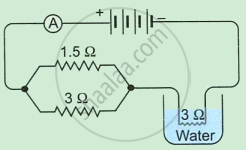
The circuit diagram shows four dry cells with an e.m.f. 1.5 V and internal resistance 0.25 Ω connected to an external circuit. A 3 Ω wire is immersed in 20 g of water at 20°C. The current switched on for 6 minutes and 36 seconds. Calculate:
- Reading shown by the ammeter
- Current in the 1.5 Ω wire
- Final temperature of water
A battery of 12 V and negligible internal resistance is connected to an external circuit consisting of three resistors of 6 Ω, 3 Ω and 2 Ω in parallel, which further connected to a resistance of 3 Ω in series to the battery. The 3 Ω resistance is immersed in 50 g oil of sp. heat capacity 0.8 Jg−1°C−1, when the temperature of the oil rises by 54°C.
- Draw the labelled circuit diagram.
- Calculate the value of the current in the main circuit.
- Calculate the current flowing in 2 resistance in parallel.
- Calculate the time for which the current is switched on.
An electric kettle is rated at 200 V and can bring a certain amount of water to its boiling point in 5 minutes. If it is connected to a voltage supply of 180 V, calculate the time in which the same amount of water will reach its boiling point.
Practice Problems 10:
An electric kettle rated 250 V can bring a certain amount of water to its boiling point in 8 min. If it is connected to a 200 V mains, calculate the time in which the water comes to its boiling point.
An immersion heating rod is rated at 220 V and can bring a certain amount of water to its boiling point in 15 min. When this immersion rod is actually connected to an electric circuit, it brings the water to a boil in 18.15 min. Calculate the line voltage.
An electric bulb is marked 100 W – 200 V, what information does it convey? How many joules of energy are consumed by this bulb in two hours? How long will it take for the bulb to consume two kilowatt-hours?
Practice Problems 11:
An electric oven is marked 1000 W – 200 V. Calculate:
- The resistance of its element.
- Energy consumed by the oven in `1/2` hour in joules.
- Time, in which it will consume 15 kWh of energy.
An electric motor is rated at 2 HP – 250 V. Calculate:
- Current flowing through it.
- Energy consumed by it in one second.
- Time in which it will consume 90 kWh of energy.
[1 HP = 750 W]
Calculate the monthly bill for a heater of resistance 50 Ω, which is used on 200 V mains, such that its daily use is for 4 h. The energy cost is ₹ 2.50 per kWh.
Practice Problems 12:
A geyser is rated 2000 W and operates 2 hours a day on 200 V mains. Calculate the monthly bill for running the geyser when energy costs ₹ 1.90 per kWh.
An electric oven with a resistance of 20 Ω draws a current of 10 A. It works 3 hours daily. Calculate the weekly bill when energy costs ₹ 1.50 per kWh. [Hint (P = I2.R)]
An electric bulb draws a current of 0.8 A and works on 250 V on an average 8 hours a day. If energy costs ₹ 1.50 per board of trade unit, calculate the monthly bill.
Two bulbs of 60 W each and two coolers of 200 W each work on average for 4 hours a day. If the energy costs ₹ 3.50 per kWh, calculate the monthly bill and the minimum fuse rating when power is supplied at 200 V.
Practice Problems 13:
4 tube lights of 40 W each and 2 fans of 100 W each are connected to 200 V mains and operate on average for 8 hours a day. If energy costs ₹ 1.50 per kWh, calculate (a) monthly bill (b) minimum fuse rating.
An electric motor of 2 H.P. and two coolers of 500 W each operate on 250 V mains for 4 hours a day. If the energy costs ₹ 1.80 per kWh, calculate (a) weekly bill (b) minimum fuse rating. [Take 1 HP = 750 W]
An electric circuit operating at 250 V has following appliances connected in parallel and the energy cost ₹ 5.40 per kVAh.
- 4 bulbs of 100 W each, working 8 hours a day.
- Two room heaters of resistance 50 Ω each, working 2 hours a day.
- Two air conditioners drawing a current of 8A, working 6 hours a day.
- Three coolers of `1/3` H.P each, working 10 hours a day.
- Calculate the monthly bill
- Calculate the minimum fuse rating.
Practice Problems 14:
A boys hostel has following appliances when energy is supplied at 200 V and costs ₹ 5.25 per kWh.
- 40 bulbs of 100 W each, working 8 hours a day.
- 20 fans each drawing a current 0.8 A and working 15 hours a day.
- Two T.V. sets, each offering a resistance of 200 Ω and working 4 hours a day.
- Two electric motors of 1.5 H.P each and working 4 hours a day
- Calculate the monthly bill
- Amongst the fuse of 48 A and 50 A which one you will use and why?
An establishment receives electric energy at a rate of ₹ 4.50 per kWh at a p.d of 240 V. It uses the following appliances:
- 20 tube lights of 40 W each working 10 h a day.
- Two stereo systems, each drawing a current of 2A and working 4h a day.
- Four ovens, each of resistance 24 Ω working 6 h a day.
- Two cooling machines of 4 H.P each working 15 hours a day.
- Calculate the monthly bill
- Minimum fuse rating of the circuit
Goyal Brothers Prakashan solutions for अ न्यू अप्रोच टू आईसीएसई [अंग्रेजी] कक्षा १० 8 Electric Energy, Power and Household Circuits EXERCISE-2 [Pages 193 - 196]
A bulb is rated 100 W – 250 V.
- What information does the marking on the bulb convey?
- What is the magnitude of the current drawn by the bulb when connected to 250 V mains?
- What is the magnitude of the resistance of the bulb?
- It is found that the actual resistance of the bulb is far more than the calculated value in (c). Give a reason.
- If on the average bulb is used for 4 hours a day find the electric energy consumed by the bulb in 30 days in kWh.
Name the device used to increase the voltage at a generating station.
At what frequency is AC supplied to residential houses?
Name the wire in a household electrical circuit to which the switch is connected.
Calculate the quantity of heat produced in a 40 Ω resistor carrying a current of 5A in 5 minutes.
State the characteristics required in a material to be used as an effective fuse wire.
Which particles are responsible for the transmission of current in metallic conductors?
To which wire of a cable in a power circuit should the metal case of the geyser be connected?
To which wire should the fuse be connected?
- Two sets A and B of two bulbs each glowing in two separate rooms. When one of the bulb of set A is fused, the other bulb cease to glow. But in the set B, when one bulb fuses, the other continues to glow. Explain, why does the phenomenon occur?
- Why do we prefer arrangement in set B for house wiring?
Water in an electric kettle connected to a 220 V supply took 5 minutes to reach its boiling point. How long will it take if the supply voltage falls to 200 V?
A 100 W bulb and 60 W bulb are connected in parallel. The bulbs are switched on for 10 minutes. Calculate the energy consumed by the bulbs in S.I. units.
How does earthing offer protection?
Draw a diagram of ring main circuit for domestic distribution of electric power.
The image given below displays kilowatt-hour meter readings recorded at two distinct points in time.

Assuming a continuously running 2000 W air conditioner as the sole electrical device in use, calculate the time interval, in hours, between these two meter readings.
Explain briefly the function of the following in the household wiring a three pin plug.
Explain briefly the function of the following in the household wiring main switch.
A bulb is marked 100 W – 200 V and an electric heater is marked 1000 W – 200 V. Answer the following questions.
- What is the ratio of resistance of filament of the bulb and the element of heater?
- How does the power voltage rating of an electric appliance help us to decide the type of connecting wire (leads) to be used for it?
- In the above mentioned devices in (b) which of the devices needs thicker wire?
An electric bulb is rated 240V-60W and is working at 100% efficiency.
(i) Calculate the resistance of bulb.
(ii) (a) Draw the circuit diagram.
(b) What is the rate of conversion of energy in each bulb?
(c) Total power used by the bulbs.
Draw two wiring diagrams of the dual control switch, both diagrams showing the combination turned ON.
Of the three connecting wires in a household circuit: Which two of the three wires are at the same potential? In which of the three wires should the switch be connected?
An electric heater of power 1 kW raises the temperature of 500 g of a given liquid from 25°C to 31°C in 2 minutes. Calculate:
- Heat capacity of the liquid.
- Specific heat capacity of the liquid.
Give two characteristic properties of a copper wire which make it unsuitable for use as a fuse wire.
In what unit does the electric meter in a house measure the electrical energy consumed? What is its value in S.I unit?
Why should switches always be connected to the live wire? Give one precaution that should be taken while handling switches.
Name the material of a fuse wire.
The diagrams (a) and (b) given alongside are plug and socket with arrows marked 1, 2, 3 and 4, 5, 6 respectively. Identify and write live (L), neutral (N) and earth (E) against the correct number on your answer sheet.
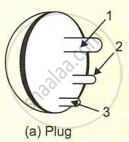
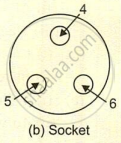
Name two safety devices that are connected to the live wire of a household electrical circuit and give one important function of each of these two devices.
An appliance with a metal covering, rated at 2 kW, 220 V, is to be connected in a circuit. Given below are four diagrams (P, Q, R and S) depicting different circuit configurations.

- Identify the safest circuit.
- Write two reasons, supported by mathematical calculations, where applicable, to justify your choice.
State the colour of household wires according to the new international standard.
Live wire
State the colour of household wires according to the new international standard.
Earth wire
State the colour of household wires according to the new international standard.
Neutral wire
Why does an electrical engineer recommend copper wires of various thicknesses for different rooms in a household circuit?
Why does the heating element of a heater become red hot, but the connecting wires remain cold?
MULTIPLE CHOICE QUESTIONS Choose the most appropriate option.
A fuse wire is connected in ______ before the switch.
neutral wire
earth wire
live wire
either neutral wire or live wire
A switch in a circuit is always connected in the ______.
live wire
earth wire
neutral wire
either live wire or earth wire
According to the old convention, the colour of the earth wire is ______.
Black
Green
Yellow
Red
According to new convention, the colour of live wire is ______.
light blue
yellow
green
brown
Which is not a characteristic of a fuse wire?
It has high resistance.
It has low melting point.
It has low resistance.
It is an alloy of lead and tin.
In a three pin plug the live pin is ______.
thinner and is towards left
thicker and is towards left
thinner and is towards right
thicker and is towards right
In a household electric circuit all appliances are connected in ______.
parallel circuit
series circuit
mixed circuit
any of these
An average lighting circuit of a poor family has a fuse rating of:
10 A
15 A
5 A
2 A
The household appliances are connected in parallel because:
Each appliances can be operated by an independent switch.
The overall resistance of all the appliances is very small and hence the magnitude of current increases in parallel circuit and each appliances gets optimum current.
All appliances work on the same voltage.
All of these
The household appliances which frequently come in contact with human hands are earthed because:
In case of short circuit the current from the metallic body of the appliances directly flows into earth, thus saving the user from electric shock.
Due to surge in current the fuse wire melts.
The melting of fuse wire prevents current flowing into circuit and hence user is protected from electric shock.
All of these
Which is not used for the heating element of a heating appliance?
Constantan wire
Tungsten wire
Eureka wire
Manganin wire
Which is not the choice of heating element of an electric appliance?
It should have appreciable resistivity.
It should not get oxidised till 1000°C.
It should have a large thermal expansion.
It should have a high melting point.
Which is not a property of the lighting element of an electric appliance?
It should have a very high melting point.
It should have a very low specific heat capacity.
It should be highly ductile.
It should have high resistivity.
Which is not a heating appliance?
Electric toaster
Arc-lamp
Electric oven
Immersion heater
Which is not a lighting appliances?
LED tubelights
Fluorescent tubes
Vacuum pump
Electric bulb
A switch is placed in:
neutral wire before the appliance
live wire after the appliance
live wire before appliance
earth wire before appliance.
A fuse is placed in:
neutral wire after the switch
live wire after a switch
live wire before a switch
neutral wire before the switch
Direction for Q. Numbers 18 to 22: The questions given below are Assertion (A) and Reason (R) type questions. Choose the correct answer from options given below:
Assertion (A): A fuse wire is the weakest point in the distribution of electric energy in a household circuit.
Reason (R): Fuse melts when an electric circuit is overloaded or short circuited.
Both Assertion (A) and Reason (R) are true and Reason (R) is the correct explanation of Assertion (A).
Both Assertion (A) and Reason (R) are true but Reason (R) is not the correct explanation of Assertion (A).
Assertion (A) is false, but Reason (R) is true.
Assertion (A) is true, but Reason (R) is false.
Assertion (A): In a domestic circuit a fuse is placed ahead of switch in the live wire.
Reason (R): The arrangement cuts off the current in case the circuit is overloaded.
Both Assertion (A) and Reason (R) are true and Reason (R) is the correct explanation of Assertion (A).
Both Assertion (A) and Reason (R) are true but Reason (R) is not the correct explanation of Assertion (A).
Assertion (A) is false, but Reason (R) is true.
Assertion (A) is true, but Reason (R) is false.
Assertion (A): When a room heater is switched on, its heating element gets red hot, but the connecting wires do not heat up.
Reason (R): Connecting wires are of more resistance than heating element.
Both Assertion (A) and Reason (R) are true and Reason (R) is the correct explanation of Assertion (A).
Both Assertion (A) and Reason (R) are true but Reason (R) is not the correct explanation of Assertion (A).
Assertion (A) is false, but Reason (R) is true.
Assertion (A) is true, but Reason (R) is false.
Assertion (A): In a household circuit all appliances are connected in parallel.
Reason (R): Equivalent resistance in parallel is always less than individual resistances.
Both Assertion (A) and Reason (R) are true and Reason (R) is the correct explanation of Assertion (A).
Both Assertion (A) and Reason (R) are true but Reason (R) is not the correct explanation of Assertion (A).
Assertion (A) is false, but Reason (R) is true.
Assertion (A) is true, but Reason (R) is false.
Assertion (A): The heating element of an electric oven is made of nichrome wire, but the filament of bulb is made of tungsten.
Reason (R): Tungsten expands less as compared to nichrome on plug heated.
Both Assertion (A) and Reason (R) are true and Reason (R) is the correct explanation of Assertion (A).
Both Assertion (A) and Reason (R) are true but Reason (R) is not the correct explanation of Assertion (A).
Assertion (A) is false, but Reason (R) is true.
Assertion (A) is true, but Reason (R) is false.
Complete the following sentences by choosing correct answers from brackets.
A fuse wire is connected in ______ before the switch.
live wire
neutral wire
earth wire
In an electric plug the live pin on the ______ side.
left
right
A fuse in an electric circuit has ______ melting point and high resistance.
high
low
The earth wire protects the user from electric shock, because the ______ melts instantly and breaks the circuit.
live wire
neutral wire
fuse wire
The heating element of an electric oven is made of nichrome or ______ as they do not expand appreciably when hot.
manganin
tungsten
Match the statements in Column A with those in Column B.
| Column A | Column B |
|---|---|
| (a) Tungsten | (i) An alloy commonly used for making heating elements of electric ovens, geysers, etc. |
| (b) Electric fuse | (ii) Name of system commonly employed for the distribution of electricity in household circuit. |
| (c) Ring system | (iii) Two wires in distribution of electric energy which are at the same potential. |
| (d) Nichrome | (iv) A weakest device in household distribution of electric energy which melts when circuit is overloaded. |
| (e) Neutral and earth wires | (v) A very thin wire of metal used as filament of electric bulbs. |
Goyal Brothers Prakashan solutions for अ न्यू अप्रोच टू आईसीएसई [अंग्रेजी] कक्षा १० 8 Electric Energy, Power and Household Circuits COMPETENCY-FOCUSED PRACTICE QUESTIONS RELEASED BY CISCE [Pages 196 - 197]
Assertion: A switch will serve the purpose of making and breaking a circuit when it is connected to the neutral wire.
Reason: Neutral wire is at zero potential.
Both Assertion and Reason are true, and the Reason is the correct explanation of the Assertion.
Both Assertion and Reason are true, but Reason is not the correct explanation of the Assertion.
Assertion is true, but the Reason is false.
Both Assertion and Reason are false.
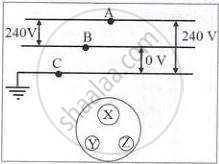
Redraw the diagram by linking points A, B, and C to points X, Y, and Z on the socket.
The diagram below shows a bulb connected by dual control switches. Observe the diagrams and answer the questions that follow.
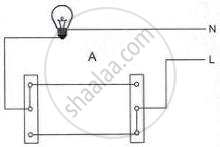
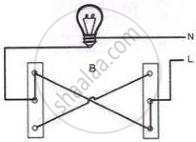
- Which of the above circuits will be able to switch ON or switch OFF the bulb using both switches?
- At present, in which circuit is the bulb glowing?
- If we interchange the L and N wires in circuit B, will the circuit work?
Solutions for 8: Electric Energy, Power and Household Circuits
Goyal Brothers Prakashan solutions for अ न्यू अप्रोच टू आईसीएसई [अंग्रेजी] कक्षा १० chapter 8 - Electric Energy, Power and Household Circuits
Shaalaa.com has the CISCE Mathematics अ न्यू अप्रोच टू आईसीएसई [अंग्रेजी] कक्षा १० CISCE solutions in a manner that help students grasp basic concepts better and faster. The detailed, step-by-step solutions will help you understand the concepts better and clarify any confusion. Goyal Brothers Prakashan solutions for Mathematics अ न्यू अप्रोच टू आईसीएसई [अंग्रेजी] कक्षा १० CISCE 8 (Electric Energy, Power and Household Circuits) include all questions with answers and detailed explanations. This will clear students' doubts about questions and improve their application skills while preparing for board exams.
Further, we at Shaalaa.com provide such solutions so students can prepare for written exams. Goyal Brothers Prakashan textbook solutions can be a core help for self-study and provide excellent self-help guidance for students.
Concepts covered in अ न्यू अप्रोच टू आईसीएसई [अंग्रेजी] कक्षा १० chapter 8 Electric Energy, Power and Household Circuits are Electric Resistance, Ohmic and Non-ohmic Resistors, Choice of Material of a Wire, Superconductors, Electromotive Force of a Cell, Terminal Voltage of a Cell, Experimental Verification of Ohm’s Law and Ohmic Resistors, Internal Resistance of a Cell, Electric Current, Resistance of a System of Resistors, Electric Charges, Ohm's Law, Potential Difference, Heating Effect of Electric Current, Resistors in Series, Forms of Energy > Electrical Energy, Measurement of Electrical Energy, Electrical Power, Commercial Unit of Electrical Energy, Power Rating of Common Electrical Appliances, Household Consumption of Electric Energy, Specific Resistance or Electrical Resistivity, Resistors in Parallel.
Using Goyal Brothers Prakashan अ न्यू अप्रोच टू आईसीएसई [अंग्रेजी] कक्षा १० solutions Electric Energy, Power and Household Circuits exercise by students is an easy way to prepare for the exams, as they involve solutions arranged chapter-wise and also page-wise. The questions involved in Goyal Brothers Prakashan Solutions are essential questions that can be asked in the final exam. Maximum CISCE अ न्यू अप्रोच टू आईसीएसई [अंग्रेजी] कक्षा १० students prefer Goyal Brothers Prakashan Textbook Solutions to score more in exams.
Get the free view of Chapter 8, Electric Energy, Power and Household Circuits अ न्यू अप्रोच टू आईसीएसई [अंग्रेजी] कक्षा १० additional questions for Mathematics अ न्यू अप्रोच टू आईसीएसई [अंग्रेजी] कक्षा १० CISCE, and you can use Shaalaa.com to keep it handy for your exam preparation.
