Advertisements
Online Mock Tests
Chapters
1: Forces: Turning Forces and Uniform Circular Motion
▶ 2: Work, Power and Energy
Chapter 3: Machines
(B) Light
Chapter 4: Refraction of Light
Chapter 5: Electromagnetic Waves and Spectrum
(C) Sound
Chapter 6: Sound
(D) Electricity and Magnetism
Chapter 7: Electric Circuits, Resistance and Ohm's Law
Chapter 8: Electric Energy, Power and Household Circuits
Chapter 9: 1. Electromagnetism 2. Magnetic Effects of Electric Current 3. Electromagnetic Induction
(E) Heat
Chapter 10: Calorimetry
(F) Modern Physics
Chapter 11: Radioactivity
![Goyal Brothers Prakashan solutions for अ न्यू अप्रोच टू आईसीएसई [अंग्रेजी] कक्षा १० chapter 2 - Work, Power and Energy - Shaalaa.com](/images/a-new-approach-to-icse-physics-english-class-10_6:7f30c0b5c38149fc86326989580f7d2b.jpg "Goyal Brothers Prakashan solutions for अ न्यू अप्रोच टू आईसीएसई [अंग्रेजी] कक्षा १० chapter 2 - Work, Power and Energy")
Advertisements
Solutions for Chapter 2: Work, Power and Energy
Below listed, you can find solutions for Chapter 2 of CISCE Goyal Brothers Prakashan for अ न्यू अप्रोच टू आईसीएसई [अंग्रेजी] कक्षा १०.
Goyal Brothers Prakashan solutions for अ न्यू अप्रोच टू आईसीएसई [अंग्रेजी] कक्षा १० 2 Work, Power and Energy EXERCISE [Pages 30 - 35]
State two conditions for work to be done.
State the mathematical expression for work, when a body is moving along horizontal plane.
State the mathematical expression for work, when a body is moving up an incline plane.
Name and define C.G.S. unit of work.
Name and define S.I. unit of work.
How is the S.I. unit of work related to C.G.S. unit of work?
Why is the work done by a body zero, when a force acts at right angles to the direction of displacement?
A man climbs a slope and another walks a same distance on a horizontal level road. Who does more work? Give a reason for your answer.
For the following scenario, state whether the work done by gravity is positive, negative, or zero.
A person walks on a levelled road.
For the following scenario, state whether the work done by gravity is positive, negative, or zero.
A person climbs a ladder.
For the following scenario, state whether the work done by gravity is positive, negative, or zero.
A car in neutral gear is coming down the slope.
In the following case, work is done or not done and why?
A group of boys pushing a thick wall.
In the following case, work is done or not done and why?
A porter carrying load on his head and climbing stairs.
In the following case, work is done or not done and why?
A porter carrying load on his head and walking along level road.
In the following case, work is done or not done and why?
A boy sitting on his chair and preparing his lesson.
In the following case, work is done or not done and why?
A girl swimming in a water tank.
In the following case, work is done or not done and why?
A man standing in a lift and going up to nth floor.
What is negative work?
Give two examples of negative work.
Express erg in terms of mass, length and time.
Express joule in terms of mass, length and time.
What kind of work is done when the driver of a speeding car applies brakes?
A force of 200 N acts on a body and displaces it 10 m. Calculate the work done by the force in S.I. units.
What force should an engine develop, so that it causes a displacement of vehicle through 100 m, such that work done by it is 0.50 mega joule?
A force of 1000 N is applied through a distance of 25 m while drawing a bucket of water from a well. Calculate the work done in joules.
Define power.
State two mathematical expressions for power.
Define absolute unit of power in S.I. system.
Derive the mathematical formula for the S.I. unit of power in terms of mass, length, and time.
What is horse power stating clearly where it is used?
How many watts equal one horse power?
State two factors which determine power of a body.
Name two bigger units of power in S.I. system and state their magnitude in watt.
Differentiate between work and power.
Name two smaller units of power and state their magnitude.
What do you understand by the term energy?
State the S.I. unit of energy.
State C.G.S. units of energy.
Differentiate between energy and power.
State the factors which determine the magnitude of potential energy.
Define elastic potential energy.
What is potential energy on the surface of earth?
Prove a freely swinging pendulum obeys law of conservation of energy.
What kind of energy is possessed by a body in the following case?
A stretched bow.
What kind of energy is possessed in a situation when?
A shooting arrow.
What kind of energy is possessed in a situation when?
Water stored in dams.
What kind of energy is possessed in a situation when?
A stone lying on the top of roof.
What kind of energy is possessed in a situation when?
A horse running along a level road
What kind of energy is possessed in a situation when?
An electron spinning around the nucleus.
Define kilowatt hour and convert it into joules.
Define electron volt and convert it into joules.
State the energy changes taking place in following case:
Switching on a flash light.
State the energy changes taking place in following case:
A car climbing on a steep hill road.
State the energy changes which take place when:
An air gun is loaded and then fired.
State the energy changes which take place when:
Water freezes in the freezing chamber of a fridge.
State the energy changes taking place in following case:
Exposure of a photographic film, while photographing.
State the energy changes taking place in following case:
Food consumed by human beings.
State the energy changes taking place in following case:
Burning of a strip of magnesium.
State the energy changes taking place in following case:
Water in a dam generates electricity.
State the energy changes taking place in following case:
A toy car is wound and then released.
State the energy changes taking place in following case:
Launching of a satellite by a rocket.
Give one example when:
Electric energy changes to potential energy.
Give one example when:
Potential energy changes to electric energy.
Give one example:
When magnetic energy changes into potential energy.
Give one example:
When electric energy changes into magnetic energy.
Give one example when:
Chemical energy changes to light energy.
Give one example when:
Light energy changes to chemical energy.
Give one example when:
Sound energy changes to electric energy.
Give one example when:
Electric energy changes to sound energy.
Give one example when:
Kinetic energy changes to heat energy.
Give one example when:
Heat energy changes to kinetic energy.
A machine raises a load of 750 N through a height of 16 m in 5 seconds. Calculate the power at which the machine works.
By what factor does the kinetic energy of a moving body change, when its speed is reduced by half?
What does the unit kilowatt hour measure? Define it.
From the ground floor, a man comes up to the fourth floor of building using staircase. Another person comes up the same floor using elevator. Neglecting friction compare the work done in two cases.
The power of a motor is 40 kW. At what speed can the motor raise a load of 20,000 N?
What energy changes are taking place in an oscillating pendulum?
Two objects A and B have masses in the ratio of 2 : 1 and are dropped from the same height.
- What is the ratio of their velocities on reaching ground?
- What is the ratio of their kinetic energy on reaching ground?
Name two different units of energy (other than S.I. unit and its multiple).
A light and heavy mass has equal momentum. Which will have more kinetic energy and why?
A, B, C and D are four points on a hemispherical cup placed inverted on the ground. Diameter BC = 360 cm and AE = `R/3` (R is the radius of the cup). A small spherical mass of 500 g at rest at the point A slides down along the smooth surface of the cup. Assuming there is no loss of energy, calculate its:
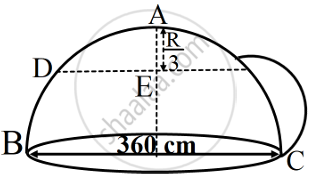
- Potential Energy at A relative to B.
- Speed at point B (lowest point).
- Kinetic Energy at D (g = 10 ms−2).
What happens to the kinetic energy when mass of body is doubled at constant velocity?
What happens to the kinetic energy when velocity of body is doubled at constant mass?
What happens to the kinetic energy when mass of body is doubled, but velocity is reduced to half?
A boy of mass 60 kg runs upstairs in 16 s and reaches 10 m high floor. Calculate:
- Force of gravity acting on the boy.
- Work done by the boy against the gravity.
- Power developed by the boy.
Name the quantity which is measured in eV.
What will be the angle between force and displacement to attain minimum work?
What will be the angle between force and displacement to attain maximum work?
The work done by the heart is 1 Joule per beat. Calculate the power of the heart if it beats 72 times in one.
State the amount of work done by an object when it moves in a circular path for one complete rotation. Give a reason to justify your answer.
Calculate the height through which a body of mass 0.5 kg is lifted if the energy spent in doing so is 1.0 J. Take g = 10 m s-2.
When an arrow is shot from a bow, it has kinetic energy in it. Explain briefly from where does it get its kinetic energy?
A stone of mass 50 g is thrown vertically upward from the ground with the initial velocity of 20.0 ms−1. Gravitational potential energy at ground level is considered zero. Apply the principle of conservation of energy to calculate the potential energy at the maximum height attained by stone. [g = 10 ms−1]
6.4 kJ of energy causes a displacement of 64 m in a body in the direction of force in 2.5 seconds. Calculate:
- Applied force.
- Power in horse power [Take 1 HP = 750 W]
A toy car is acted upon by a force. State two conditions under which work done is zero.
A body of mass 50 kg has momentum 5000 kgms−1. Calculate
- Velocity of body
- Kinetic energy of body.
A body of mass 0.2 kg falls from a height of 10 m to a height of 6 m above the ground. Find the loss in potential energy taking place in the body. [g = 10ms−2]
A moving body weighing 400 N possesses 500 J of kinetic energy. Calculate the velocity with which the body is moving. (g = 10 ms2)
Abhay exerts a force of 150 N in pulling a cart with a constant speed of 10 ms−1. Calculate the power applied on cart.
Explain briefly why the work done by a fielder when he takes a catch in a cricket match is negative.
MULTIPLE CHOICE QUESTIONS Choose the most appropriate option.
A boy drags a load 'L' along horizontal plane AB by applying a force F. The boy does:
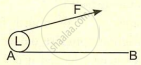
no work
some positive work
negative work
none of these
The SI unit of work is joule. It is expressed in terms of mass, length and time as:
kg m2s−3
kg m3s−2
kg2 m2s−2
kg m2s−2
The SI unit of power is watt. It is expressed in terms of mass, length and time as:
kg m2s−3
kg m s−3
kg2 m2s−2
kg m s−2
A stone resting on the roof of a building has:
potential energy
gravitational energy
kinetic energy
both potential energy and gravitational energy
One horse power is equal to ______.
1000 W
500 W
764 W
746 W
700 W
One electron volt is equal to ______.
1.6 × 10⁻¹⁷ J
6.1 × 10⁻¹⁹ J
1.6 × 10⁻¹⁹ J
1.6 × 10⁻¹⁰ J
Kilowatt hour is the commercial unit of ______.
electric power
electric energy
electric force
none of these
Power is the product of ______.
force and velocity
force and displacement
force and acceleration
force and time
The kinetic energy of a given body depends on the ______.
position
center of gravity of the body
momentum
displacement
One kilocalorie is the amount of heat required to raise the temperature of:
one gram of water through 1°C
1 kg of water through 100°C
one kg of water through 1°C
1 kg of water through 10°C
When a flash light is switched on the electric energy:
directly changes to light energy
first changes to light energy and then to heat energy
first changes to heat energy and then to light energy
none of the above
A pendulum is swinging freely. The bob of pendulum has:
maximum K.E. at its extreme positions
minimum K.E. at its mean position
maximum K.E. at its mean position
both minimum and maximum K.E. at its mean position
A pendulum is oscillating freely. Its bob has:
only kinetic energy
maximum kinetic energy at extreme position
maximum potential energy at its mean position
a constant energy, which is the sum of potential and kinetic energy
A ball of mass m is dropped from height 'h'.
Potential energy of the ball at ground level is mgh.
Potential energy of the ball at height h is mgh.
kinetic energy of the ball at ground level is mgh.
Both potential energy of the ball at height h is mgh and kinetic energy of the ball at ground level is mgh.
The factors which determine the work done by a body are:
There must be a force acting on body.
The force acting on the body must cause displacement in body.
The displacement of the body must be in the direction of applied force.
All of these
No work is done if the force acting on a body is:
in the direction of displacement of body.
at some acute angle in the direction of displacement of body.
at right angles to the direction of displacement of body
none of these
A stone whirled around in a circle with constant speed does:
maximum work
some work
no work
none of these
In a stretched bow and arrow system, the arrow has:
translational kinetic energy
gravitational potential energy
elastic potential energy
all of these
A body of mass 'm' is moving with a uniform velocity of 'v'. If the velocity increases three times the kinetic energy of the body will increase:
3 times
9 times
6 times
not very certain
A glass of boiling hot water cools down to room temperature. This process of cooling is known as:
waste of energy
dissipation of energy
losing of energy
destruction of energy
During power production in a coal-based thermoelectric power plant, the correct sequence of energy conversions taking place is:
heat → mechanical → chemical
heat → mechanical → electrical
chemical → heat → light
heat → chemical → electrical
One kilowatt hour is equal to:
3,600 kJ
3.6 MJ
3,60000 J
both 3,600 kJ and 3.6 MJ
A body of mass 0.2 kg falls from a height of 10 m to a height of 6 m above the ground level. If 'g' = 10 ms−2, the loss of gravitational potential energy is:
8.0 J
80.0 J
0.8 J
12 J
A girl of mass 35 kg climbs from the first floor of a building at a height of 4 m above the ground to third floor at a height of 12 m above the ground. If 'g' is equal to 10 ms−2, the increase in gravitational potential energy of the girl is:
1400 J
2800 J
4600 J
4200 J
A boy exerts a force of 150 N while pulling a hand cart at a speed of 3 ms−1. The power exerted by the body is:
50 W
150 W
1500 W
450 W
Direction for Q. Numbers 26 to 30: The questions given below are Assertion (A) and Reason (R) type questions. Choose the correct answer from options given below:
Assertion (A): It is not necessary that a force always causes displacement of the body in its own direction.
Reason (R): The work done depends on (i) the magnitude of force, (ii) magnitude of displacement and (iii) the angle between the force and displacement.
Both Assertion (A) and Reason (R) are true and Reason (R) is the correct explanation of Assertion.
Both Assertion (A) and Reason (R) are true but Reason (R) is not the correction explanation of Assertion.
Assertion (A) is false, but Reason (R) is true.
Assertion (A) is true, but Reason (R) is false.
Assertion (A): When a coolie walks on the horizontal ground while carrying a load on his head, no work is done against the force of gravity.
Reason (R): The coolie does work against the force of friction when he moves with load.
Both Assertion (A) and Reason (R) are true and Reason (R) is the correct explanation of Assertion.
Both Assertion (A) and Reason (R) are true but Reason (R) is not the correction explanation of Assertion.
Assertion (A) is false, but Reason (R) is true.
Assertion (A) is true, but Reason (R) is false.
Assertion (A): A body capable of doing work is said to possess energy.
Reason (R): There is a transfer of energy if a body is acted upon by a force normal to the direction of displacement.
Both Assertion (A) and Reason (R) are true and Reason (R) is the correct explanation of Assertion.
Both Assertion (A) and Reason (R) are true but Reason (R) is not the correction explanation of Assertion.
Assertion (A) is false, but Reason (R) is true.
Assertion (A) is true, but Reason (R) is false.
Assertion (A): In the uniform circular motion, the body is acted upon by a centripetal force, normal to displacement.
Reason (R): In the uniform circular motion, work done by the body is zero.
Both Assertion (A) and Reason (R) are true and Reason (R) is the correct explanation of Assertion.
Both Assertion (A) and Reason (R) are true but Reason (R) is not the correction explanation of Assertion.
Assertion (A) is false, but Reason (R) is true.
Assertion (A) is true, but Reason (R) is false.
Assertion (A): In a polyatomic molecule, atoms can vibrate about their mean positions.
Reason (R): A polyatomic molecule has the vibrational energy in addition to rotational and translational energies.
Both Assertion (A) and Reason (R) are true and Reason (R) is the correct explanation of Assertion.
Both Assertion (A) and Reason (R) are true but Reason (R) is not the correction explanation of Assertion.
Assertion (A) is false, but Reason (R) is true.
Assertion (A) is true, but Reason (R) is false.
Complete the following by choosing the correct answers from brackets.
When a body vibrates about its mean position, the kinetic energy possessed by body is called ______ kinetic energy.
elastic
rotational
vibrational
One watt hour is equal to ______ J.
3.6 × 10⁶
3.6 × 10³
One electron volt (eV) is equal to ______ J.
1.6 × 10⁻¹⁹
1.6 × 10⁻²¹
Rate of doing work is called ______.
energy
power
The energy possessed by a stretched bow is ______.
gravitation potential energy
elastic potential energy
Match the statements in Column A with those in Column B.
| Column A | Column B |
|---|---|
| (a) Law of conservation of energy. | (i) Energy possessed by a body due to its position with respect to ground level. |
| (b) Kilowatt hour | (ii) Energy possessed by an eagle flying high in sky. |
| (c) Kilocalorie | (iii) Unit for buying or selling electric energy. |
| (d) Kinetic energy + Potential energy | (iv) Energy cannot be created or destroyed and the sum total of energy in a system is constant. |
| (e) Gravitational potential energy. | (v) Amount of energy required to raise the temperature of 1 kg of water through 1°C. |
Goyal Brothers Prakashan solutions for अ न्यू अप्रोच टू आईसीएसई [अंग्रेजी] कक्षा १० 2 Work, Power and Energy NUMERICAL PROBLEMS ON WORK, POWER AND ENERGY [Pages 35 - 40]
A boy of mass 55 kg runs up a flight of 40 stairs, each measuring 0.15 m in 15 s. Calculate
- Force acting on the boy.
- Work done by the boy.
- Gain of potential energy by the boy.
- Power developed by the boy.
- Horse power and power in kilowatts.
Practice Problems 1:
A girl of mass 50 kg, climbs a flight of 100 stairs each measuring 0.25 m in height, in 20 s. Find
- Force acting on the girl
- Work done by the girl
- Gain in potential energy
- Power in (i) Watts (ii) Horse power.
[Take g = 10 ms−2; 1 HP = 750 W]
A load of 220 kg is vertically pulled up by a crane through a vertical height of 16 m in 40 s. Calculate
- Force acting in the upward direction
- Total work done
- Horse power of the engine pulling the rope.
[Take g = 9.8 ms−2; 1 HP = 750 W]
An energy of 4 kJ causes a displacement of 64 m in 2.5 s. Calculate
- Force
- Power
Practice Problems 2:
A work of 1000 J is done on a body in 4 s, such that a displacement of 20 m is caused. Calculate
- Force
- Power
What force must be applied to a body through a distance of 10 m, such that it does a work of 4000 J. If the mass of body is 20 kg, what is the acceleration of the body?
An engine of power 200 W, operates for 4 s. Find the work done by the engine. If the force developed by the engine is 100 N, calculate the maximum displacement caused.
Calculate the horse power of an engine, which lifts 4000 m3 of water from a depth of 50 m in 40 minutes.
[g = 10 ms−2, \[ \mathrm{D}_{\mathrm{H_{2}O}} \] = 103 kg m−3, 1 HP = 750 W]
Practice Problems 3:
Calculate the horse power of the motor of an elevator, which can carry 10 persons of average mass 60 kg through a vertical height of 20 m in 30 s.
[Take g = 10 N/kg, 1 HP = 750 W]
Calculate the power of an electric pump in horse power, which can lift 2000 m3 of water from a depth of 20 m in 25 minutes.
[Take g = 10 ms−2, 1 m3 of water = 103 kg and 1 HP = 750 W]
Calculate the height through which a crane can lift a load of 4 t, when its motor of 4 HP operates for 10 s.
(Take g = 10 ms−2, 1 HP = 750 W)
How long should an electric motor, of power 2 H.P. operate, so as to pump 5 m3 of water from a depth of 15m. [Take g = 10 N kg−1]
An electric motor of power 200 W is switched on for 1 minute and 40 seconds. If 60% of the energy of the motor is useful, calculate
- useful work done by the motor
- load lifted by it through a vertical height of 10 m.
[g = 10 ms−2]
Practice Problems 4:
An electric pump is 60% efficient and is rated 2 HP. Calculate the maximum amount of water it can lift through a height of 5 m in 40 s.
[Take g = 10 ms−2 and 1 HP = 750 W]
Calculate the time for which a motor pump of 10 HP and efficiency 80% must be switched on, so as to pump 20 m3 of water through a vertical height of 20 m.
[Density of water = 1000 kg m−3; g = 10 ms−2; 1 HP = 750 W]
In a hydroelectric power station, 1000 kg of water is allowed to drop through a height of 100 m in 1 sec. If the conversion of potential energy to electric energy is 60%. Calculate the power output. [Take: g = 10m/sec2]
A bullet of an air gun weighs 0.01 kg. It is propelled out from the air gun with a velocity of 40 ms−1. Calculate the potential energy of the spring.
Practice Problems 5:
A compressed spring is held near a small toy car of mass 0.15 kg. On the release of the spring, the toy car moves forward with a velocity of 10 ms−1. Find the potential energy of the spring.
A catapult throws a stone of mass 0.10 kg with a velocity of 30 ms−1. If 25% of the P.E. of the elastic band is wasted during transmission, find the magnitude of the potential energy.
A body of mass 4 kg is moving with a velocity of 4 ms−1. Find the ratio of its initial and final kinetic energy, if its mass is doubled and velocity is tripled.
Practice Problems 6:
A body A of mass 20 kg is moving with a velocity of 1 ms−1. Another body B of mass 1 kg is moving with a velocity of 20 ms−1. Find the ratio of kinetic energy of A and B.
A bullet of mass 0.2 kg, moving with a velocity of 200 ms−1, strikes a stationary wooden target of mass 5 kg. If all the energy is transferred to the wooden target, calculate the velocity with which the target moves in the forward direction.
A body has a KE 'P'. If the mass of body increases 25 times, calculate its velocity, the kinetic energy remaining same.
Practice Problems 7:
A body of mass (m) has a velocity (v). If the mass of the body increases 81 times, but the kinetic energy remains same, calculate the new velocity.
A body P has KE (E). Another body Q, whose mass is 9 times than P, also has kinetic energy (E). Calculate the ratio of velocities of P and Q.
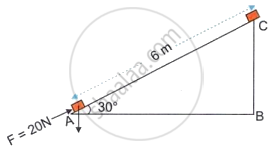
A force of 20 N is required to pull up a body of mass 1.5 kg through a distance of 6 m along an inclined plane as shown in diagram alongside. Calculate
- Force of gravity acting on the body. (Take g = 10 ms−2)
- Work done by the force in pulling body along the inclined plane.
- Work done against the force due to gravity
- Account for the difference in answers (b) and (c).
Practice Problems 8:
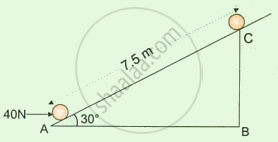
A force of 40 N is required to pull up cylindrical barrel of mass 2.5 kg through a distance of 7.5 m along the inclined plane as shown in diagram alongside. Calculate.
- Force of gravity acting on the barrel. (Take g = 10 ms−2)
- Work done by the force in pulling body along the inclined plane.
- Work done against the force of gravity.
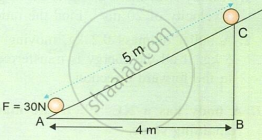
Adjacent diagram shows a body of mass 5 kg pulled up an inclined plane by a force of 30 N.
- Calculate force of gravity acting on body. (Take g = 10 ms−2)
- Work done by the force in pulling body along the inclined plane.
- Work done against the force of gravity.
A rickshaw puller exerts a force of 250 N in pulling rickshaw at a constant speed of 5 ms−1. Calculate the power developed by the rickshaw puller.
Practice Problems 9:
A scooter develops a power of 1 HP while running at 36 km h−1. Calculate the force generated by its engine.
[Take 1 HP = 750 watts]
The engine of a car develops a power of 5 HP and force 500 N while running a uniform speed S. Calculate the value of S.
The heart of running athlete is beating 100 times a minute. If the work done by the heart per beat 1.2 J, calculate the power of the heart.
Practice Problems 10:
The work done by the heart is 1 Joule per beat. Calculate the power of the heart if it beats 72 times in one.
The heart of a deer chased by a tiger beats 200 times in a minute and does a work of 1.4 joules per beat. What is the power of heart?
An accelerated electron has an energy of 6.4 × 10⁻¹⁹ J. Express the energy of electron in electron volts (eV).
Practice Problems 11:
A beam of electrons has an energy of 1 joule. How many electrons are in the beam?
[1 eV = 1.6 × 10⁻¹⁹ J]
An accelerated electron has energy of 9.6 × 10⁻¹⁸ J. Express the energy in electron volts (eV).
A body of momentum 10 kgms−1 and mass 0.05 kg. Calculate the kinetic energy of body.
Practice Problems 12:
Calculate the kinetic energy of a body of mass 100 g and having a momentum of 20 kgms−1.
Solutions for 2: Work, Power and Energy
Goyal Brothers Prakashan solutions for अ न्यू अप्रोच टू आईसीएसई [अंग्रेजी] कक्षा १० chapter 2 - Work, Power and Energy
Shaalaa.com has the CISCE Mathematics अ न्यू अप्रोच टू आईसीएसई [अंग्रेजी] कक्षा १० CISCE solutions in a manner that help students grasp basic concepts better and faster. The detailed, step-by-step solutions will help you understand the concepts better and clarify any confusion. Goyal Brothers Prakashan solutions for Mathematics अ न्यू अप्रोच टू आईसीएसई [अंग्रेजी] कक्षा १० CISCE 2 (Work, Power and Energy) include all questions with answers and detailed explanations. This will clear students' doubts about questions and improve their application skills while preparing for board exams.
Further, we at Shaalaa.com provide such solutions so students can prepare for written exams. Goyal Brothers Prakashan textbook solutions can be a core help for self-study and provide excellent self-help guidance for students.
Concepts covered in अ न्यू अप्रोच टू आईसीएसई [अंग्रेजी] कक्षा १० chapter 2 Work, Power and Energy are Work Done by the Force of Gravity (W = mgh), Forms of Energy > Solar Energy, Concept of Work, Measurement of Work, Concept of Power, Conversion of Potential Energy into Kinetic Energy, Conversion of Energies, Principle of Conservation of Energy, Proof: Kinetic + Potential Energy = Constant for Free Fall, Application of the Principle of Conservation of Energy, Expression for Work (W = F S cosθ), Mechanical Energy > Potential Energy (U), Concept of Energy, Mechanical Energy > Kinetic Energy (K), Forms of Energy > Heat Energy, Work vs Power, Energy vs Power, Potential vs Kinetic Energy, Forms of Energy > Light Energy, Forms of Energy > Chemical Energy, Forms of Energy > Hydro Energy, Forms of Energy > Electrical Energy, Forms of Energy > Nuclear Energy, Forms of Energy > Geo Thermal Energy, Forms of Energy > Wind Energy, Forms of Energy > Sound Energy, Forms of Energy > Magnetic Energy, Forms of Energy > Mechanical Energy.
Using Goyal Brothers Prakashan अ न्यू अप्रोच टू आईसीएसई [अंग्रेजी] कक्षा १० solutions Work, Power and Energy exercise by students is an easy way to prepare for the exams, as they involve solutions arranged chapter-wise and also page-wise. The questions involved in Goyal Brothers Prakashan Solutions are essential questions that can be asked in the final exam. Maximum CISCE अ न्यू अप्रोच टू आईसीएसई [अंग्रेजी] कक्षा १० students prefer Goyal Brothers Prakashan Textbook Solutions to score more in exams.
Get the free view of Chapter 2, Work, Power and Energy अ न्यू अप्रोच टू आईसीएसई [अंग्रेजी] कक्षा १० additional questions for Mathematics अ न्यू अप्रोच टू आईसीएसई [अंग्रेजी] कक्षा १० CISCE, and you can use Shaalaa.com to keep it handy for your exam preparation.
