Advertisements
Advertisements
प्रश्न
A ball of mass m is dropped freely from point A. It is given that AB = BC = CD = h. If the acceleration due to gravity at the given place is g, then what will be its
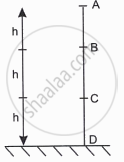
- potential energy at point A?
- kinetic energy at point C?
संख्यात्मक
Advertisements
उत्तर
(a) Taking the ground at D as the zero level of potential energy.
Point A is 3h above the ground.
Therefore, potential energy at A = mg(3h) = 3mgh.
(b) The ball falls from rest through a distance AC = AB + BC = 2h before reaching C.
By conservation of energy, the loss in potential energy becomes kinetic energy.
Hence, kinetic energy at C = mg(2h) = 2mgh.
shaalaa.com
क्या इस प्रश्न या उत्तर में कोई त्रुटि है?
