Advertisements
Advertisements
प्रश्न
Advertisements
उत्तर
संबंधित प्रश्न
Define the term energy.
What should be the angle between the direction of force and the direction of motion of a body so that the work done is zero?
Draw a neat labeled diagram to show the direction of two forces acting on a body to produce rotation in it. Also mark the point about which rotation takes place.
What is the work done against gravity when a body is moved horizontally along a frictionless surface?
Is power a scalar quantity?
In what way does an ‘Ideal machine’ differ from a ‘Practical machine’?
A truck driver can load oil drums into the back of the truck by pushing them up a sloping plank, or by lifting them directly. Each drum has a mass of 80 kg, the plank is 3 m long, and the back of the truck is 0.8 m above the ground.
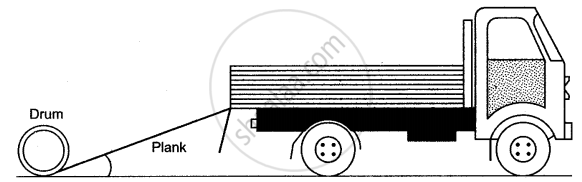
(i) How much force would be needed to lift a drum into the truck directly/without using the plank? (Take g = 10 m/s2)
(ii) How much energy would be required in lifting the drum into the truck without the plank?
(iii) If the force needed to push the drum up the plank is 300 N, why is this less than the answer to part (i)?
(iv) When the truck is loaded, the driver drives off. List the major energy changes that take place in moving the truck.
(v) The driver has to stop at the factory gates. What happens to the kinetic energy of the truck?
A coolie is pushing a box weighing 1500 N up an inclined plane 7.5 m long on to a platform, 2.5 m above the ground.
(i) Calculate the mechanical advantage of the inclined plane. (ii) Calculate the effort applied by the coolie.
(iii) In actual practice, the coolie needs to apply more effort than what is calculated. Give one reason why you think the coolie needs to apply more effort.
