Advertisements
Online Mock Tests
Chapters
2: Light
3: Sound
4: Electricity and Magnetism
5: Heat
6: Modern Physics
![Frank solutions for फिज़िक्स पार्ट [अंग्रेजी] कक्षा १० आईसीएसई chapter 1 - Force, Work, Energy and Power - Shaalaa.com](/images/physics-part-2-english-class-10-icse_6:6e65a815841c4e1d9c2ecbfd294c9e9c.jpg "Frank solutions for फिज़िक्स पार्ट [अंग्रेजी] कक्षा १० आईसीएसई chapter 1 - Force, Work, Energy and Power")
Advertisements
Solutions for Chapter 1: Force, Work, Energy and Power
Below listed, you can find solutions for Chapter 1 of CISCE Frank for फिज़िक्स पार्ट [अंग्रेजी] कक्षा १० आईसीएसई.
Frank solutions for फिज़िक्स पार्ट [अंग्रेजी] कक्षा १० आईसीएसई 1 Force, Work, Energy and Power 1.1 Graded Assignment [Pages 13 - 14]
Define the moment of force.
State the S.I. unit of moment of force.
Its moment of a force scalar or a vector quantity?
Name the physical quantity whose SI unit is Nm.
What is meant by a translational motion? Give one example.
What is meant by a rotatory motion? Give one example.
What is the relationship between Nm and dyne cm?
State the factors on which moment of force about a point depends.
What do you understand by the clockwise and anti clockwise moment of force?
State the condition when a force produces
(i) linear motion.
(ii) rotational motion, in a body.
Why is it easier to open a door by applying the force at the free end of it?
Why does a spanner have a long handle?
What do you mean by equilibrium of a body?
State the condition when a body is in static equilibrium.
Give one example of static equilibrium.
State the condition when a body is in dynamic equilibrium.
Give one example of dynamic equilibrium.
State two conditions for a body acted upon by several forces to be in equilibrium.
State the principle of moments.
Draw a neat labeled diagram to show the direction of two forces acting on a body to produce rotation in it. Also mark the point about which rotation takes place.
Give two examples of couple actions in our daily life.
P, Q and R are three forces which act as shown in fig.
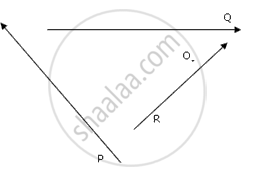
The point O lies in the same plane. Given, P = Q = R = 10N
(i) Which force has the least moment about O? Give a reason.
(ii)Which force has the greatest moment about O? Give a reason.
What do you understand by the term couple?
State the couple's effect on a body.
Define the moment of a couple.
Write S.I. unit of moment of couple.
Prove that
Moment of couple = Force × couple arm.
A body is provided at a point. A force of 20 N is applied at a distance of 40 cm from the pivot. Find the moment of force about the pivot.
The moment of a force 10 N about a point 0 is 4 Nm. Calculate the distance of point of application of force from the point 0.
A mechanic can open a nut by applying a force of 200 N while using a lever handle of 50 cm length. How long handle is required if he wants to open it by applying a force of only 50 N?
State the conditions of equilibrium for a rigid body.
P, Q and R are the three forces, each of magnitude 6 N acting in the plane of paper as shown in Fig. The point O lies in the same plane.
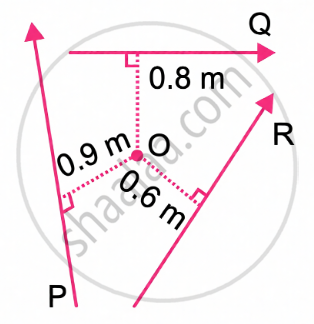
- Which force has the least moment about O?
- Which force has the greatest moment about O?
- Name the forces producing (a) clockwise, (b) anticlockwise moments.
- What is the resultant torque about the point O?
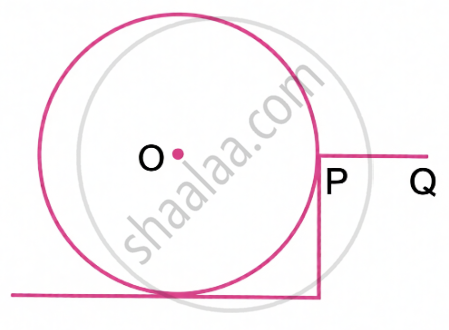
Fig. shows a heavy roller, with its axle at O, which is to be raised on a pavement PQ. If there is friction between the roller and pavement, show by an arrow on the diagram the point of application and the direction of force to be applied.
On a see-saw, two children of masses 30 kg and 50 kg are sitting on one side of it at distance 2 m and 2.5 m respectively, from its middle, where should a man of mass 74 kg sit to balance it?
Select the most appropriate word from the given box and fill in the following blanks.
| couple, rotation, dynamic, static, newton-metre, positive, negative, torque, vector |
Moment of force is also known as ______.
Select the most appropriate word from the given box and fill in the following blanks.
| couple, rotation, dynamic, static, newton-metre, positive, negative, torque, vector |
Torque is a ______ physical quantity.
Select the most appropriate word from the given box and fill in the following blanks.
| couple, rotation, dynamic, static, newton-metre, positive, negative, torque, vector |
The clockwise moment is taken as ______ and anticlockwise moment is taken as ______.
Select the most appropriate word from the given box and fill in the following blanks.
| couple, rotation, dynamic, static, newton-metre, positive, negative, torque, vector |
The ______ is always produced by a pair of forces.
Select the most appropriate word from the given box and fill in the following blanks.
| couple, rotation, dynamic, static, newton-metre, positive, negative, torque, vector |
A ______ is always needed to produce a rotation.
Select the most appropriate word from the given box and fill in the following blanks.
| couple, rotation, dynamic, static, newton-metre, positive, negative, torque, vector |
A book lying on a table is in ______ equilibrium.
Select the most appropriate word from the given box and fill in the following blanks.
| couple, rotation, dynamic, static, newton-metre, positive, negative, torque, vector |
The motion of a planet around the sun is in ______ equilibrium.
Select the most appropriate word from the given box and fill in the following blanks.
| couple, rotation, dynamic, static, newton-metre, positive, negative, torque, vector |
SI unit of moment of couple is ______.
Frank solutions for फिज़िक्स पार्ट [अंग्रेजी] कक्षा १० आईसीएसई 1 Force, Work, Energy and Power 1.2 Graded Assignment [Pages 17 - 18]
What do you mean by uniform circular motion?
A uniform circular motion is an accelerated motion. Justify it.
What is a centripetal force?
Is centrifugal force considered as the force of reaction of the centripetal force?
Explain the difference between a uniform linear motion and a uniform circular motion.
Name the force needed for circular motion. What is the direction of the force?
Which of the following quantity remains constant in a uniform circular motion?
Velocity
speed
acceleration
Both velocity and speed
None of these
Is the motion of moon around the earth in circular path an accelerated motion?
Does the earth move around the sun with a uniform velocity?
What do you mean by a centrifugal force?
Name the force acting away from the centre of circular path.
Explain the motion of moon around the earth.
With reference to magnitude of force and its direction, how does centripetal force differ from centrifugal force?
State two differences between the centripetal and centrifugal force.
State whether following statement are True or False.
SI unit of centripetal force is newton.
State whether following statement are True or False.
Work done by a centripetal force is zero.
State whether following statement are True or False.
Centrifugal force is a real force.
State whether following statement are True or False.
Centrifugal force is the force of reaction of the centripetal force.
State whether following statement are True or False.
SI unit of centrifugal force is newton.
State whether following statement are True or False.
Centripetal force causes circular as well as linear motion.
Frank solutions for फिज़िक्स पार्ट [अंग्रेजी] कक्षा १० आईसीएसई 1 Force, Work, Energy and Power 1.3 Graded Assignment [Pages 30 - 32]
What is the use of a fixed pulley?
What is an ideal machine?
Write the relation between mechanical advantage, velocity ratio and efficiency.
Can a machine be 100% efficient?
Define the term velocity ratio.
State the unit of velocity ratio.
What is the purpose of a machine?
Give an example for each of the following uses of a machine:
to obtain gain in force,
Give an example for each of the following uses of a machine:
to change the point of application of force
Give an example of the following uses of a machine:
to change the direction of force
Give an example of the following uses of a machine:
to obtain gain in speed
The diagram below shows a pulley arrangement.
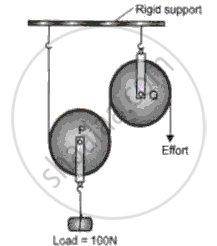
(i) In the diagram, mark the direction of the forces due to tension, acting on the pulley P.
(ii) What is the purpose of the pulley Q?
(iii) If the tension is T newton, deduce the relation between T and E.
(iv) Calculate the velocity ratio of the arrangement.
(v) Assuming that the efficiency of the system is 100%, what is the mechanical advantage?
(vi) Calculate the value of E
What is a block and tackle system of pulleys?
What is a single movable pulley?
What is the mechanical advantage of a single movable pulley in the ideal case?
Name the type of single pulley that can act as a force multiplier. Draw a labeled diagram of the pulley mentioned by you.
Give a reason for the following:
In a single fixed pulley, the velocity ratio is always more than the mechanical advantage.
Give reason for the following:
The efficiency of a pulley is always less than 100%
Give reason for the following:
In case of a block and tackle system, the mechanical advantage increases with the increase in the number of pulleys.
Name a machine which is used to multiply force.
Name a machine which is used to multiply speed.
Name a machine which is used to change the direction for force applied.
Write two uses of pulleys. Is pulley a force multiplier?
In the fig draw a tackle to lit a load by applying the torce in a convinient direction. Mark the position of load and effort.
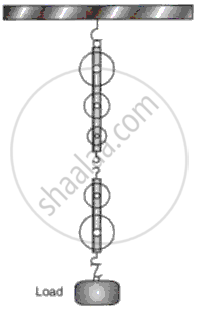
(i) If the load is raised by 1 m, Through what distance will the effort move?
(ii) State how many strands of tackle are supporting the load?
(iii) What is the mechanical advantage of the sysytem?
Figure shows a block-and-tackle system of pulleys used to lift a load.
- How many strands of tackle are supporting the load?
- Draw arrows to represent tension in each strand.
- What is the mechanical advantage of the system?
- When the load is pulled up by a distance of 1 m, how far does the effort end move?

What is a block and tackle system of pulleys?
Figure shows a system of four pulleys. The upper two pulleys are fixed and the lower two are movable.
- Draw a string around the pulleys. Also show the place and direction in which the effort is applied.
- What is the velocity ratio of the system?
- What is the mechanical advantage of the system?
- What assumption do you make in arriving at your answer in part (iii)?
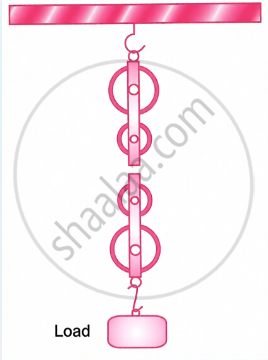
Figure shows the combination of two pulleys P1 and P2 used to lift up a load W.
- State the kind of pulleys P1 and P2.
- State the function of the pulley Р2.
- If the free end F of the string moves through a distance y, by what distance is the load W raised?
- What effort E has to be applied at C to just raise the load W = 30 kgf? Neglect both the weight of the pulley P1 and the friction.
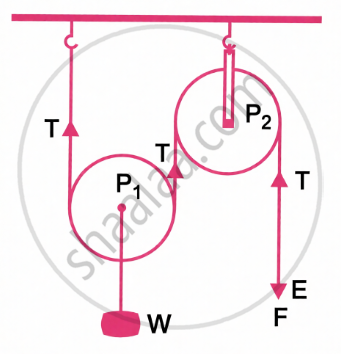
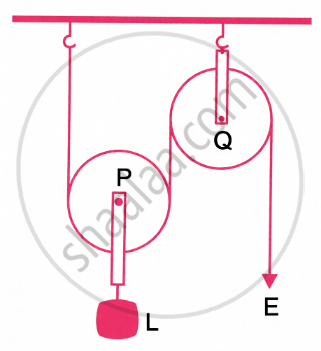
Figure shows a pulley arrangement.
- Name the pulleys P and Q.
- In the diagram, mark the direction of tension on each strand of string.
- What is the purpose of the pulley Q?
- If the tension is T, deduce the relation between (i) Tand E, and (ii) E and L.
- What is the velocity ratio of the arrangement?
- Assuming that the efficiency of the system is 100%, what is the mechanical advantage?
Frank solutions for फिज़िक्स पार्ट [अंग्रेजी] कक्षा १० आईसीएसई 1 Force, Work, Energy and Power 1.4 Graded Assignment [Pages 41 - 33]
Work is the application of a ....... through a distance.
A boy does work when he pushes against a brick wall. (yes/no).
What is the SI unit of work?
Nm is the unit of .......
One joule is the amount of work done when a force of ......... moves a body through a distance of .......
What is the work done when no net force is applied on the body?
What is the work done when the object acted upon by a force remains at rest?
What is the work done when the force on the object and the displacement of the object are perpendicular to each other?
Is work done a scalar or a vector physical quantity?
What is the work done when the displacement of the body is in the opposite direction to that of the applied force?
A man lifts a mass of 10 kg from the floor to a shelf 4 meter high. If g = 10 ms-2, what is the work done?
What is the work done against gravity when a body is moved horizontally along a frictionless surface?
When you move upstairs, do you perform some work?
In which one of the following cases is the work done more? When the angle between the direction of motion and that of the force is (i) 90° (ii) 0°.
A man carrying a suitcase in his hand is walking horizontally. What is the work done against gravity?
What is the work done on the earth by the gravitational force of the sun during the earth’s motion around the sun?
What do you mean by a kilo joule?
How many joules are there in 1 mega joule?
Define 'joule'.
What is the ratio of SI units to CGS units of 'work'?
An engine does 54,000 J of work by exerting a force of 6000 N on it. What is the displacement in the direction of the force?
How much force is applied on a body when 150 J of work is done in displacing the body through a distance of 10 m in the direction of the force?
Work done by a force is equal to the product of ....... and ....
Give two examples of work done.
On what factors does the work done by a force depend?
Write the expression for work done by a force.
Write an expression for the work done against gravity.
No work is done by a man moving on a horizontal road while carrying a box on his head. Explain.
Is power a scalar quantity?
Can every force produce work?
Distinguish between work and power.
Complete the following sentences:
The SI unit of work is ....... and of power is .......
Complete the following sentences:
Kilowatt is the unit of ....... and kWh is the unit of
Complete the following sentences:
Joule is the unit of .......
Complete the following sentences:
1 J = ........ Erg.
Complete the following sentences:
1 H.P. = ........ W.
A weight lifter lifted a load of 200 kgf to a height of 2.5 m in 5 s. Calculate:
- the work done, and
- the power developed by him. Take g = 10 N kg-1
A machine raises a load of 750 N through a height of 16 m in 5s. calculate:
(i) work done by machine,
(ii) power at which the machine works.
Name the physical quantity whose MKS units are kgm2s-3.
A boy of mass m climbs up a staircase of vertical height h. What is the work done by the boy against the force of gravity? What would have been the work done if he uses a lift in climbing the same vertical height?
Can work done be zero even if force acts on the body?
Write the SI and CGS units of power. How are H.Р. and W related?
Activity
Lift an object (box) through some distance. Did you do some work in doing so? To lift the box, you exert a force. As you lift the box, work is done. The force has raised the box through a height.
But some forces do not produce motion in objects. These forces do not produce any work.
Push against a wall. How much work did you do in pushing against the wall?
Even if you push hard all day against a wall, it will not move at all. So, since the distance travelled is zero, the work performed will also be zero.
Outwardly, nothing seems to change. Yet you feel tired. It is because when you constantly push hard against the wall, your muscles get tired as they stretch and contract i.e., they change in shape. The heart pumps more blood to these muscles. Complex chemical reactions take place in your body which make you feel tired, thereby performing work within your system, but the work done on the wall is still zero.
Perform the activities as illustrated in Fig. Record your observations. The examples in the figure are self-illustrated to tell you that work done on an object directly depends
(i) on the force applied, and
(ii) the distance through which an object moves.
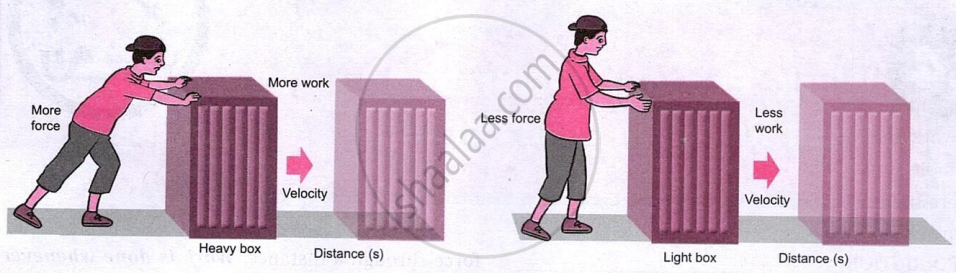 More force is needed to move an object (through a distance) of large mass than an object of small mass. More work is done by a bigger force.
Frank solutions for फिज़िक्स पार्ट [अंग्रेजी] कक्षा १० आईसीएसई 1 Force, Work, Energy and Power 1.5 Graded Assignment [Pages 55 - 48]
State the S.I. unit of energy.
Name the type of energy possessed by a
(i) stretched catapult (ii) hot iron
(iii) wound up clock
An object is dropped from a height H. when is its
(i) P.E. maximum,
(ii) K.E. maximum,
(iii) P.E. = K.E.?
A cricket ball is thrown up from the earth's surface. What happens to its P.E.
(a) during the motion
(b) at the highest point?
Name the energy changes for the following:
electric ball
Name the energy changes for the following:
bicycle brakes
Name the energy change for the following:
pendulum
Name the energy changes for the following
human body
Name the energy changes for each of the following cases:
dynamo
A body does 20 J of work in 10 s. What is its power?
Name the physical quantity associated with the 'rate of doing work'.
An electric motor drives a machine which lifts a mass of 4 kg through a height of 10 m in 5 s at a constant speed. Assuming g = 10 ms-2, calculate
(i) the amount of work done, (ii) the power of the machine.
A 100 W electric lamp emits energy in the form of light at the rate 10 J per second. What percentage of electric energy does the lamp transform into light energy?
If an electric bulb of 100 watt is lighted for 2 hours, how much electric energy would be consumed?
A woman pulls a bucket of water of total mass 5 kg from a well which is 10 s. calculate the power used by her.
Site two examples of energy degradation in dayto-day life.
A block of mass 30 kg is pulled up by a rope as shown in Fig. with a constant speed by applying a force of 200 N parallel to the slope. P and Q are the initial and the final positions of the block respectively. Calculate:
- the work done by the force in moving the block from P to Q.
- the potential energy gained by the block.
- account for the difference in work done by the force and the increase in potential energy of the block.
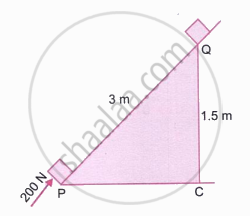
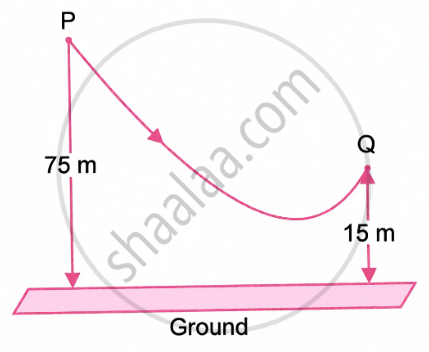
Figure shows a ski-jump. A skier of mass 60 kg stands at P at the top of the ski-jump. He moves from P to Q and takes off for his jump at Q.
- Calculate the change in the gravitational potential energy of the skier between P and Q.
- If 75% of the energy in part (a) becomes the kinetic energy at Q, calculate the speed at which the skier arrives at Q.
Activity
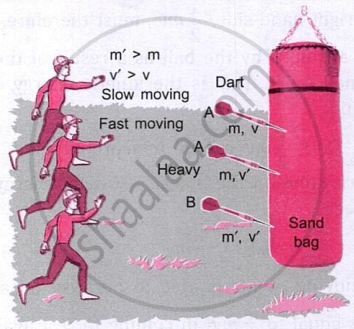
(a) Take a dart, some sand or plasticine in a bag or a dartboard. Aim the dart at the sand bag with
- little force (less velocity), and
- full force (high velocity).
Record your observations. In which case does the dart penetrate more in the sandbag and why? Refer to Fig.
(b) Repeat the above activity by throwing two darts of unequal masses using full force. When do you do more work? Which dart possesses more kinetic energy and why?
It is seen that a fast-moving dart penetrates more in the sandbag. It does more work. So a fast-moving dart possesses more K.E. Also the heavier dart penetrates more in the sandbag. It does more work and, therefore, possesses more kinetic energy.
(a) Allow two nails of unequal mass to fall through the same height on to a heap of sand [Fig. (a)]. Which nail penetrates more into the sand and why?
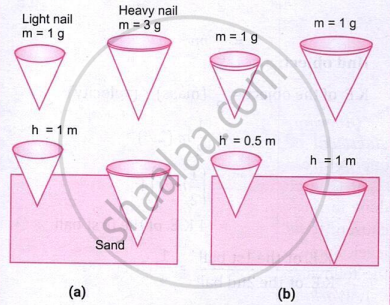
(b) Allow a nail to fall through different heights alternately on a sandbag. When does the nail penetrate more into the sand? Why? [Fig. (b)]
The nail falling from a greater height penetrates more into the sand. More work is done to penetrate more. This work changes to energy known as potential energy (P.E.). It means a high-lying object possesses more P.E. than a low-lying object of the same mass. Similarly, a nail with high mass possesses more P.E. Thus, a massive high-lying body possesses more P.E. than a light, low-lying body.
Frank solutions for फिज़िक्स पार्ट [अंग्रेजी] कक्षा १० आईसीएसई 1 Force, Work, Energy and Power Frequently Asked Questions in Board Examination [Pages 77 - 82]
How is work done by a force measured when the force is in an angle to the direction of displacement?
How is work done by a force measured when the force is in an angle to the direction of displacement?
State the energy in the following while in use:
Burning of a candle
State the energy in the following while in use:
A steam engine
A scissor is a ______ multiplier.
1k Wh = ______J
Rajan exerts a force of 150 N in pulling a cart at a constant speed of 10 m/s-1. Calculate the power exerted.
The power of a motor is 40 kW. At what speed can the motor raise a load of 20,000 N?
A body of mass 5 kg is moving with a velocity of 10 ms−1. What will be the ratio of its initial kinetic energy and final kinetic energy, if the mass of the body is doubled and its velocity is halved?
6.4 kJ of energy causes a displacement of 64 m in a body in the direction of force in 2.5 seconds. Calculate (a) the force applied (b) power in horse power (HP). (Take 1 HP = 746 W).
Name the physical quantity measured in terms of horse power.
A nut is opened by a wrench of length 20 cm. If the least force required is 2N, find the moment of force needed to loosen the nut.
Explain briefly why the work done by a fielder when he takes a catch in a cricket match is negative.
A boy weighing 40 kgf climbs up a stair of 30 steps each 20 cm high in 4 minutes and a girl weighing 30 kgf does the same in 3 minutes. Compare:
- The work done by them.
- The power developed by them.
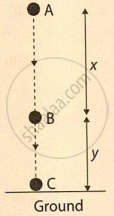
An object of mass ‘m’ is allowed to fall freely from point A as shown in the figure. Calculate the total mechanical energy of the object at:
- Point A
- Point B
- Point C
- State the law which is verified by your calculations in parts (i), (ii) and (iii).
A toy is acted upon by a force.
State two conditions under which the work done could be zero.
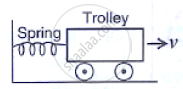
A spring is kept compressed by a small trolley of mass 0.5 kg lying on a smooth horizontal surface as shown in the adjacent fig. When the trolley is released, it is found to move at a speed v = 2 m s-1. What potential energy did the spring possess when compressed?
A body of mass 50 kg has a momentum of 3000 kg−1 ms. Calculate:
(j) the kinetic energy of the body.
(ii) the velocity of the body.
A ball of mass 0.5 kg is thrown vertically upward with a velocity of 8 m/s. Calculate the maximum potential energy it gains at the highest point.
Which physical quantity does the electron volt measure? How is it related to SI unit of this quantity?
What would be the angle between force and displacement to get the minimum work?
What would be the angle between force and displacement to get the minimum work?
A man having a box on his head, climbs up a slope and another man having an identical box walks the same distance on a levelled road.
Who does more work against the force of gravity and why?
A body is thrown vertically upward. Its velocity keeps on decreasing. What happens to its kinetic energy as its velocity becomes zero?
Which type of lever has a mechanical advantage always more than one? Give one example. What change can be made in this lever to increase its mechanical advantage?
Write an expression to show the relationship between mechanical advantage, velocity ratio, and efficiency for a simple machine.
A block and tackle pulley system has a velocity ratio 3.
Draw a labelled diagram of this system. In your diagram, indicate clearly the points of application and the directions of the load and effort.
Why should the lower block of a block and tackle pulley system have negligible weight?
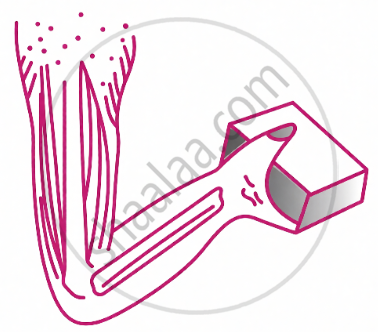
Copy the diagram of the forearm given below, indicate the positions of Load, Effort and Fulcrum.
What is the principle of an ideal machine?
Draw a diagram to show how a single pulley can be used so as to have its ideal M.A= 2.
Derive a relationship between mechanical advantage, velocity ratio and efficiency of a machine.
Draw a simplified diagram of a lemon crusher, indicting of load and effort.
A block and tackle system has V.R. = 5.
Draw a neat labeled diagram of a system indicating the direction of its load and effort.
A block and tackle system has V.R. = 5.
Rohan exerts a pull of 150 kgf. What is the maximum load he can raise with this pulley system if its efficiency = 75%?
What is meant by an ideal machine?
Write a relationship between the mechanical advantage (M.A.) and velocity ratio (V.R) of an ideal machine.
A coolie carrying a load on his head and moving on a frictionless horizontal platform does no work. Explain the reason why.
State the class of levers and the relative positions of load (L) effort (E) and fulcrum (F) in a bottle opener?
State the class of levers and the relative positions of load (L), effort (E) and fulcrum (F) in sugar tongs.
Draw a labelled diagram of a block and tackle system of pulleys with two pulleys in each block. Indicate the directions of the load, effort and tension in the string.
Write down the relation between the load and the effort of the pulley system.
With reference to the terms mechanical advantage, velocity ratio and efficiency of a machine, name and define the term that will not change for the machine of a given design.
From the diagram given below. answer the question that follows:
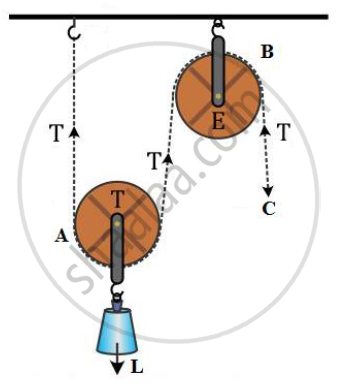
- What kind of pulleys are A and B?
- State the purpose of pulley B.
- What effort has to be applied at C just raise the load L = 20 kgf?
(Neglect the weight of pulley A and friction)
A pulley system has three pulleys. A load of 120 N is overcome by applying an effort of 50 N. Calculate the Mechanical Advantage and Efficiency of this system.
Which class of lever found in the human body is being used by a boy when he holds a load on the palm of his hand.
Which class of lever found in the human body is being used by a boy when he raises the weight of his body on his toes?
A block and tackle system of pulleys has a velocity ratio of 4.
- Draw a labelled diagram of the system indicating clearly the points of application and directions of load and effort.
- What is the value of the mechanical advantage of the given pulley system if it is an ideal pulley system?
Why is the mechanical advantage of a lever of the second order always greater than one?
Name the type of single pulley that has a mechanical advantage greater than one.
Write down a relation expressing the mechanical advantage of a lever.
Give two reasons as to why the efficiency of a single movable pulley system is always less than 100%.
A body of mass 10 Kg is kept at a height of 5m. It is allowed to fall and reach the ground.
(i) What is the total mechanical energy possessed by the body at the height of 2m assuming it is a frictionless medium ?
(ii) What is the kinetic energy possessed by the body just before hitting the ground ? Take g = 10 m/s2.
A uniform meter scale is in equilibrium as shown in the diagram :
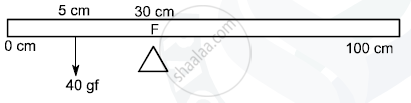
(i) Calculate the weight of the meter scale.
(ii) Which of the following options is correct to keep the ruler in equilibrium when 40 gf wt is shifted to 0 cm mark ?
F is shifted towards 0 cm
or
F is shifted towards 100 cm
The diagram below shows a pulley arrangement :
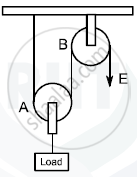
(i) Copy the diagram and mark the direction of tension on each strand of the string.
(ii) What is the velocity ratio of the arrangement ?
(iii) If the tension acting on the string is T, then what is the relationship between T and effort E ?
(iv) If the free end of the string moves through distance x, find the distance by which the load is raised.
The diagram below shows a claw hammer used to remove a nail.
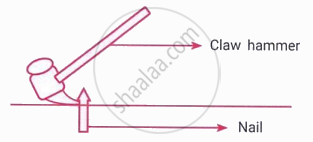
- To which class of lever does it belong?
- Give one more example of the same class of lever mentioned by you in (i) for which the mechanical advantage is greater than one.
- Two bodies A and B have masses in the ratio 5 : 1 and their kinetic energies are in the ratio 125 : 9. Find the ratio of their velocities.
A satellite revolves around a planet in a circular orbit. What is the work done by the satellite at any instant? Give a reason.
- Identify the class of the lever shown in the diagram below.
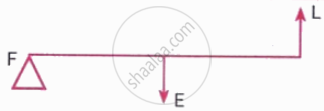
- How is it possible to increase the M.A. of the above lever without increasing its length?
The figure below shows a simple pendulum of mass 200 g. It is displaced from the mean position A to the extreme position B. The potential energy at the position A is zero. At the position B the pendulum bob is raised by 5 m.

- What is the potential energy of the pendulum at the position B?
- What is the total mechanical energy at point C?
- What is the speed of the bob at the position A when released from position B?
(Take g = 10 ms-2, given that there is no loss of energy.)
With reference to the direction of action, how does a centripetal force differ from a centrifugal force during uniform circular motion?
Is centrifugal force considered as the force of reaction of the centripetal force?
Compare the magnitudes of centripetal and centrifugal force.
A block and tackle system of pulleys has velocity ratio 4.
- Draw a neat labelled diagram of the system indicating clearly the points of application and direction of load and effort.
- What will be its V.R., if the weight of the movable block is doubled?
Name a single pulley in which displacement of load and effort is not the same.
State one advantage of this pulley.
At which point is the centre of gravity situated in a triangular lamina?
When this triangular lamina is suspended freely from any one vertex, what is the moment of force produced by its own weight in its rest position?
The diagram shows wheel O pivoted at point A. Three equal forces F1, F2 and F3 act at point B on the wheel.

- Which force will produce maximum moment about A?
- Give a reason for your answer in (a).
A block and tackle system of pulleys has velocity ratio 4.
- Draw a labelled diagram of the system indicating clearly, the direction of the load and the effort.
- What is the value of the mechanical advantage of the given pulley system if it an ideal pulley system?
A metre scale of weight 50 gf can be balanced at 40 cm mark without any weight suspended on it.
- If this ruler is cut at its centre then state which part [0 to 50 cm or 50 to 100 cm] of the ruler will weigh more than 25 gf.

- What minimum weight placed on this metre ruler can balance this ruler when it is pivoted at its centre?
A car of mass 120 kg is moving at a speed 18 km/h and it accelerates to attain a speed of 54 km/h in 5 seconds. Calculate:
- the work done by the engine.
- the power of the engine.
Name the class of the lever shown in the picture below:
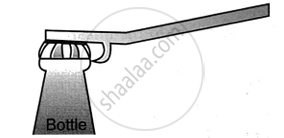
Fill in the blanks.
When a stone tied to a string is rotated in a horizontal plane, the tension in the string provides ______ force necessary for circular motion.
Work done by this force at any instant is ______.
A non uniform beam of weight 120 N pivoted at one end is shown in the diagram below. Calculate the value of F to keep the beam in equilibrium.
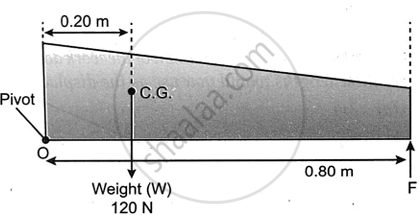
| Meera chose to use a block and tackle system of '9' pulleys instead of a single movable pulley to lift a heavy load. |
What is the advantage of using a block and tackle system over a single movable pulley?
| Meera chose to use a block and tackle system of '9' pulleys instead of a single movable pulley to lift a heavy load. |
Why should she connect more number of pulleys in the upper fixed block?
Sumit does 600 J of work in 10 min and Amit does 300 J of work in 20 min. Calculate the ratio of the powers delivered by them.
class II levers
(a) centripetal (b) zero
30 N
4 : 1
Define centre of gravity.
A hollow ice cream cone has height 6 cm.
- Where is the position of its center of gravity from the broad base?
- Will its position change when it is filled completely with honey? Write Yes or No.

Two identical marbles A and B are rolled down along Path 1 and Path 2 respectively.
Path 1 is frictionless and Path 2 is rough.
- Which marble will surely reach the next peak?
- Along which path/s the mechanical energy will be conserved?
- Along which path/s is the law of conservation of energy obeyed?
Given here are two pulleys.
Copy and complete the labelled diagram connecting the two pulleys with a tackle to obtain Velocity Ratio= 2.

If Load = 48 kgf and efficiency is 80% then calculate:
- Mechanical Advantage.
- Effort needed to lift the load.

Frank solutions for फिज़िक्स पार्ट [अंग्रेजी] कक्षा १० आईसीएसई 1 Force, Work, Energy and Power Exercises (Cumulative Revision) [Pages 84 - 90]
Name the physical quantity whose SI unit is Nm.
What is meant by equilibrium?
What is the difference between mass and weight?
Following Fig shows piece of cardboard of uniform thickness cut into different shapes. Draw two lines to indicate the position of centre of gravity G.
Following Fig shows piece of cardboard of uniform thickness cut into different shapes. Draw two lines to indicate the position of centre of gravity G.
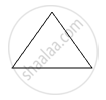
Following Fig shows piece of cardboard of uniform thickness cut into different shapes. Draw two lines to indicate the position of centre of gravity G.
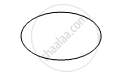
Following Fig shows piece of cardboard of uniform thickness cut into different shapes. Draw two lines to indicate the position of centre of gravity G.
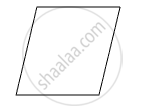
Following Fig shows piece of cardboard of uniform thickness cut into different shapes. Draw two lines to indicate the position of centre of gravity G.

What do you mean by a couple?
Write S.I. unit of moment of couple.
Write CGS unit of couple.
A body is acted upon by two forces of magnitude F but in opposite directions. State the effect of the force if both forces act at the same point of the body.
A body is acted upon by two forces of magnitude F, but in opposite directions. State the effect of the forces when the two forces act at two different points of the body at a separation d.
A wheel of diameter 3 m is shown in fig. 2 with axle at 0. A force F = 8 N is applied at Q in the direction shown in figure. Calculate the moment of force about:
(i) centre o, and
(ii) point p.
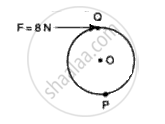
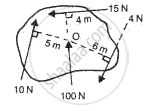
Calculate the resultant moment of forces about O and state its direction in fig.
State the principle of moments. A meter scale is pivoted at 30 cm mark and it is in equilibrium when a mass of 40 g is suspended from 10 cm mark. Calculate the mass of the ruler.
A metre scale is pivoted at its midpoint when the various masses are suspended on it as shown in Fig. From which point will you suspend a 50 g mass in order to keep the ruler in equilibrium?
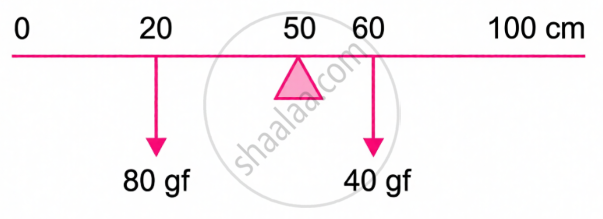
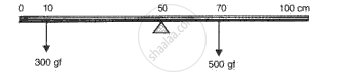
Fig. 5 shows a uniform meter scale weighing 200 gf. Provided at its centre. Two weights 300 gf and 500 gf are suspended from the ruler as shown in the diagram. Calculate the resultant torque of the ruler and hence calculate the distance from mid-point where a 100 gf should be suspended to balance the meter scale.
A meter scale is pivoted at its mid point and a 50 g mass suspended from the 20 cm mark. What mass balances the ruler when suspended from 65 cm mark?
What do you mean by the state of equilibrium? What are the conditions for stable equilibrium?
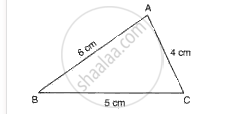
Fig. shows the dimensions of an acute angled triangle. By geometrical construction mark the C.G. of the triangle.
A right-angled triangle cardboard piece is placed as shown in fig. 7. Redraw the diagram showing the relative position of the vertices of the triangle when it is suspended by a pin from the hole A. Explain why the position changes?
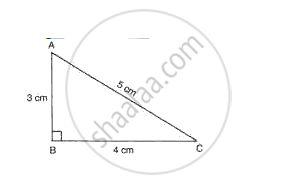
Give scientific reason for the following:
It is easier to push a boy standing on one leg than on both legs.
Give scientific reason for the following:
When a man climbs a slope he bends forward.
Give scientific reason for the following:
There are chances of toppling when a truck takes a sharp turn especially when it is not fully loaded
Give scientific reason for the following:
A man runs in the direction of train while getting down from a moving train.
Give scientific reason for the following:
Passengers in a bus are pushed backward when it starts suddenly.
(i) What do you understand by the term couple of forces?
(ii) Calculate the moment of a couple shown in fig.
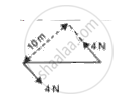
Give scientific reasons for the following:
Even though the Tower of Pisa is leaning through an angle it does not fall.
Give scientific reason for the following:
While climbing a hill you will try to bend your body forward.
Give scientific reason for the following:
In a moving bus the standing passenger stands keeping both his legs apart.
Give scientific reason for the following:
In a doubled decker bus passengers are not allowed to stand in the upper deck.
Three forces A, B and C are acting on a rigid body which can turn about O in fig.9. If all the three forces are applied simultaneously, in which direction will the body move? Explain.
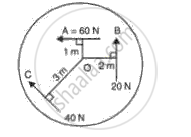
Fig. shows a uniform meter scale weighing 100 N pivoted at its centre. Two weights of 500 N and 300 N are hung from the ruler as shown in fig.

(i) Calculate total clockwise and anticlockwise moments.
(ii) Calculate difference in clockwise moment and anticlockwise moment.
(iii) Calculate the distance from O where a 100 N weight should be suspended to balance the meter scale.
A meter scale is provided at 10 cm mark and is balanced by suspending 400 g from 0 cm mark (fig.). Calculate the mass of meter scale.
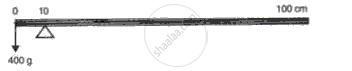
Define work.
Name the CGS unit of work.
Name the SI units of work.
The following are some of the energy transformations.
A. Electrical to light
B. Work to heat
C. Chemical to light
D. Electrical to sound
E. Mechanical to electrical
Identify the energy transformation that takes place in the following by inserting the corresponding letter in the shape provided.
(i) A candle flame
(ii) A torch is lighted
(iii) A microphone is used in a meeting
(iv) A cycle dynamo
(v) A piece of metal is being filed
A boy pulls a box up to 10 m with a force of 5 kgf. Calculate the work done by him.
Calculate the amount of work done by a child carrying a bag of 20 kg when he moves a distance of 40 m in
(a) Vertical direction, and
(b) Horizontal direction
Define power.
Name units of power.
A girl weighting 50 kg climbs up 60 steps each of 20 cm height in 5 minutes. Calculate the power developed.
Define the term energy.
When an elevator starts to rise suddenly, we experience ‘weightlessness’. Explain.
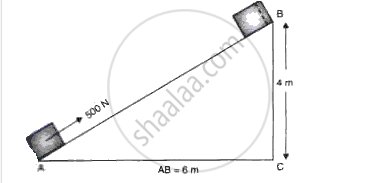
A block of mass 20 kg is pulled up a slope (fig.12) with a constant speed by applying a force of 500 N parallel to the slope. A and B are initial and final positions of the block.
(a) Calculate the work done by the force in moving the block from A and B.
(b) Calculate the potential energy gained by the block.
How fast should a boy weighting 30 kg run so that his kinetic energy is 375 joule?
A girl of mass 50 kg runs up a flight of 40 steps in 20 seconds. If each step in 20 cm high, calculate the power developed by the girl. (g= 10 ms-2).
Define the term energy.
List any six forms of energy and write a short note on each of them.
What do you understand by ‘potential energy’? Give three examples to illustrate your answer.
What do you understand by ‘kinetic energy’? Give three examples to illustrate your answer.
A bullet is of mass 'm' g and is moving with a velocity 'v' m/s. Find the kinetic energy of the bullet when
(a) The mass is doubled,
(b) The velocity is tripled.
Identify the type of energy possessed by the body in the following:
A coiled spring of the toy car.
Identify the type of energy possessed by the body in the following:
A hammer which is raised.
Identify the type of energy possessed by the body in the following:
A stone shot from a catapult.
Identify the type of energy possessed by the body in the following:
Water stored in the overhead tank.
Identify the type of energy possessed by the body in the following:
A tadpole moving in water.
Fill in the respective box to show the corresponding energy transformation.

Fill in the respective box to show the corresponding energy transformation.
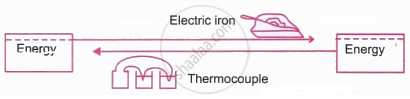
Fill in the respective box to show the corresponding energy transformation.
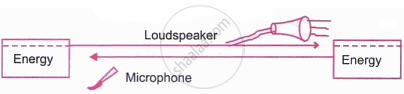
Fill in the respective box to show the corresponding energy transformation.
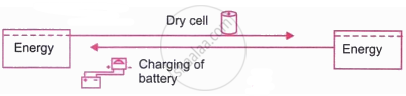
Fill in the respective box to show the corresponding energy transformation.
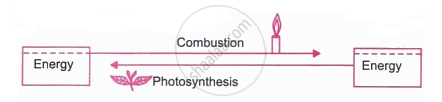
State the energy changes which take place when Water stored in the dam is used to turn turbine in dynamo.
State the energy changes which take place when An electric bulb glows when it is connected to a source of electric current.
State the energy changes which take place when A piece of magnesium wire is burnt in a jar of oxygen.
State the energy changes which take place when A stone dropped from the top of a cliff reaches the ground after some time.
State the energy changes which take place when A toy car with a wound spring moves on ground.
Give one example when:
Electric energy changes to sound energy.
Give an example
Chemical energy changes to heat energy.
Give an example
Chemical energy changes to electrical energy.
Give an example
Light energy changes to electrical energy.
Give an example
Electrical energy changes to heat energy.
Define simple machine.
Define lever.
Define mechanical advantage.
Define velocity ratio.
Define efficiency.
Class I lever can have M.A. = 1, M.A. < 1 and M.A. > 1. Explain each giving examples.
Fig. shows a spade. It is being used to lift soil weighing 30N from the ground.
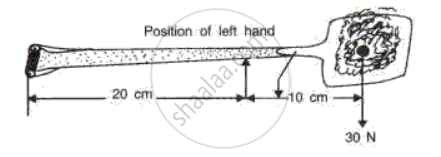
(a) Mark the direction of the least force on the handle necessary to keep the spade balanced.
(b) Calculate the least force on the handle necessary to keep the spade balanced (the weight of the spade is negligible).
(c) If the left hand was move towards the soil on the spade, would the force on the handle necessary to keep the soil balance the greater or less? Give a reason for your answer.
(d) To which class of lever does the spade belong?
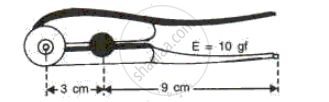
A pair of nut crackers is 12 cm long. An effort of 10 gf is required to crack a nut which is passed at a point 3 cm from the finger. Calculate the load Fig.
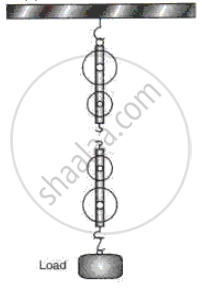
(a) Fig represents an incomplete diagram of a simple string pulley system. Copy this diagram on a new page and complete it and mark where the effort must be applied to lift the load.
(b) What is the velocity ratio of this system?
(c) If the pulley system is 80% efficient and the load is 720 N, then
(i) What effort must be applied to lift the load?
(ii) What work must be done must be done in lifting the load through a distance of 2 m using this machine?
What makes a balance faulty?
A faulty balance of equal arms but pans of unequal weight is used to find the weight of a body. By the method of double weighing the weights are found as 8 kg and 8.2 kg. Find the actual weight of the body.
The arms of a beam balance are 20 cm and 21 cm, but the pans are of equal weight. By the method of double weighing the weights are found to be 1000 g and 20 g. Find the actual weight of the body
A faulty balance of unequal arms and pans of unequal weights is used to find the true weight of a metal. By double weighing the weights are found to be 1210 g and 1000 g. Calculate the true weight of the metal.
Select the most appropriate words from the given box and fill in the blanks.
| work, power, centripetal, torque, couple, centre, joule, scalar, energy |
SI unit of work is ______.
Select the most appropriate words from the given box and fill in the blanks.
| work, power, centripetal, torque, couple, centre, joule, scalar, energy |
Nm is SI unit of moment of ______.
Select the most appropriate words from the given box and fill in the blanks.
| work, power, centripetal, torque, couple, centre, joule, scalar, energy |
Moment of force is also called ______.
Select the most appropriate words from the given box and fill in the blanks.
| work, power, centripetal, torque, couple, centre, joule, scalar, energy |
The centre of gravity of a ball is at its geometrical ______.
Select the most appropriate words from the given box and fill in the blanks.
| work, power, centripetal, torque, couple, centre, joule, scalar, energy |
______ force acts in a direction towards the centre of circular path.
Select the most appropriate words from the given box and fill in the blanks.
| work, power, centripetal, torque, couple, centre, joule, scalar, energy |
______ done by a body is due to stored ______.
Select the most appropriate words from the given box and fill in the blanks.
| work, power, centripetal, torque, couple, centre, joule, scalar, energy |
Energy is a ______ physical quantity.
Select the most appropriate words from the given box and fill in the blanks.
| work, power, centripetal, torque, couple, centre, joule, scalar, energy |
The rate of doing work is called ______.
Frank solutions for फिज़िक्स पार्ट [अंग्रेजी] कक्षा १० आईसीएसई 1 Force, Work, Energy and Power Multiple Choice Questions and Assertion-Reason Type Questions [Pages 90 - 94]
Multiple Choice Questions Choose the correct answers to the questions from the given options.
In order to rotate a bar pivoted at its midpoint, we need to apply ______.
a large force at any point on the bar
a small force exactly at the midpoint where it is pivoted
two unequal forces at the two ends, but in the same direction
two equal forces at the two ends, but in opposite directions
A body is acted upon by two unequal forces in opposite directions, but not in the same line. The effect is that ______.
the body will only have rotational motion.
the body will have only the translational motion.
the body will have neither the rotational motion nor the translational motion.
the body will have rotational as well as translational motion.
When a boy weighing 20 kgf sits at one end of a 4 m long see-saw, it gets depressed at this end. It can be brought to the horizontal position if a man weighing 40 kgf sits at ______.
the opposite end of the see-saw
one-metre distance on the side of the boy
one-metre distance on the side opposite to the boy
the middle of the sea-saw
The moment of a force about axis depends ______.
only on the magnitude of force
only on the perpendicular distance of force from the axis
neither on the force nor on the perpendicular distance of force from the axis
on both the force and its perpendicular distance from the axis
The unit of moment of force is ______.
N
`N/m`
kg m2 s−1
N m
Which of the following is not the force at a distance?
Electrostatic force
Gravitational force
Frictional force
Magnetic force
1 N is the force which produces ______.
an acceleration of 1 cm s2 on a body of mass 1 g
an acceleration of 1 cm s2 on a body of mass 1 kg
an acceleration of 1 m s−2 on a body of mass 1 g
an acceleration of 1 m s−2 on a body of mass 1 kg
Relationship between kgf and N is ______.
1 kgf = 1 N
1 kgf = 9.8 N
9.8 kgf = 1 N
1 kgf = 100 N
Two forces, each of magnitude 10 N, act vertically upwards and downwards respectively on the two ends of a uniform rod of length 4 m, freely pivoted at its midpoint as shown in Fig. Then the magnitude of the resultant moment of forces about the pivot O is.
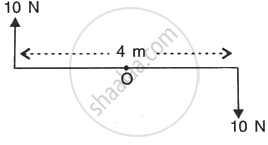
40 Nm (clockwise)
40 Nm (anticlockwise)
20 Nm (clockwise)
20 Nm (anticlockwise)
Which of the following appliance works on the principle of moments?
Spring balance
Beam balance
Pendulum clock
Balance wheel
The SI unit of couple is ______.
N
N/m
N m
J m
N m−1
N m−2
Figure shows two forces acting at points A and B of a rod pivoted at a point O, such that OА = 2 m and OB = 4 m.
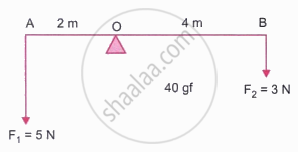
The moment of force F1 about O is:
10 Nm (anticlockwise)
10 Nm (clockwise)
20 Nm (clockwise)
20 Nm (clockwise)
Figure shows two forces acting at points A and B of a rod pivoted at a point O, such that OА = 2 m and OB = 4 m.
The moment of force F2 about O is:
8 N m (clockwise)
8 N m (anticlockwise)
12 N m (clockwise)
12 N m (anticlockwise)
Figure shows two forces acting at points A and B of a rod pivoted at a point O, such that OА = 2 m and OB = 4 m.
Total moment of the forces about O is:
2 N m (clockwise)
2 N m (anticlockwise)
22 N m (clockwise)
22 N m (anticlockwise)
Which of the following is different from others, as regards the centre of gravity?
Solid cone
Solid sphere
Rod
Hollow sphere
Cylinder
Ring
Rectangular lamina
Which of the following is different from others, as regards the centre of gravity?
Solid cone
Solid sphere
Rod
Hollow sphere
Cylinder
Ring
Rectangular lamina
Figure shows the position of the centre of gravity by the point G for a circular ring, circular disc, rectangle and a parallelogram. Which one is different from others?

Circular ring

Circular disc
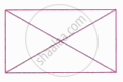
Rectangle
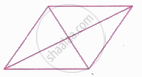
Parallelogram
Which of the following wrongly represents the position of centre of gravity of the given objects?
Object Position of centre of gravity Rod Rate of doing work by a body is called power. Object Position of centre of gravity Circular disc Geometric centre Object Position of centre of gravity Solid sphere Geometric centre of the sphere Object Position of centre of gravity Cylinder Axis of cylinder
Which of the following wrongly represents the position of centre of gravity of the given objects?
Object Position of centre of gravity Solid cone Centre of base of the cone Object Position of centre of gravity Circular ring Centre of ring Object Position of centre of gravity Triangular lamina Point of intersection of the medians Object Position of centre of gravity Parallelogram Point of intersection of the diagonals
In case of a square shown in Fig., the centre of gravity is shown by
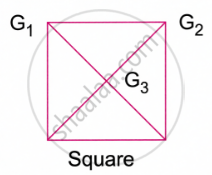
G1
G2
G3
any one of the above
In case of a triangular lamina shown in Fig., the centre of gravity is shown by
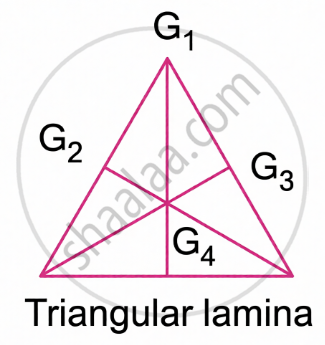
G1
G2
G3
G4
For a particle moving along a circular path with a constant speed, the acceleration is constant in ______.
magnitude
direction
both magnitude and direction
neither magnitude nor direction
A body moves along a circular path of constant radius. The body has acceleration which is ______.
zero
unity
variable
infinity
A couple produces ______.
linear motion
rotational motion
both (a) and (b)
neither (a) nor (b)
A rigid body is rotating about an axis. To stop the rotation, we have to apply ______.
force
pressure
momentum
torque
The product of force and perpendicular distance from the axis of rotation is commonly called ______.
moment
torque
impulsive force
any one of the above
The SI unit of centrifugal force is ______.
N
N m
dyne
dyne × cm
The ratio of SI to CGS units of force is ______.
105
107
106
10−5
Which of the following is different from others?
Gravitational force
Electrostatic force
Normal reaction force
Magnetic force
Tension in the string is expressed in ______.
N m
kg wt
N m−1
kg m
1 kg wt equals ______.
9.8 N
`(1/9.8)` N
(9.8)2 N
9.8 dyne
1 kgf equals ______.
9.8 N
`(1/9.8)` N
(9.8)2 N
9.8 dyne
Kilowatt-hour is the unit of ______.
energy
power
linear momentum
none of these
1 kWh equals ______.
3.6 J
3.6 M J
3.6 kJ
3.6 × 10⁶ M J
A stretching force of 5 N is applied at one end of a spring balance and an equal stretching force is applied at the other end at the same time. The reading on the balance will be ______.
5 N
10 N
2.5 N
zero
kg m2 s−3 is associated with ______.
kinetic energy
force
work
power
If the momentum of a body increases by 0.01%, its kinetic energy will increase by ______.
0.01 %
0.02 %
0.04 %
0.08 %
Watt-second represents the unit for ______.
power
linear momentum
kinetic energy
all the above
If m, p and k respectively denote mass, linear momentum and kinetic energy then we can write ______.
p = 2mk
p = `sqrt(2mk)`
p = `(2m)/k`
p = `(k)/(2m)`
The energy stored in a body by virtue of its configuration is called ______.
kinetic energy
potential energy
pressure energy
none of these
For a fixed mass, the graph between linear momentum (p) and kinetic energy (k) is best represented by:
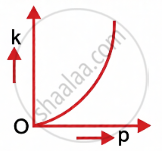
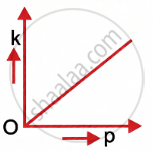
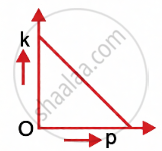
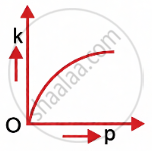
When a machine gun fires n bullets per second, each with kinetic energy k then the power of machine gun is ______.
nk
`n/k`
n2k
`k/n`
When linear momentum of a body becomes n times, its kinetic energy becomes ______.
n2 times
`1/(n^2)` times
n3 times
`1/(n^3)` times
A body at rest may have ______.
energy
momentum
speed
velocity
The work done by all the forces (external and internal) on a system equals the change in ______.
total energy
kinetic energy
potential energy
none of these
A man has a box of weight 20 kg. The energy of the box when he holds the box in his hand for 5 minutes is ______.
100 J
200 J
400 J
zero
A moving body may not have ______.
potential energy
kinetic energy
momentum
velocity
If kinetic energy of a body increases by 0.1%, the per cent increase in its momentum will be ______.
10 %
1 %
0.1 %
0.05 %
If a force `vecF` applied on a body moves it with а velocity `vecv` then power will be ______.
`(vecF)/(vecv)`
`vecF * vecv`
`F/vecv`
`F vecv`
You lift a suitcase from the floor and keep it on a table. The work done by you on the suitcase does not depend on ______.
the path taken by the suitcase
the time taken by you in doing so
the weight of the suitcase
your weight
Assertion and Reason Type Questions Choose the correct answers to the questions froт the given options.
Assertion: The moment of a force is a vector quantity.
Reason: Moment of a force = Torque × perpendicular distance of the pivot from other force.
If both Assertion and Reason are true and the Reason is correct explanation of the Assertion.
If both Assertion and Reason are true and the Reason is correct explanation of the Assertion.
If Assertion is true, but the Reason is false.
If Assertion is false, but the Reason is true.
Assertion: As the centre of gravity of a body is raised, the body becomes more unstable.
Reason: This happens because when the body is tilted, the vertical line is drawn from the centre of gravity outside the base.
If both Assertion and Reason are true and the Reason is correct explanation of the Assertion.
If both Assertion and Reason are true, but Reason is not correct explanation of the Assertion.
If Assertion is true, but the Reason is false.
If Assertion is false, but the Reason is true.
Assertion: The circular motion is accelerated even though the speed of the body is uniform.
Reason: Due to continuous change in the direction of motion, the motion is no longer uniform, i.e., the motion is an accelerated motion.
If both Assertion and Reason are true and the Reason is correct explanation of the Assertion.
If both Assertion and Reason are true, but Reason is not correct explanation of the Assertion.
If Assertion is true, but the Reason is false.
If Assertion is false, but the Reason is true.
Assertion: The efficiency of a machine is always less than 100%.
Reason: This happens because practical mechanical advantage is always less than theoretical mechanical advantage due to friction and the weight of the moving parts.
If both Assertion and Reason are true and the Reason is correct explanation of the Assertion.
If both Assertion and Reason are true, but Reason is not correct explanation of the Assertion.
If Assertion is true, but the Reason is false.
If Assertion is false, but the Reason is true.
Assertion: Velocity ratio of a machine has no unit.
Reason: Velocity ratio is defined as the ratio of the distance moved by the effort to the corresponding distance moved by the road. So, it being the ratio of the two similar quantities (i.e., distances), has no unit.
If both Assertion and Reason are true and the Reason is correct explanation of the Assertion.
If both Assertion and Reason are true, but Reason is not correct explanation of the Assertion.
If Assertion is true, but the Reason is false.
If Assertion is false, but the Reason is true.
Assertion: A centripetal force can't do any work on a body undergoing uniform circular motion.
Reason: During the uniform circular motion, the force and displacement are always perpendicular to each other.
If both Assertion and Reason are true and the Reason is correct explanation of the Assertion.
If both Assertion and Reason are true, but Reason is not correct explanation of the Assertion.
If Assertion is true, but the Reason is false.
If Assertion is false, but the Reason is true.
Assertion: The power of a source is measured as the amount of work done per second by the source, or energy change per second.
Reason: When a body does work, its energy decreases.
If both Assertion and Reason are true and the Reason is correct explanation of the Assertion.
If both Assertion and Reason are true, but Reason is not correct explanation of the Assertion.
If Assertion is true, but the Reason is false.
If Assertion is false, but the Reason is true.
Assertion: The work done against gravity by a porter carrying a box of 40 kg on his head and moving 50 m horizontally is zero.
Reason: The direction of motion is perpendicular to the direction of gravitational force, hence work done zero.
If both Assertion and Reason are true and the Reason is correct explanation of the Assertion.
If both Assertion and Reason are true, but Reason is not correct explanation of the Assertion.
If Assertion is true, but the Reason is false.
If Assertion is false, but the Reason is true.
Assertion: The power spent by a person exerting a force of 300 N in pulling a cart at a constant speed of 10 ms−1 is 30 W.
Reason: Power = Force × Velocity
= 300 × 10
= 3 kW
If both Assertion and Reason are true and the Reason is correct explanation of the Assertion.
If both Assertion and Reason are true, but Reason is not correct explanation of the Assertion.
If Assertion is true, but the Reason is false.
If Assertion is false, but the Reason is true.
Assertion: Tightening the cap of an ink bottle involves the application of a couple.
Reason: A couple always produces motion of rotation in a rigid body.
If both Assertion and Reason are true and the Reason is correct explanation of the Assertion.
If both Assertion and Reason are true, but Reason is not correct explanation of the Assertion.
If Assertion is true, but the Reason is false.
If Assertion is false, but the Reason is true.
Assertion: mN and Nm represent SI units of the same physical quantity.
Reason: They represent different physical quantities as:
1 mN = 10−3 N
1 Nm is the SI unit of moment of force.
If both Assertion and Reason are true and the Reason is correct explanation of the Assertion.
If both Assertion and Reason are true, but Reason is not correct explanation of the Assertion.
If Assertion is true, but the Reason is false.
If Assertion is false, but the Reason is true.
Assertion: Joule and calorie are the units used to express energy.
Reason: 1 calorie = 4.2 joule
If both Assertion and Reason are true and the Reason is correct explanation of the Assertion.
If both Assertion and Reason are true, but Reason is not correct explanation of the Assertion.
If Assertion is true, but the Reason is false.
If Assertion is false, but the Reason is true.
Assertion: During the explosion of a cracker, chemical energy changes into heat, light and sound energy.
Reason: Whenever one form of energy dissipates, another form of equivalent amount of energy is produced.
If both Assertion and Reason are true and the Reason is correct explanation of the Assertion.
If both Assertion and Reason are true, but Reason is not correct explanation of the Assertion.
If Assertion is true, but the Reason is false.
If Assertion is false, but the Reason is true.
Assertion: SI unit of energy is electron volt.
Reason: I electron volt (eV) = 1.602 × 10⁻¹⁹ J
If both Assertion and Reason are true and the Reason is correct explanation of the Assertion.
If both Assertion and Reason are true, but Reason is not correct explanation of the Assertion.
If Assertion is true, but the Reason is false.
If Assertion is false, but the Reason is true.
Solutions for 1: Force, Work, Energy and Power
Frank solutions for फिज़िक्स पार्ट [अंग्रेजी] कक्षा १० आईसीएसई chapter 1 - Force, Work, Energy and Power
Shaalaa.com has the CISCE Mathematics फिज़िक्स पार्ट [अंग्रेजी] कक्षा १० आईसीएसई CISCE solutions in a manner that help students grasp basic concepts better and faster. The detailed, step-by-step solutions will help you understand the concepts better and clarify any confusion. Frank solutions for Mathematics फिज़िक्स पार्ट [अंग्रेजी] कक्षा १० आईसीएसई CISCE 1 (Force, Work, Energy and Power) include all questions with answers and detailed explanations. This will clear students' doubts about questions and improve their application skills while preparing for board exams.
Further, we at Shaalaa.com provide such solutions so students can prepare for written exams. Frank textbook solutions can be a core help for self-study and provide excellent self-help guidance for students.
Concepts covered in फिज़िक्स पार्ट [अंग्रेजी] कक्षा १० आईसीएसई chapter 1 Force, Work, Energy and Power are Work Done by the Force of Gravity (W = mgh), Forms of Energy > Solar Energy, Concept of Work, Measurement of Work, Concept of Power, Conversion of Potential Energy into Kinetic Energy, Conversion of Energies, Principle of Conservation of Energy, Proof: Kinetic + Potential Energy = Constant for Free Fall, Application of the Principle of Conservation of Energy, Expression for Work (W = F S cosθ), Mechanical Energy > Potential Energy (U), Concept of Energy, Mechanical Energy > Kinetic Energy (K), Forms of Energy > Heat Energy, Work vs Power, Energy vs Power, Potential vs Kinetic Energy, Forms of Energy > Light Energy, Forms of Energy > Chemical Energy, Forms of Energy > Hydro Energy, Forms of Energy > Electrical Energy, Forms of Energy > Nuclear Energy, Forms of Energy > Geo Thermal Energy, Forms of Energy > Wind Energy, Forms of Energy > Sound Energy, Forms of Energy > Magnetic Energy, Forms of Energy > Mechanical Energy, Force, Translational and Rotational Motions, Couple, Moment (Turning Effect) of a Force or Torque, Equilibrium of Bodies, Principle of Moments, Centre of Gravity, Uniform Circular Motion (UCM), Centripetal Force, Centrifugal Forces, Static Equilibrium, Dynamic Equilibrium, Force, Translational and Rotational Motions, Couple, Moment (Turning Effect) of a Force or Torque, Equilibrium of Bodies, Principle of Moments, Centre of Gravity, Uniform Circular Motion (UCM), Centripetal Force, Centrifugal Forces, Static Equilibrium, Dynamic Equilibrium, Work Done by the Force of Gravity (W = mgh), Forms of Energy > Solar Energy, Concept of Work, Measurement of Work, Concept of Power, Conversion of Potential Energy into Kinetic Energy, Conversion of Energies, Principle of Conservation of Energy, Proof: Kinetic + Potential Energy = Constant for Free Fall, Application of the Principle of Conservation of Energy, Expression for Work (W = F S cosθ), Mechanical Energy > Potential Energy (U), Concept of Energy, Mechanical Energy > Kinetic Energy (K), Forms of Energy > Heat Energy, Work vs Power, Energy vs Power, Potential vs Kinetic Energy, Forms of Energy > Light Energy, Forms of Energy > Chemical Energy, Forms of Energy > Hydro Energy, Forms of Energy > Electrical Energy, Forms of Energy > Nuclear Energy, Forms of Energy > Geo Thermal Energy, Forms of Energy > Wind Energy, Forms of Energy > Sound Energy, Forms of Energy > Magnetic Energy, Forms of Energy > Mechanical Energy, Concept of Machines, Levers, Technical Terms Related to a Machine, Principle of a Machine, Types of Levers, Single Fixed Pulley, Combination of Pulleys, A Single Movable Pulley, Using one fixed pulley and other movable pulleys, Using several pulleys in two blocks (block and tackle system), Pulley, Efficiency, Mechanical Advantage, and Velocity Ratio, Single Pulley vs Single Movable Pulley.
Using Frank फिज़िक्स पार्ट [अंग्रेजी] कक्षा १० आईसीएसई solutions Force, Work, Energy and Power exercise by students is an easy way to prepare for the exams, as they involve solutions arranged chapter-wise and also page-wise. The questions involved in Frank Solutions are essential questions that can be asked in the final exam. Maximum CISCE फिज़िक्स पार्ट [अंग्रेजी] कक्षा १० आईसीएसई students prefer Frank Textbook Solutions to score more in exams.
Get the free view of Chapter 1, Force, Work, Energy and Power फिज़िक्स पार्ट [अंग्रेजी] कक्षा १० आईसीएसई additional questions for Mathematics फिज़िक्स पार्ट [अंग्रेजी] कक्षा १० आईसीएसई CISCE, and you can use Shaalaa.com to keep it handy for your exam preparation.
