Advertisements
Advertisements
प्रश्न
A man lifts a mass of 10 kg from the floor to a shelf 4 meter high. If g = 10 ms-2, what is the work done?
Advertisements
उत्तर
Given, mass m = 10kg; height h = 4m; g = 10ms²
W = mgh = 10 x 10 x 4 = 400J
APPEARS IN
संबंधित प्रश्न
Explain degradation of energy by taking two examples of your daily life.
What is the SI unit of work?
Nm is the unit of .......
Define 'joule'.
Distinguish between work and power.
What do you understand by the term energy? Is energy a scalar or vector? How is the energy possessed by a body measured?
A truck driver can load oil drums into the back of the truck by pushing them up a sloping plank, or by lifting them directly. Each drum has a mass of 80 kg, the plank is 3 m long, and the back of the truck is 0.8 m above the ground.
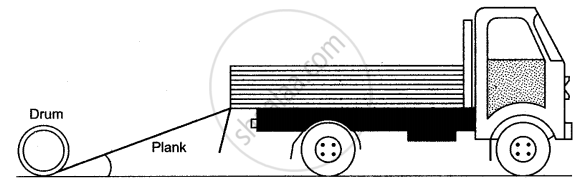
(i) How much force would be needed to lift a drum into the truck directly/without using the plank? (Take g = 10 m/s2)
(ii) How much energy would be required in lifting the drum into the truck without the plank?
(iii) If the force needed to push the drum up the plank is 300 N, why is this less than the answer to part (i)?
(iv) When the truck is loaded, the driver drives off. List the major energy changes that take place in moving the truck.
(v) The driver has to stop at the factory gates. What happens to the kinetic energy of the truck?
