Advertisements
Advertisements
प्रश्न
Advertisements
उत्तर
The turning effect produced by a force on a rigid body about a point, pivot or fulcrum is called the moment of force or torque. It is measured by the product of force and the perpendicular distance of the pivot from the line of action of the force.
Moment of a force = Force × perpendicular distance of the pivot from the force.
Its SI unit is newton-metre (Nm).
APPEARS IN
संबंधित प्रश्न
An effort is applied on the bigger wheel of a gear having 32 teeth. It is used to turn a wheel of 8 teeth. Where it is used.
State two effects of a force when applied on a body.
State the S.I. unit of moment of force.
Sleepers are used below the rails.
A spanner of length 10 cm is used to open a nut by applying a minimum force of 5.0 N. Calculate the moment of force required.
The spanner (or wrench) has a long handle.
A body is acted upon by two forces of magnitude F but in opposite directions. State the effect of the force if both forces act at the same point of the body.
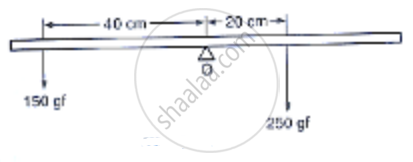
The diagram in the figure shows a uniform metre rule weighing 100 gf, pivoted as its centre O. two weight 150 gf and 250 gf hang from the point A and B respectively of the metre rule such that OA = 40 cm and OB = 20 cm . Calculate
the total anticlockwise moment about o.
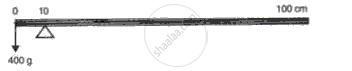
A meter scale is provided at 10 cm mark and is balanced by suspending 400 g from 0 cm mark (fig.). Calculate the mass of meter scale.
State one factor on which the magnitude of a non-contact force depends. How does the magnitude of a non-contact force change along with distance?
