Advertisements
Advertisements
प्रश्न
Advertisements
उत्तर
Given, mass of water = 80 kg
height = 20 m
g = 10 ms-2
time taken = 10s
Work done = mgh = 80 x 10 x 20 = 16000 J
Power = `"work done"/"time taken" = 16000/10 = 1600 "watt"`
APPEARS IN
संबंधित प्रश्न
Define 1 joule of work.
A boy does work when he pushes against a brick wall. (yes/no).
Write an expression for work done by a force depends?
No work is done by a man moving on a horizontal road while carrying a box on his head. Explain.
A boy of mass m climbs up a staircase of vertical height h.
- What is the work done by the boy against the force of gravity?
- What would have been the work done if he uses a lift in climbing the same vertical height?
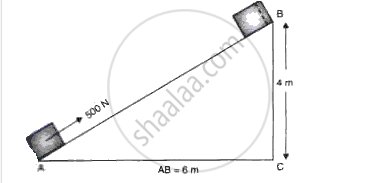
A block of mass 20 kg is pulled up a slope (fig.12) with a constant speed by applying a force of 500 N parallel to the slope. A and B are initial and final positions of the block.
(a) Calculate the work done by the force in moving the block from A and B.
(b) Calculate the potential energy gained by the block.
A bullet is of mass 'm' g and is moving with a velocity 'v' m/s. Find the kinetic energy of the bullet when
(a) The mass is doubled,
(b) The velocity is tripled.
An electric motor pump is 60% efficient and is rated 2.5 H.P. Calculate the maximum load it can lift through a height of 10m in 8 sec. (1 H.P. = 750 W).
A uniform chain of length 2 m is kept on a table such that a length of 60 cm hangs freely from the edge of the table. The total mass of the chain is 4 kg. What is the work done in pulling the entire chain on the table?
