Advertisements
Advertisements
प्रश्न
The arms of a beam balance are 20 cm and 21 cm, but the pans are of equal weight. By the method of double weighing the weights are found to be 1000 g and 20 g. Find the actual weight of the body
Advertisements
उत्तर
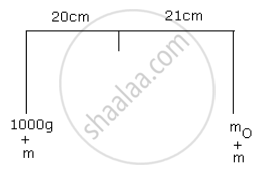
m = mass of each pan
m0 = actual mass of the body
(100 + m)20 = (m + m0) 21
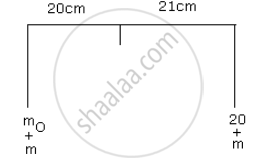
Dividing the two equations
`21/20 = ((100 + "m")20)/((20 + "m") 21)`
1.1 (20 + m) = (1000 + m)
22 + 1.1m = 1000 + m
0.1m = 978
m = 9780g
APPEARS IN
संबंधित प्रश्न
Define equilibrium.
The figure shows a uniform metre rule placed on a fulcrum at its mid-point O and having a weight 40 gf at the 10 cm mark and a weight of 20 gf at the 90 cm mark.
- Is the metre rule in equilibrium? If not how will the rule turn?
- How can the rule be brought in equilibrium by using an additional weight of 40 gf?

State two conditions for a body acted upon by several forces to be in equilibrium.
State the principle of moments. A meter scale is pivoted at 30 cm mark and it is in equilibrium when a mass of 40 g is suspended from 10 cm mark. Calculate the mass of the ruler.
In equilibrium algebraic sum of moments of all forces about the point of rotation is ______.
Explain when we carry weight, on one hand, we bend on the other side.
What is meant by equilibrium?
Explain the types of stability with suitable examples.
Give one example of static equilibrium.
