Advertisements
Advertisements
प्रश्न
In figure, a uniform bar of length l m is supported at its ends and loaded by a weight W kgf at its middle. In equilibrium, find the reactions R1 and R2 at the ends.

`["Hint:" "In equilibrium" "R"_1 + "R"_2 = "W" "and" "R"_1 xx l/2 = "R"_2 xx l/2]`
Advertisements
उत्तर
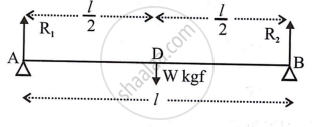
As D is the mid-point of AB `(l)`
∴ AD = DB = `l/2`
The usual responses R1 and R2, which act upward, balance the bar's weight W, which acts downward toward the center of the earth.
∴In equilibrium, R1 + R2 = W
Total upward reaction = (R1 × AD) + (R2 × DB)
= `(R_1 xx l/2) + (R_2 xx l/2)`
∵ `R_1 xx l/2 + R_2 xx l/2 = R` ...(suppose)
Total upward reaction = downward wt. of bar.
∴ R + R = W
2R = W
R = `"W"/2`
∴ R1 = `"W"/2 " kgf"` and R2 = `"W"/2 " kgf"`
APPEARS IN
संबंधित प्रश्न
Define equilibrium.
State two condition for a body acted upon by several forces to be in equilibrium.
What makes a balance faulty?
The moon revolving around the earth is in ______ equilibrium.
State the principle of moments.
What is the weight of a body placed at the centre of the earth?
What is a couple?
One end of a spring is kept fixed while the other end is stretched by a force as shown in the diagram.

(i) Copy the diagram and mark on it the direction of the restoring force.
(ii) Name one instrument which works on the above principle.
What are the three types of stability of an object?
Give one example of dynamic equilibrium.
