Advertisements
Advertisements
Question
In figure, a uniform bar of length l m is supported at its ends and loaded by a weight W kgf at its middle. In equilibrium, find the reactions R1 and R2 at the ends.

`["Hint:" "In equilibrium" "R"_1 + "R"_2 = "W" "and" "R"_1 xx l/2 = "R"_2 xx l/2]`
Advertisements
Solution
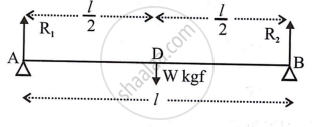
As D is the mid-point of AB `(l)`
∴ AD = DB = `l/2`
The usual responses R1 and R2, which act upward, balance the bar's weight W, which acts downward toward the center of the earth.
∴In equilibrium, R1 + R2 = W
Total upward reaction = (R1 × AD) + (R2 × DB)
= `(R_1 xx l/2) + (R_2 xx l/2)`
∵ `R_1 xx l/2 + R_2 xx l/2 = R` ...(suppose)
Total upward reaction = downward wt. of bar.
∴ R + R = W
2R = W
R = `"W"/2`
∴ R1 = `"W"/2 " kgf"` and R2 = `"W"/2 " kgf"`
APPEARS IN
RELATED QUESTIONS
Define equilibrium.
State two condition for a body acted upon by several forces to be in equilibrium.
State two conditions for a body acted upon by several forces to be in equilibrium.
State the principle of moments. A meter scale is pivoted at 30 cm mark and it is in equilibrium when a mass of 40 g is suspended from 10 cm mark. Calculate the mass of the ruler.
What do you mean by the state of equilibrium? What are the conditions for stable equilibrium?
Give scientific reason for the following:
In a moving bus the standing passenger stands keeping both his legs apart.
What do you mean by static equilibrium? Give one example.
A ball is placed on a compressed spring. When the spring is released, the ball is observed to fly away.
(i) What form of energy does the compressed spring possess?
(ii) Why does the ball fly away?
Explain the concept which is used in the continuous movement of the Thanjavur doll?
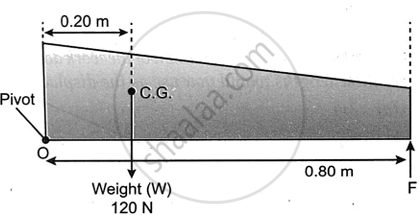
A non uniform beam of weight 120 N pivoted at one end is shown in the diagram below. Calculate the value of F to keep the beam in equilibrium.