Advertisements
Advertisements
Question
A uniform metre rule of mass 100 g is balanced on the fulcrum at mark 40 cm by suspending an unknown mass m at the mark 20 cm.
- Find the value of m.
- To which side the rule will tilt if the mass m is moved to the mark 10 cm?
- What is the resultant moment now?
- How can it be balanced by another mass of 50 g?
Advertisements
Solution
i. The 100 g weight of the rule produces a clockwise motion around the knife edge. Using the principle of moments, O. Wt. mg generates an anticlockwise moment.
Anticlockwise moment = Clockwise moment
(40 − 20) × M g = 100 g (50 − 40)
20 M g = 100 × 10
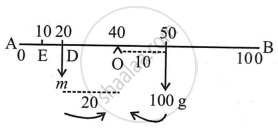
M = `(100 xx 10)/20`
= 50 g
ii. Suppose mass M is shifted to the left, or to the 10 cm mark. The rule will tilt to the left, or M's side.
iii. When M (50 g) is moved to left from 20 cm mark to E 10 cm mark by 10 cm.
Resultant moment now = M g × 10 cm
= (50 × 10) gf × cm
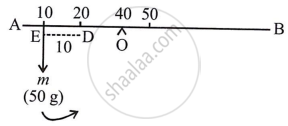
= 500 gf × cm anticlockwise
iv.
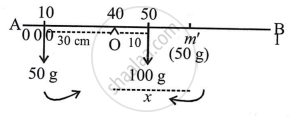
Let a mass of 50 g be suspended at a distance of x cm from O to the right side to balance the mass of 50 g at the 10 cm mark.
∴ Clockwise moments = Anticlockwise moment
100 × (50 − 40) + (50 × x) = 50 (40 − 10)
100 × 10 + 50x = 50 × 30
1000 + 50x = 1500
50x = 1500 − 1000
50x = 500
x = `500/50 = 10` cm to the right from the 40 cm mark, i.e., at 50 cm mark.
APPEARS IN
RELATED QUESTIONS
A uniform metre rule is pivoted at its mid-point. A weight of 50 gf is suspended at one end of it. Where should a weight of 100 gf be suspended to keep the rule horizontal?
The diagram below shows a uniform bar supported at the middle point O. A weight of 40 gf is placed at a distance of 40 cm to the left of the point O. How can you balance the bar with a weight of 80 gf?

When a boy weighing 20 kgf sits at one end of a 4 m long see-saw, it gets depressed at this end. How can it be brought to the horizontal position by a man weighing 40 kgf.
A uniform metre rule balances horizontally on a knife edge placed at the 58 cm mark when a weight of 20 gf is suspended from one end.
- Draw a diagram of the arrangement.
- What is the weight of the rule?
The diagram in Fig. shows a uniform metre rule weighing 100 gf, pivoted at its centre O. Two weights 150 gf and 250 gf hang from the point A and B respectively of the metre rule such that OA = 40 cm and OB = 20 cm. Calculate :
- the total anticlockwise moment about O,
- the total clockwise moment about O,
- the difference of anticlockwise and clockwise moments, and
- the distance from O where a 100 gf weight should be placed to balance the metre rule.

A uniform metre rule of weight 10 gf is pivoted at its 0 mark.
- What moment of force depresses the rule?
- How can it be made horizontal by applying a least force?
A uniform half-metre rule can be balanced at the 29.0 cm mark when a mass of 20 g is hung from its one end.
- Draw a diagram of the arrangement.
- Find the mass of the half-metre rule.
- In which direction would the balancing point shift if 20 g mass is shifted inside from its one end?
A uniform metre rule of mass 100g is balanced on a fulcrum at mark 40cm by suspending an unknown mass m at the mark 20cm. What is the resultant moment now?
A uniform metre rule of mass 100g is balanced on a fulcrum at mark 40cm by suspending an unknown mass m at the mark 20cm.
How can it be balanced by another mass 50 g ?
State the principle of moments.
