Advertisements
Advertisements
प्रश्न
In figure, a uniform bar of length l m is supported at its ends and loaded by a weight W kgf at its middle. In equilibrium, find the reactions R1 and R2 at the ends.

`["Hint:" "In equilibrium" "R"_1 + "R"_2 = "W" "and" "R"_1 xx l/2 = "R"_2 xx l/2]`
Advertisements
उत्तर
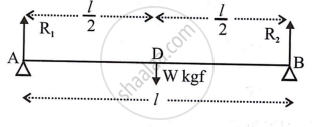
As D is the mid-point of AB `(l)`
∴ AD = DB = `l/2`
The usual responses R1 and R2, which act upward, balance the bar's weight W, which acts downward toward the center of the earth.
∴In equilibrium, R1 + R2 = W
Total upward reaction = (R1 × AD) + (R2 × DB)
= `(R_1 xx l/2) + (R_2 xx l/2)`
∵ `R_1 xx l/2 + R_2 xx l/2 = R` ...(suppose)
Total upward reaction = downward wt. of bar.
∴ R + R = W
2R = W
R = `"W"/2`
∴ R1 = `"W"/2 " kgf"` and R2 = `"W"/2 " kgf"`
APPEARS IN
संबंधित प्रश्न
State the principle of moments. A meter scale is pivoted at 30 cm mark and it is in equilibrium when a mass of 40 g is suspended from 10 cm mark. Calculate the mass of the ruler.
A meter scale is pivoted at its mid point and a 50 g mass suspended from the 20 cm mark. What mass balances the ruler when suspended from 65 cm mark?
A faulty balance of unequal arms and pans of unequal weights is used to find the true weight of a metal. By double weighing the weights are found to be 1210 g and 1000 g. Calculate the true weight of the metal.
In equilibrium algebraic sum of moments of all forces about the point of rotation is ______.
State the principle of moments.
Explain why It is easier to knock down a boy who is standing on one foot than one who is standing on two.
Give an experiment to verify the principle of moments.
How can we increase the stability of an object?
Give one example of static equilibrium.
Give one example of dynamic equilibrium.
