Advertisements
Online Mock Tests
Chapters
▶ 1: Force
2: Work, Energy and Power
3: Machines
LIGHT
4: Refraction of Light at Plane Surfaces
5: Refraction through a Lens
6: Spectrum
SOUND
7: Sound
ELECTRICITY AND MAGNETISM
8: Current Electricity
9: Household Circuits
10: Electro-Magnetism
HEAT
11: Calorimetry
MODERN PHYSICS
12: Radioactivity

Advertisements
Solutions for Chapter 1: Force
Below listed, you can find solutions for Chapter 1 of CISCE Selina for कनसाइज फिज़िक्स [इंग्रजी] इयत्ता १० आईसीएसई.
Selina solutions for कनसाइज फिज़िक्स [इंग्रजी] इयत्ता १० आईसीएसई 1 Force EXERCISE - 1 (A) [Pages 10 - 13]
MULTIPLE CHOICE TYPE: (Choose the correct answer from the options given below).
The motion of a door when a force is applied on its handle is:
rotational motion
linear motion
angular motion
zig-zag motion
The moment of a force about axis depends ______.
only on the magnitude of force
only on the perpendicular distance of force from the axis
neither on the force nor on the perpendicular distance of force from the axis
on both the force and its perpendicular distance from the axis
For producing the maximum turning effect ona body by a given force, the perpendicular distance of the line of action of force from the axis of rotation should be ______.
minimum
it does not matter
maximum
zero
The moment of force for anticlockwise moment is taken as ______ and for clockwise moment is taken as ______.
positive, negative
negative, positive
positive, positive
negative, negative
The direction of rotation of a pivoted body can be changed by changing ______.
the direction of force.
the point of application of force.
both the direction of force and the point of application of force.
the magnitude of force.
A couple is formed when ______ are not acting along the same line.
two unequal and parallel forces.
two equal and parallel forces.
two equal and opposite parallel forces.
two unequal and opposite parallel forces.
As per the principle of moments in equilibrium ______.
Sum of anticlockwise moments is greater than sum of clockwise moments.
Sum of anticlockwise moments is equal to sum of clockwise moments.
Sum of anticlockwise moments is less than sum of clockwise moments.
none of the above.
A body is acted upon by two unequal forces in opposite directions, but not in the same line. The effect is that ______.
the body will only have rotational motion.
the body will have only the translational motion.
the body will have neither the rotational motion nor the translational motion.
the body will have rotational as well as translational motion.
For a body to be in equilibrium, which of the following conditions is necessary?
Its momentum is zero.
Its kinetic energy is zero.
Its velocity is zero.
Its acceleration is zero.
State the condition when on applying a force, the body has the translational motion.
State the condition when on applying a force, the body has the rotational motion.
State whether the moment of force is a scalar or vector quantity?
Write the expression for the moment of force about a given axis.
State one way to reduce the moment of given force about a given axis of rotation.
State one way to obtain greater moment of a given force about a given axis of rotation.
Complete the following sentences:
The S.I. unit of moment of force is ______.
In equilibrium algebraic sum of moments of all forces about the point of rotation is ______.
In a beam balance, when the beam is balanced in a horizontal position, it is in ______ equilibrium.
The moon revolving around the earth is in ______ equilibrium.
SHORT QUESTIONS:
Define the moment of force.
State the S.I. unit of moment of force.
State two factors affecting the turning effect of a force.
When does a body rotate? State one way to change the direction of rotation of a body. Given a suitable example to explain your answer.
What do you understand by the clockwise and anticlockwise moment of force? When is it taken positive?
Why is it easier to open a door by applying the force at the free end of it?
The stone of hand flour grinder is provided with a handle near its rim. Give reason.
It is easier to turn the steering wheel of a large diameter than that of a small diameter. Given reason.
A spanner (or wrench) has a long handle. Why?
A jack screw is provided with a long arm. Explain why?
The adjacent diagram shows a heavy roller, with its axle at O, which is to be raised on a pavement XY. If there is friction between the roller and pavement, show by an arrow on the diagram the point of application and the direction of force to be applied. If pivoted at O, now will it go up?

Define the moment of a couple.
Write S.I. unit of moment of couple.
What do you mean by an equilibrium of a body?
State the condition when a body is in static equilibrium.
State the condition when a body is in dynamic equilibrium.
Give one example of static equilibrium.
Give one example of dynamic equilibrium.
State two conditions for a body acted upon by several forces to be in equilibrium.
State the principle of moments.
A, B and C are the three forces each of magnitude 4 N acting in the plane of the paper as shown in Figure. The point O lies in the same plane.
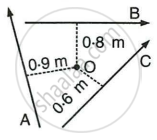
- Which force has the least moment about O? Give a reason.
- Which force has the greatest moment about O? Give a reason.
- Name the forces producing
(a) Clockwise
(b) anticlockwise moments. - What is the resultant torque about the point O?
A body is acted upon by two forces of magnitude F but in opposite directions. State the effect of the force if both forces act at the same point of the body.
A body is acted upon by two forces of magnitude F, but in opposite directions. State the effect of the force if the two forces act at two different points of the body at a separation r.
What do you understand by the term couple?
State the couple's effect on a body.
Give two examples of a couple's actions in our daily life.
Prove that
Moment of couple = Force × couple arm.
Describe a simple experiment to verify the principle of moments, if you are supplied with a metre rule, a fulcrum and two springs with slotted weights.
NUMERICALS:
A nut is opened by a wrench of length 25 cm. If the least force required is 10 N, find the moment of force needed to turn the nut.
A wheel of diameter 2 m is shown in the figure with the axle at O. A force F = 2 N is applied at B in the direction shown in the figure. Calculate the moment of force about
- the centre O, and
- the point A.

A 50 kg mass is being lifted by using a 1 metre long lever. If the length of the lever is reduced by 20%, how much more or less force is to be applied to achieve the same torqu?
A mechanic applies a force of 100 N at the end of a spanner to tighten a bolt. The length of the spanner is 0.5 metres. How much torque is exerted on the bolt? If the mechanic increases the force applied by 20% but holds the spanner closer at 0.4 metres, would it result in an increase or decrease of torque?
A steering wheel of diameter 0.5 m is rotated anticlockwise by applying two forces each of magnitude 6 N. Draw a diagram to show the application of forces and calculate the moment of forces applied.
The diagram in Fig shows two forces F1 = 5 N and F2 = 3 N acting at points A and B respectively of a rod pivoted at a point O, such that OA = 2 m and OB = 4 m.
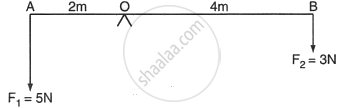
Calculate:
- the moment of force F1 about O.
- the moment of force F2 about O.
- total moment of the two forces about O.
Two forces each of magnitude 10 N act vertically upwards and downwards respectively at the two ends A and B of a uniform rod of length 4 m which is pivoted at its midpoint O as shown in the figure. Determine the magnitude of the resultant moment of forces about the pivot O.

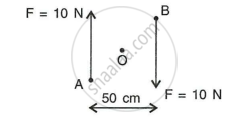
The figure shows two forces each of magnitude 10 N acting at the point A and B at a separation of 50 cm, in opposite directions. Calculate the resultant moment of two forces about the point.
- A,
- B and
- O situated exactly at the middle of the two forces.
A 55 kg student is climbing a rope ladder hanging from a helicopter. While climbing, the student leans 0.35 m backward from the vertical line of the ladder.
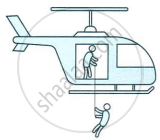
- Calculate the torque produced about the top support point of the rope ladder due to the student’s weight. [Take g = 10 m/s2]
- Explain why the ladder starts swinging when the student leans backward and how the student should climb to minimize the swinging.
An aluminium rod of length 50 cm whose mass per unit length is 0.15 kg/m is joined with a steel rod of length 50 cm whose mass per unit length is 0.45 kg/m as shown in the figure below.
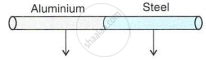
At what point should the rod be supported so that it remains in equilibrium horizontally?
The diagram below shows a uniform bar supported at the middle point O. A weight of 40 gf is placed at a distance of 40 cm to the left of the point O. How can you balance the bar with a weight of 80 gf?

The figure shows a uniform metre rule placed on a fulcrum at its mid-point O and having a weight 40 gf at the 10 cm mark and a weight of 20 gf at the 90 cm mark.
- Is the metre rule in equilibrium? If not how will the rule turn?
- How can the rule be brought in equilibrium by using an additional weight of 40 gf?

When a boy weighing 20 kgf sits at one end of a 4 m long see-saw, it gets depressed at this end. How can it be brought to the horizontal position by a man weighing 40 kgf.
A physical balance has its arms of length 60 cm and 40 cm. What weight kept on pan of the longer arm will balance an object of weight 100 gf kept on other pan?
The diagram in Fig. shows a uniform metre rule weighing 100 gf, pivoted at its centre O. Two weights 150 gf and 250 gf hang from the point A and B respectively of the metre rule such that OA = 40 cm and OB = 20 cm. Calculate :
- the total anticlockwise moment about O,
- the total clockwise moment about O,
- the difference of anticlockwise and clockwise moments, and
- the distance from O where a 100 gf weight should be placed to balance the metre rule.

A uniform metre rule of weight 10 gf is pivoted at its 0 mark.
- What moment of force depresses the rule?
- How can it be made horizontal by applying a least force?
A uniform half-metre rule can be balanced at the 29.0 cm mark when a mass of 20 g is hung from its one end.
- Draw a diagram of the arrangement.
- Find the mass of the half-metre rule.
- In which direction would the balancing point shift if 20 g mass is shifted inside from its one end?
A uniform metre rule of mass 100 g is balanced on the fulcrum at mark 40 cm by suspending an unknown mass m at the mark 20 cm.
- Find the value of m.
- To which side the rule will tilt if the mass m is moved to the mark 10 cm?
- What is the resultant moment now?
- How can it be balanced by another mass of 50 g?
In figure, a uniform bar of length l m is supported at its ends and loaded by a weight W kgf at its middle. In equilibrium, find the reactions R1 and R2 at the ends.

`["Hint:" "In equilibrium" "R"_1 + "R"_2 = "W" "and" "R"_1 xx l/2 = "R"_2 xx l/2]`
Selina solutions for कनसाइज फिज़िक्स [इंग्रजी] इयत्ता १० आईसीएसई 1 Force EXERCISE - 1 (B) [Pages 16 - 17]
MULTIPLE CHOICE TYPE: (Choose the correct answer from the options given below).
The centre of gravity of a body is the point about which the algebraic sum of moments of weights of all the particles constituting the body is ______.
1
>1
<1
0
The centre of gravity of a hollow cone of height h is at distance x from its vertex where the value of x is ______.
`h/3`
`h/4`
`(2h)/3`
`(3h)/4`
Where should the centre of gravity of a body be located for stable equilibrium?
above the base
near the geometric centre
can be anywhere
both (a) and (b)
Two objects have the same mass but different shapes. Which object would have a higher centre of gravity?
the one with a larger base.
the one with a smaller base.
both would have the same centre of gravity.
it depends on the material of the object.
A hollow cone is kept upright on a table. When sand is slowly poured in it, the centre of gravity of the cone-sand system will ______.
always rise continuously.
always fall continuously.
first falls and then rises.
remain fixed at the same point.
A child starts eating an ice cream from a fully-filled cone. What happens to its centre of gravity?
rises continuously
falls continuously
remains constant
none of the above
A hollow spherical tank is half-filled with oil. If water (denser than oil) is added, the overall centre of gravity will ______.
move upward
move downward
remain at the same point
first rises and then falls
A hollow rectangular box is standing upright. A heavy brick is placed on top of the box. The centre of gravity of the system will ______.
move downward
move upward
remain at the same point
first move up and then down
VERY SHORT QUESTIONS:
State whether the following statements are true or false.
'The position of the centre of gravity of a body remains unchanged even when the body is deformed'.
True
False
'The centre of gravity of a freely suspended body always lies vertically below the point of suspension'.
True
False
SHORT QUESTIONS:
State a factor on which the position of the centre of gravity of a body depend? Explain your answer with an example.
A square cardboard is suspended by passing a pin through a narrow hole at its one corner. Draw a diagram to show its rest position. In the diagram, mark the point of suspension by the letter S and the centre of gravity by the letter G.
Humans bend forward when they carry a heavy load on their back. Give reason.
You are assigned to look after a loading of a cargo ship with containers marked A and B. The A type containers are (50%) more heavier than B type containers. What precaution would you take and why so that the ship sails smoothly even in rougher seas?
A uniform flat circular rim is balanced on a sharp vertical nail by supporting it at point A, as shown in the figure. Mark the position of the centre of gravity of the rim in the diagram by the letter G.

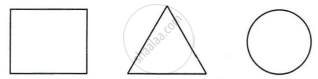
The figure shows three pieces of cardboard of uniform thickness cut into three different shapes. On each diagram draw two lines to indicate the position of the centre of gravity G.
LONG QUESTIONS:
Explain how you will determine experimentally the position of the centre of gravity for a triangular lamina (or a triangular piece of cardboard).
Selina solutions for कनसाइज फिज़िक्स [इंग्रजी] इयत्ता १० आईसीएसई 1 Force EXERCISE - 1 (C) [Pages 20 - 21]
MULTIPLE CHOICE TYPE: (Choose the correct answer from the options given below).
Which of the following quantity remains constant in uniform circular motion:
Velocity
Speed
Acceleration
Both velocity and speed
The direction of motion in circular motion ______.
is linear
is along the tangent at that point of the circular path
towards the centre
none of these
The direction of centripetal force is always ______.
along the tangent at that point of the circular path.
towards the centre.
outwards from the centre.
none of the above.
The centrifugal force is ______.
a real force
the force of reaction of centripetal force
a fictitious force
Directed towards the centre of circular path
An artificial satellite is moving in a circular orbit around the Earth. Which statement is correct?
A force is needed to keep it moving as its speed is changing.
No force is needed as it is in space.
A tangential force of gravity increases its speed.
Centripetal force due to the Earth’s gravity continuously changes the direction of velocity.
Clothes in a dryer of a washing machine appear to stick to the drum walls during spinning. What provides the necessary centripetal force to keep the clothes moving in a circle.
gravitational force
friction between clothes
tension in clothes
drum wall
Assertion (A): When a beam is in static equilibrium, the sum of clockwise moments is equal to the sum of anticlockwise moments.
Reason (R): According to the principle of moments for a body in equilibrium, the sum of moments acting in one direction must be equal to the sum of moments in opposite direction.
both A and R are true and R is the correct explanation of A.
both A and R are True and R is not the correct explanation of A.
assertion is false but reason is true.
assertion is true but reason is false.
Assertion (A): A heavier object placed at a far distance from the pivot point will have the same moment as a lighter object placed close to the pivot point.
Reason (R): The moment of force is determined by the magnitude of the force along with its perpendicular distance from the pivot point.
both A and R are true and R is the correct explanation of A.
both A and R are True and R is not the correct explanation of A.
assertion is false but reason is true.
assertion is true but reason is false.
Assertion (A): The centre of gravity of an irregularly-shaped object always lies at its geometric centre.
Reason (R): The centre of gravity depends on the distribution of mass within an object.
both A and R are true and R is the correct explanation of A.
both A and R are True and R is not the correct explanation of A.
assertion is false but reason is true.
assertion is true but reason is false.
VERY SHORT QUESTIONS:
Is it possible to have an accelerated motion with a constant speed? Name such type of motion.
Give an example of motion in which speed remains uniform, but the velocity changes.
Name the force required for circular motion. State its direction.
Is centrifugal force a real force?
State whether the following statements are true or false by writing T/F against them.
Earth moves around the sun with uniform velocity.
True
False
The motion of the moon around the earth in a circular path is an accelerated motion.
True
False
A uniform linear motion is unaccelerated, while a uniform circular motion is an accelerated motion.
True
False
In a uniform circular motion, the speed continuously changes because of the direction of motion changes.
True
False
A boy experiences a centrifugal force on his hand when he rotates a piece of stone tied at one end of a string, holding the other end in the hand.
True
False
SHORT QUESTIONS:
Differentiate between uniform linear motion and uniform circular motion.
With reference to the direction of action, how does a centripetal force differ from centrifugal force?
Is centrifugal force considered as the force of reaction of the centripetal force?
Compare the magnitudes of centripetal and centrifugal force.
State two differences between the centripetal and centrifugal force.
LONG QUESTIONS:
Explain the meaning of uniform circular motion.
Why is uniform circular motion said to be accelerated?
Draw a neat labelled diagram for a particle moving in a circular path with a constant speed. In you diagram show the direction of velocity at any instant.
A uniform circular motion is an accelerated motion. Explain it. State whether the acceleration is uniform or variable? Name the force responsible to cause this acceleration. What is the direction of force at any instant? Draw a diagram in support of your answer.
| A small pebble tied at one end of a string is placed near the periphery of a circular disc, at the centre of which the other end of the string is tied to a peg. The disc is rotating about an axis passing through its centre. |
- What will be your observation when you are standing outside the disc? Explain.
- What will be your observation when you are standing at the centre of the disc? Explain.
A piece of stone tied at the end of a thread is whirled in a horizontal circle with uniform speed by hand. Answer the following questions:
- Is the velocity of stone uniform or variable?
- Is the acceleration of stone uniform or variable?
- What is the direction of acceleration of stone at any instant?
- Which force provides the centripetal force required for circular motion?
- Name the force and its direction which acts on the hand.
Solutions for 1: Force
Selina solutions for कनसाइज फिज़िक्स [इंग्रजी] इयत्ता १० आईसीएसई chapter 1 - Force
Shaalaa.com has the CISCE Mathematics कनसाइज फिज़िक्स [इंग्रजी] इयत्ता १० आईसीएसई CISCE solutions in a manner that help students grasp basic concepts better and faster. The detailed, step-by-step solutions will help you understand the concepts better and clarify any confusion. Selina solutions for Mathematics कनसाइज फिज़िक्स [इंग्रजी] इयत्ता १० आईसीएसई CISCE 1 (Force) include all questions with answers and detailed explanations. This will clear students' doubts about questions and improve their application skills while preparing for board exams.
Further, we at Shaalaa.com provide such solutions so students can prepare for written exams. Selina textbook solutions can be a core help for self-study and provide excellent self-help guidance for students.
Concepts covered in कनसाइज फिज़िक्स [इंग्रजी] इयत्ता १० आईसीएसई chapter 1 Force are Forms of Energy > Solar Energy, Concept of Work, Measurement of Work, Concept of Power, Conversion of Energies, Principle of Conservation of Energy, Interconnection of Kinetic and Potential Energies, Application of the Principle of Conservation of Energy, Expression for Work (W = F S cosθ), Mechanical Energy > Potential Energy (U), Concept of Energy, Mechanical Energy > Kinetic Energy (K), Forms of Energy > Heat Energy, Forms of Energy > Light Energy, Forms of Energy > Chemical Energy, Forms of Energy > Hydro Energy, Forms of Energy > Electrical Energy, Forms of Energy > Nuclear Energy, Forms of Energy > Geo Thermal Energy, Forms of Energy > Wind Energy, Forms of Energy > Sound Energy, Forms of Energy > Magnetic Energy, Forms of Energy > Mechanical Energy, Examples of No Work Being Done, Work Done Against Gravity, Expression for Kinetic Energy, Rotational, Translational and Vibrational Kinetic Energy, Expression for Potential Energy, Work Energy Theorem, Conservation of Energy In Case of a Freely Falling Body, Dissipation of Energy, Examples of Inte-Conversion of Energy, Introduction to Effects of Force, Translational and Rotational Motions, Couple, Moment (Turning Effect) of a Force or Torque, Equilibrium of Bodies, Principle of Moments, Turning Forces On Rigid Bodies, Centre of Gravity, Uniform Circular Motion (UCM), Centripetal Force, Centrifugal Forces, Examples of Couple in Everyday Life, Conditions of Equilibrium, Equilibrium and Stability, States of Equilibrium, Centre of Gravity and Stability, Conditions for Stable Equilibrium, Practical Examples of Stability and Centre of Gravity, Introduction to Effects of Force, Translational and Rotational Motions, Couple, Moment (Turning Effect) of a Force or Torque, Equilibrium of Bodies, Principle of Moments, Turning Forces On Rigid Bodies, Centre of Gravity, Uniform Circular Motion (UCM), Centripetal Force, Centrifugal Forces, Examples of Couple in Everyday Life, Conditions of Equilibrium, Equilibrium and Stability, States of Equilibrium, Centre of Gravity and Stability, Conditions for Stable Equilibrium, Practical Examples of Stability and Centre of Gravity, Introduction to Effects of Force, Translational and Rotational Motions, Couple, Moment (Turning Effect) of a Force or Torque, Equilibrium of Bodies, Principle of Moments, Turning Forces On Rigid Bodies, Centre of Gravity, Uniform Circular Motion (UCM), Centripetal Force, Centrifugal Forces, Examples of Couple in Everyday Life, Conditions of Equilibrium, Equilibrium and Stability, States of Equilibrium, Centre of Gravity and Stability, Conditions for Stable Equilibrium, Practical Examples of Stability and Centre of Gravity.
Using Selina कनसाइज फिज़िक्स [इंग्रजी] इयत्ता १० आईसीएसई solutions Force exercise by students is an easy way to prepare for the exams, as they involve solutions arranged chapter-wise and also page-wise. The questions involved in Selina Solutions are essential questions that can be asked in the final exam. Maximum CISCE कनसाइज फिज़िक्स [इंग्रजी] इयत्ता १० आईसीएसई students prefer Selina Textbook Solutions to score more in exams.
Get the free view of Chapter 1, Force कनसाइज फिज़िक्स [इंग्रजी] इयत्ता १० आईसीएसई additional questions for Mathematics कनसाइज फिज़िक्स [इंग्रजी] इयत्ता १० आईसीएसई CISCE, and you can use Shaalaa.com to keep it handy for your exam preparation.
