Advertisements
Advertisements
प्रश्न
Why is uniform circular motion said to be accelerated?
Advertisements
उत्तर
A body travelling in a circular path with a constant speed is said to be moving at an accelerated rate, since the velocity changes as the direction changes.
APPEARS IN
संबंधित प्रश्न
An aircraft executes a horizontal loop of radius 1.00 km with a steady speed of 900 km/h. Compare its centripetal acceleration with the acceleration due to gravity.
Draw a neat labelled diagram for a particle moving in a circular path with a constant speed. In you diagram show the direction of velocity at any instant.
A uniform circular motion is an accelerated motion. Explain it. State whether the acceleration is uniform or variable? Name the force responsible to cause this acceleration. What is the direction of force at any instant? Draw a diagram in support of your answer.
Which of the following quantity remains constant in a uniform circular motion?
A particle goes round a circular path with uniform speed v. After describing half the circle, what is the change in its centripetal acceleration?
The ratio of the angular speed of minute hand and hour hand of a watch is ____________.
A small sphere is attached to a cord and rotates in a vertical circle about a point O. If the average speed of the sphere is increased, the cord is most likely to break at the orientation when the mass is at ____________.
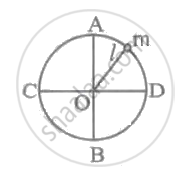
It is possible to have objects moving with uniform velocity but non-uniform acceleration.
For a particle performing uniform circular motion, choose the correct statement(s) from the following:
- Magnitude of particle velocity (speed) remains constant.
- Particle velocity remains directed perpendicular to radius vector.
- Direction of acceleration keeps changing as particle moves.
- Angular momentum is constant in magnitude but direction keeps changing.
In uniform circular motion, although the speed is constant, why does acceleration occur?
