Advertisements
Advertisements
प्रश्न
A stone tied to the end of a string 80 cm long is whirled in a horizontal circle with a constant speed. If the stone makes 14 revolutions in 25 s, what is the magnitude and direction of acceleration of the stone?
Advertisements
उत्तर
Length of the string, l = 80 cm = 0.8 m
Number of revolutions = 14
Time taken = 25 s
Frequency v = `"Number of revolution"/"Time taken" = 14/25 Hz`
Angular frequency, ω = 2πν
`2xx22/7xx14/25 = 88/25 rads^(-1)`
Centripetal acceleration, `a_c = omega^2 r`
=`(88/25)^2 xx 0.8`
= `0.80 xx 88/25 xx 88/25`
= 9.90 `ms^(-2)`
The direction of centripetal acceleration is always directed along the string, toward the centre, at all points.
APPEARS IN
संबंधित प्रश्न
In U. C. M (Uniform Circular Motion), prove the relation `vec v = vec w xx vec r`, where symbols have their usual meanings.
A vehicle is moving on a circular track whose surface is inclined towards the horizon at an angle of 10°. The maximum velocity with which it can move safely is 36 km / hr. Calculate the length of the circular track. [π = 3.142]
Explain the meaning of uniform circular motion. Give one example of such motion.
Which of the following quantity remains constant in a uniform circular motion?
A uniform metre rule of mass 100g is balanced on a fulcrum at mark 40cm by suspending an unknown mass m at the mark 20cm.
To which side the rule will tilt if the mass m is moved to the mark 10cm ?
Which of the following remains constant in a uniform circular motion, Speed or Velocity, or both?
Is it possible to have an accelerated motion with a constant speed? Explain.
What is a conical pendulum?
Answer the following question.
Show that the centripetal force on a particle undergoing uniform circular motion is -mrω2.
If a particle moves with uniform speed then its tangential acceleration will be ______.
A particle goes round a circular path with uniform speed v. After describing half the circle, what is the change in its centripetal acceleration?
A small sphere is attached to a cord and rotates in a vertical circle about a point O. If the average speed of the sphere is increased, the cord is most likely to break at the orientation when the mass is at ____________.
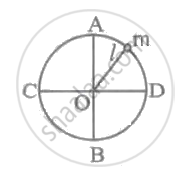
A cyclist is riding with a speed of 43.2 km/h. As he approaches a circular turn on the road of radius 60 m, he applies brakes and reduces his speed at constant rate of 1.8 ms-2. The magnitude of the net acceleration of the cyclist is ______.
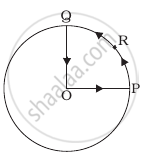
A cyclist starts from centre O of a circular park of radius 1 km and moves along the path OPRQO as shown figure. If he maintains constant speed of 10 ms–1, what is his acceleration at point R in magnitude and direction?
A wet open umbrella is held upright and is rotated about the handle at a uniform rate of 21 revolutions in 44 s. If the rim of the umbrella is a circle of 1 metre in diameter and the height of the rim above the floor is 1.5 m, the drops of water spun off the rim and hit the floor at a horizontal ______ m from the umbrella.
A ceiling fan rotates about its own axis with some angular velocity. When the fan is switched off the angular velocity becomes `(1/4)^"th"` of the original in time 't' and 'n' revolutions are made in that time. The number of revolutions made by the fan during the time interval between switch off and rest are ______. (Angular retardation is uniform)
A particle moves along a circle of radius r with constant tangential acceleration. If the velocity of the particle is v at the end of second revolution, after the revolution has started, then the tangential acceleration is ______.
A thin uniform circular disc of mass M and radius R is rotating in a horizontal plane about an axis passing through its centre and perpendicular to its plane with an angular velocity ω. Another disc of same dimensions, but of mass `1/4`M is placed gently on the first disc co-axially. The. angular velocity of the system is ______.
A wheel is Subjected to uniform angular acceleration about its axis. Initially. its angular velocity is zero. In the first 2 s, it rotates through an angle θ1, in the next 2 s, it rotates through an angle θ2. The ratio of `theta_2/theta_1` is ______.
What is the direction of the velocity of an object at any point during uniform circular motion?
