Advertisements
Advertisements
प्रश्न
A stone tied to the end of a string 80 cm long is whirled in a horizontal circle with a constant speed. If the stone makes 14 revolutions in 25 s, what is the magnitude and direction of acceleration of the stone?
Advertisements
उत्तर
Length of the string, l = 80 cm = 0.8 m
Number of revolutions = 14
Time taken = 25 s
Frequency v = `"Number of revolution"/"Time taken" = 14/25 Hz`
Angular frequency, ω = 2πν
`2xx22/7xx14/25 = 88/25 rads^(-1)`
Centripetal acceleration, `a_c = omega^2 r`
=`(88/25)^2 xx 0.8`
= `0.80 xx 88/25 xx 88/25`
= 9.90 `ms^(-2)`
The direction of centripetal acceleration is always directed along the string, toward the centre, at all points.
APPEARS IN
संबंधित प्रश्न
Draw a neat labelled diagram of conical pendulum. State the expression for its periodic time in terms of length.
Is it possible to have an accelerated motion with a constant speed? Explain
Explain the meaning of uniform circular motion. Give one example of such motion.
Name the force required for uniform circular motion. State its direction.
Define Uniform circular motion.
Solve the following problem.
A particle moves in a circle with a constant speed of 15 m/s. The radius of the circle is 2 m. Determine the centripetal acceleration of the particle.
Which one of the following is most likely not a case of uniform circular motion?
Which of the following graph represents uniform motion of a moving particle?
What is meant by uniform circular motion? Give two examples of uniform circular motion.
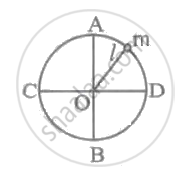
A small sphere is attached to a cord and rotates in a vertical circle about a point O. If the average speed of the sphere is increased, the cord is most likely to break at the orientation when the mass is at ____________.
Certain neutron stars are believed to be rotating at about 1 rev/s. If such a star has a radius of 1.6 km, the acceleration of an object on the equator of the star will be nearly ____________.
The motion of the bus is ______ motion.
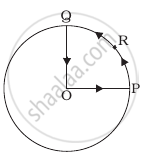
A cyclist starts from centre O of a circular park of radius 1 km and moves along the path OPRQO as shown figure. If he maintains constant speed of 10 ms–1, what is his acceleration at point R in magnitude and direction?
A particle is given an initial speed u inside a smooth spherical shell of radius R = 1 m that it is just able to complete the circle. Acceleration of the particle when its velocity is vertical is ______.

A rod PQ of mass M and length L is hinged at end P. The rod is kept horizontal by a massless string tied to point Q as shown in figure. When string is cut, the initial angular acceleration of the rod is ______.

Angular speed of hour hand of a clock in degree per second is ______.
A wheel is rotating at 900 rpm about its axis. When the power is cut off it comes to rest in 1 min. The angular retardation (assumed to be uniform (in rad s-1) is ______.
Why is uniform circular motion said to be accelerated?
In uniform circular motion, although the speed is constant, why does acceleration occur?
Angular displacement is measured in which unit?
