Advertisements
Advertisements
प्रश्न
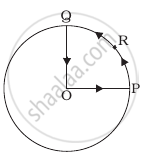
A cyclist starts from centre O of a circular park of radius 1 km and moves along the path OPRQO as shown figure. If he maintains constant speed of 10 ms–1, what is his acceleration at point R in magnitude and direction?
Advertisements
उत्तर
According to the problem, the path of the cyclist is OPRQO.
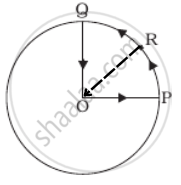
The cyclist is in uniform circular motion and it is given that linear velocity = 10 m/s, R = 1 km = 1000 m. As we know whenever an object is performing a circular motion, acceleration is called centripetal acceleration and is always directed towards the centre. So cyclist experiences a centripetal force (acceleration) at point R towards the centre.
The centripetal acceleration at R is given by the relation, `a_c = v^2/r`
⇒ `a_c = (10)^2/1000`
= `100/10^3`
= 0.1 m/s2 along RO.
APPEARS IN
संबंधित प्रश्न
Why is the motion of a body moving with a constant speed around a circular path said to be accelerated?
Give an example of motion in which speed remains uniform, but the velocity changes.
State True or False
The earth moves around the sun with a uniform.
Answer the following question.
Show that the centripetal force on a particle undergoing uniform circular motion is -mrω2.
Solve the following problem.
A projectile is thrown at an angle of 30° to the horizontal. What should be the range of initial velocity (u) so that its range will be between 40m and 50 m? Assume g = 10 m s-2.
Which one of the following is most likely not a case of uniform circular motion?
The angle subtended by the vector A = `5hat"i" + 3hat"j" + 12hat"k"` with the X-axis is ______.
A uniform rod of length '6L' and mass '8 m' is pivoted at its centre 'C'. Two masses 'm' and ' 2m' with speed 2v, v as shown strikes the rod and stick to the rod. Initially the rod is at rest. Due to impact, if it rotates with angular velocity 'w1' then 'w' will be ________.

A small sphere is attached to a cord and rotates in a vertical circle about a point O. If the average speed of the sphere is increased, the cord is most likely to break at the orientation when the mass is at ____________.
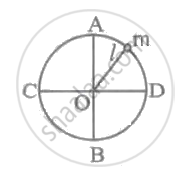
A particle is moving in uniform circular motion with speed 'V' and radius 'R'. The angular acceleration of the particle is ______.
Select the WRONG statement.
The angular speed of the minute hand of a clock in degrees per second is ______.
Which of the following is correct about uniform circular motion
- the direction of motion is continuously changed
- the direction of motion is not changed
- speed and direction both remain constant
- speed is constant but the direction is changing
Define uniform circular motion and give an example of it. Why is it called accelerated motion?
A point object moves along an arc of a circle of radius 'R'. Its velocity depends upon the distance covered 'S' as V = `Ksqrt(S)` where 'K' is a constant. If 'e' is the angle between the total acceleration and tangential acceleration, then
A particle is performing a uniform circular motion along a circle of radius R. In half the period of revolution, its displacement and distance covered are respectively.
The kinetic energy K of a particle moving along a circle of radius R depends on the distance covered s as K = as2, where a is a constant. The force acting on the particle is ______.
Explain the meaning of uniform circular motion.
By applying Kepler's third law to the formula for centripetal force, Newton concluded that the force acting on a planet is:
