Advertisements
Advertisements
Question
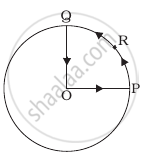
A cyclist starts from centre O of a circular park of radius 1 km and moves along the path OPRQO as shown figure. If he maintains constant speed of 10 ms–1, what is his acceleration at point R in magnitude and direction?
Advertisements
Solution
According to the problem, the path of the cyclist is OPRQO.
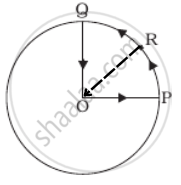
The cyclist is in uniform circular motion and it is given that linear velocity = 10 m/s, R = 1 km = 1000 m. As we know whenever an object is performing a circular motion, acceleration is called centripetal acceleration and is always directed towards the centre. So cyclist experiences a centripetal force (acceleration) at point R towards the centre.
The centripetal acceleration at R is given by the relation, `a_c = v^2/r`
⇒ `a_c = (10)^2/1000`
= `100/10^3`
= 0.1 m/s2 along RO.
APPEARS IN
RELATED QUESTIONS
In U. C. M (Uniform Circular Motion), prove the relation `vec v = vec w xx vec r`, where symbols have their usual meanings.
Draw a neat labelled diagram of conical pendulum. State the expression for its periodic time in terms of length.
Read the statement below carefully and state, with reason, if it is true or false:
The velocity vector of a particle at a point is always along the tangent to the path of the particle at that point.
Is it possible to have an accelerated motion with a constant speed? Explain
State True or False
The earth moves around the sun with a uniform.
Which of the following quantity remains constant in a uniform circular motion?
Which of the following remains constant in a uniform circular motion, Speed or Velocity, or both?
Define Uniform circular motion.
A particle goes round a circular path with uniform speed v. After describing half the circle, what is the change in its centripetal acceleration?
A wheel is 0.25 m in radius. When it makes 15 revolutions per minute, its linear speed at the point on circumference is ____________.
A ball of mass 'm' is attached to the free end of an inextensible string of length 'l'. Let 'T' be the tension in the string. The ball is moving in horizontal circular path about the vertical axis. The angular velocity of the ball at any particular instant will be ______.
A stone of mass 3 kg attached at one end of a 2m long string is whirled in horizontal circle. The string makes an angle of 45° with the vertical then the centripetal force acting on the string is ______.
(g = 10 m/s2 , tan 45° = 1)
A string of length `l` is fixed at one end and carries a mass 'm' at the other end. The mass is revolving along a horizontal circle of radius 'r' making 'θ' as the semi-vertical angle of cone and `(1/pi)` revolutions per second around the vertical axis through fixed end. The tension in the string is ______.
The given graph represents motion with ______ speed.
In uniform motion, an object travels equal ______ in ______ interval of time.
For a particle performing uniform circular motion, choose the correct statement(s) from the following:
- Magnitude of particle velocity (speed) remains constant.
- Particle velocity remains directed perpendicular to radius vector.
- Direction of acceleration keeps changing as particle moves.
- Angular momentum is constant in magnitude but direction keeps changing.
Earth can be thought of as a sphere of radius 6400 km. Any object (or a person) is performing circular motion around the axis of earth due to earth’s rotation (period 1 day). What is acceleration of object on the surface of the earth (at equator) towards its centre? what is it at latitude θ? How does these accelerations compare with g = 9.8 m/s2?
A wet open umbrella is held upright and is rotated about the handle at a uniform rate of 21 revolutions in 44 s. If the rim of the umbrella is a circle of 1 metre in diameter and the height of the rim above the floor is 1.5 m, the drops of water spun off the rim and hit the floor at a horizontal ______ m from the umbrella.
The distance of the Sun from earth is 1.5 × 10¹¹ m and its angular diameter is (2000) s when observed from the earth. The diameter of the Sun will be ______.
The relationship between an object's linear velocity (v) and its angular velocity (ω) in a circular path of radius (r) is given by:
