Advertisements
Advertisements
Question
In U. C. M (Uniform Circular Motion), prove the relation `vec v = vec w xx vec r`, where symbols have their usual meanings.
Advertisements
Solution
Analytical method :
Consider a particle revolving in the anticlockwise sense along the circumference of a circle of radius r with centre O as shown.
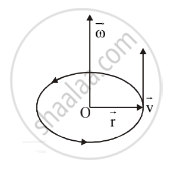
Let
`vec omega`= angular velocity of the particle
`vec v`= linear velocity of the particle
`vec r`= radius of the particle
In the vector form, the linear dispalcement is
`vec (delta s) = vec (delta theta) times vec r`
Dividing both sides by `delta t` we get
`vec (delta s)/(delta t) = vec (delta theta)/(delta t) times vec r`
`lim_(delta t -> 0) vec (delta s)/(delta t) = lim_(delta t -> 0) vec (delta theta)/(delta t) times vec r`
`therefore vec(dS)/dt = vec(d theta)/(delta t) times vec r`
but
`vec(dS)/dt = vec v` = Linear velocity
`vec(d theta)/(delta t) = vec omega` = angular velocity
`therefore vec v = vec omega times vec r`
APPEARS IN
RELATED QUESTIONS
For a particle performing uniform circular motion `vecv=vecomegaxxvecr`obtain an expression for linear acceleration of the particle performing non-uniform circular motion.
A uniform circular motion is an accelerated motion. Explain it. State whether the acceleration is uniform or variable? Name the force responsible to cause this acceleration. What is the direction of force at any instant? Draw a diagram in support of your answer.
Differentiate between uniform linear motion and uniform circular motion.
A uniform linear motion is unaccelerated, while a uniform circular motion is an accelerated motion.
A uniform metre rule of mass 100g is balanced on a fulcrum at mark 40cm by suspending an unknown mass m at the mark 20cm.
To which side the rule will tilt if the mass m is moved to the mark 10cm ?
Answer the following question.
Show that the centripetal force on a particle undergoing uniform circular motion is -mrω2.
Which one of the following is most likely not a case of uniform circular motion?
Which of the following graph represents uniform motion of a moving particle?
Is the uniform circular motion accelerated? Give reasons for your answer.
What is meant by uniform circular motion? Give two examples of uniform circular motion.
The angle subtended by the vector A = `5hat"i" + 3hat"j" + 12hat"k"` with the X-axis is ______.
A particle goes round a circular path with uniform speed v. After describing half the circle, what is the change in its centripetal acceleration?
The ratio of the angular speed of minute hand and hour hand of a watch is ____________.
Consider a simple pendulum of length 4 m. Its bob performs a circular motion in horizontal plane with its string making an angle 60° with the vertical. The Period of rotation of the bob is ____________.(Take g = 10 m/s2)
A body of mass ·m' is moving along a circle of radius 'r' with linear speed 'v'. Now, to change the linear speed to `V/2` and to move it along the circle of radius '4r', required change in the centripetal force of the body is ______.
A mass 'm' is tied to one end of a spring and whirled in a horizontal circle with constant angular velocity. The elongation in the spring is 1 cm. If the angular speed is doubled, the elongation in the spring is 6 cm. The original length of the spring is ______.
Two particles P and Q are moving in concentric circles of rarui rp and rQ respectively. If their period of revolutions are in ratio 2 : 3, then ratio of their centripetal acceleration is ____________.
Which of the following is correct about uniform circular motion
- the direction of motion is continuously changed
- the direction of motion is not changed
- speed and direction both remain constant
- speed is constant but the direction is changing
A flywheel at rest is to reach an angular velocity of 24 rad/s in 8 second with constant angular acceleration. The total angle turned through during this interval is ______.
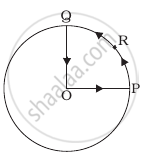
A cyclist starts from centre O of a circular park of radius 1 km and moves along the path OPRQO as shown figure. If he maintains constant speed of 10 ms–1, what is his acceleration at point R in magnitude and direction?
A wet open umbrella is held upright and is rotated about the handle at a uniform rate of 21 revolutions in 44 s. If the rim of the umbrella is a circle of 1 metre in diameter and the height of the rim above the floor is 1.5 m, the drops of water spun off the rim and hit the floor at a horizontal ______ m from the umbrella.
The distance of the Sun from earth is 1.5 × 10¹¹ m and its angular diameter is (2000) s when observed from the earth. The diameter of the Sun will be ______.
A particle is performing a uniform circular motion along a circle of radius R. In half the period of revolution, its displacement and distance covered are respectively.
A horizontal circular platform of mass M is rotating at angular velocity ω about a vertical axis passing through its centre. A boy of mass m is standing at the edge of the platform. If the boy comes to the centre of the platform, then the new angular velocity becomes ______.
Why is uniform circular motion said to be accelerated?
What is the direction of the velocity of an object at any point during uniform circular motion?
The relationship between an object's linear velocity (v) and its angular velocity (ω) in a circular path of radius (r) is given by:
By applying Kepler's third law to the formula for centripetal force, Newton concluded that the force acting on a planet is:
A particle moving with uniform speed in a circular path maintains ______.
