Advertisements
Advertisements
Question
Why is the motion of a body moving with a constant speed around a circular path said to be accelerated?
Advertisements
Solution
In circular motion with constant speed linear velocity changes in terms of direction, therefore, it is accelerated motion.
APPEARS IN
RELATED QUESTIONS
For a particle performing uniform circular motion `vecv=vecomegaxxvecr`obtain an expression for linear acceleration of the particle performing non-uniform circular motion.
A cyclist is riding with a speed of 27 km/h. As he approaches a circular turn on the road of radius 80 m, he applies brakes and reduces his speed at the constant rate of 0.50 m/s every second. What is the magnitude and direction of the net acceleration of the cyclist on the circular turn?
Give an example of motion in which speed remains uniform, but the velocity changes.
A uniform linear motion is unaccelerated, while a uniform circular motion is an accelerated motion.
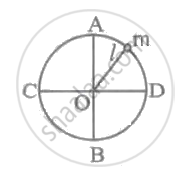
A small sphere is attached to a cord and rotates in a vertical circle about a point O. If the average speed of the sphere is increased, the cord is most likely to break at the orientation when the mass is at ____________.
Consider a simple pendulum of length 4 m. Its bob performs a circular motion in horizontal plane with its string making an angle 60° with the vertical. The Period of rotation of the bob is ____________.(Take g = 10 m/s2)
Select the WRONG statement.
A string of length `l` is fixed at one end and carries a mass 'm' at the other end. The mass is revolving along a horizontal circle of radius 'r' making 'θ' as the semi-vertical angle of cone and `(1/pi)` revolutions per second around the vertical axis through fixed end. The tension in the string is ______.
If a body is moving in a circle of radius r with a constant speed v, its angular velocity is ______.
In uniform circular motion, although the speed is constant, why does acceleration occur?
