Advertisements
Advertisements
Question
Earth can be thought of as a sphere of radius 6400 km. Any object (or a person) is performing circular motion around the axis of earth due to earth’s rotation (period 1 day). What is acceleration of object on the surface of the earth (at equator) towards its centre? what is it at latitude θ? How does these accelerations compare with g = 9.8 m/s2?
Advertisements
Solution
Radius of the earth (R) = 6400 km = 6.4 × 10⁶ m
Time period (T) = 1 day = 24 × 60 × 60 s = 86400 s
Centripetal acceleration (ac) = `ω^2 R = R((2pi)/T)^2 = (4pi^2R)/T`
= `(4 xx (22/7)^2 xx 64 xx 10^6)/(24 xx 60 xx 60)^2`
= `(4 xx 484 xx 64 xx 10^6)/(49 xx (24 xx 3600)^2`
= 0.034 m/s2
At equator, latitude θ = 0°
∴ `a_c/g = 0.034/9.8 = 1/288`
APPEARS IN
RELATED QUESTIONS
For a particle performing uniform circular motion `vecv=vecomegaxxvecr`obtain an expression for linear acceleration of the particle performing non-uniform circular motion.
Why is the motion of a body moving with a constant speed around a circular path said to be accelerated?
Give an example of motion in which speed remains uniform, but the velocity changes.
Which of the following remains constant in a uniform circular motion, Speed or Velocity, or both?
Is it possible to have an accelerated motion with a constant speed? Explain.
Define angular velocity.
Answer the following question.
Show that the centripetal force on a particle undergoing uniform circular motion is -mrω2.
Which one of the following is most likely not a case of uniform circular motion?
The angle subtended by the vector A = `5hat"i" + 3hat"j" + 12hat"k"` with the X-axis is ______.
The ratio of angular speed of a hour-hand to the second-hand of a watch is ____________.
A particle is moving in uniform circular motion with speed 'V' and radius 'R'. The angular acceleration of the particle is ______.
Consider a simple pendulum of length 4 m. Its bob performs a circular motion in horizontal plane with its string making an angle 60° with the vertical. The Period of rotation of the bob is ____________.(Take g = 10 m/s2)
A stone of mass 3 kg attached at one end of a 2m long string is whirled in horizontal circle. The string makes an angle of 45° with the vertical then the centripetal force acting on the string is ______.
(g = 10 m/s2 , tan 45° = 1)
The given graph represents motion with ______ speed.
Statement A: Uniform circular motion is a case of accelerated motion
Statement B: In the third equation of motion we do not have the term time
Define uniform circular motion and give an example of it. Why is it called accelerated motion?
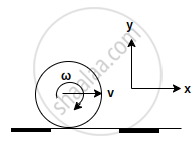
A disc of radius 5 cm rolls on a horizontal surface with linear velocity v = 1`hat"i"` m/s and angular velocity 50 rad/s. Height of particle from ground on rim of disc which has velocity in vertical direction is ______ cm.
A rod PQ of mass M and length L is hinged at end P. The rod is kept horizontal by a massless string tied to point Q as shown in figure. When string is cut, the initial angular acceleration of the rod is ______.

What is the direction of the velocity of an object at any point during uniform circular motion?
A particle moving with uniform speed in a circular path maintains ______.
